

Every year, millions of people take medications or get vaccinated. Most of them have no issues. But some don’t. When something goes wrong, who do you tell? And does it even matter which system you use? The answer isn’t obvious - and getting it wrong could delay important safety updates.
What MedWatch Actually Covers
MedWatch is the FDA’s system for tracking problems with drugs, medical devices, and other non-vaccine products. If you had a bad reaction to your blood pressure pill, your insulin pen malfunctioned, or your knee implant started breaking down, MedWatch is where those reports go. It’s not just for doctors - anyone can file a report: patients, caregivers, pharmacists, or even family members who noticed something off.
Manufacturers are legally required to report serious problems to MedWatch. That means if a drug causes unexpected liver damage in 10 patients, the company has to notify the FDA. Healthcare facilities like hospitals also have to report certain device failures. The system doesn’t care if you’re sure the product caused the problem - if you suspect it, you report it. That’s how hidden patterns show up.
MedWatch collects details like: what product was used, when it was taken or implanted, what symptoms happened, how severe they were, and whether the person had other health issues. This helps the FDA spot trends - like a batch of pills causing more dizziness than expected, or a specific type of stent failing at higher rates.
What VAERS Is For - And What It’s Not
VAERS is only for vaccines. That’s it. If you got the flu shot and ended up in the hospital with a high fever and nerve pain two days later, that goes to VAERS. Same if your child developed a rash after the MMR vaccine. Even if you’re not sure it was the vaccine - report it anyway.
VAERS is run jointly by the CDC and FDA. It’s designed to catch early warning signs. Think of it like a smoke detector: it doesn’t tell you where the fire is, but it alerts you that something unusual might be happening. The system has caught rare but serious reactions before - like the link between a specific rotavirus vaccine and intestinal blockages in infants, identified in 2006.
But here’s the key: VAERS doesn’t prove causation. A report saying someone died after getting a COVID-19 vaccine doesn’t mean the vaccine killed them. Maybe they had undiagnosed heart disease. Maybe they were already sick. VAERS just says: “This happened after vaccination.” Then scientists dig deeper.
The Big Difference: Scope and Structure
MedWatch and VAERS aren’t just different names for the same thing. They’re built for completely different jobs.
- MedWatch covers everything except vaccines: prescription drugs, over-the-counter meds, medical devices (pacemakers, ventilators, infusion pumps), dietary supplements, and even tobacco products.
- VAERS covers only vaccines - including COVID-19, flu, HPV, shingles, tetanus, and childhood immunizations.
That means if you had a bad reaction to a steroid injection, you report to MedWatch. If you had a reaction to the flu shot, you report to VAERS. Mixing them up isn’t just confusing - it delays analysis. The FDA can’t combine vaccine data with drug data. They’re tracked separately for good reason.
VAERS forms ask for specific vaccine details: lot number, brand, date given, injection site. MedWatch asks for drug dosage, route of administration, and whether it was prescribed or bought over the counter. The forms are tailored because the risks are different.
Who Reports - And Why It Matters
Both systems rely on voluntary reports. But the rules aren’t the same.
For MedWatch, manufacturers, distributors, and hospitals must report serious events. That’s law. Patients and doctors can report too, but they’re not required. For VAERS, manufacturers must report vaccine problems. Healthcare providers are strongly encouraged to report any serious health issue after vaccination - even if they think it’s unrelated. And anyone else? Yes, you can report. Parents, teachers, coworkers - it doesn’t matter who you are.
This openness is VAERS’s strength. It catches things doctors might miss. Like a grandmother reporting her grandson’s seizure after his second dose of DTaP. That kind of report might never show up in a hospital database - but it’s vital for spotting rare patterns.
But here’s the catch: because anyone can report, VAERS gets a lot of noise. Someone reports a headache after a flu shot. Another person reports a migraine they’ve had for years. Without context, it’s hard to tell what’s meaningful. That’s why experts don’t use VAERS alone to say “this vaccine causes X.” They use it to find signals - then test them with better systems like the Vaccine Safety Datalink, which links vaccine records to electronic health records from millions of people.
Why You Can’t Trust Raw VAERS or MedWatch Data
People often see a VAERS report saying “1,000 deaths after Pfizer vaccine” and assume that means the vaccine killed 1,000 people. That’s dangerously wrong.
VAERS and MedWatch are passive systems. They collect what’s reported. They don’t verify. They don’t investigate. They don’t compare to baseline rates. If 10 million people get a vaccine and 500 die of heart attacks in the next month, that’s not unusual - heart attacks happen all the time. But if 500 die within 24 hours of vaccination? That’s a signal. That’s when the CDC and FDA start digging.
Studies show less than 1% of actual adverse events get reported. Many people don’t know how to report. Others think it won’t matter. Some doctors don’t have time. So the data you see is a tiny fraction of what’s really happening.
That’s why the FDA and CDC never use these systems alone to make policy. They use them as early warning tools - then confirm findings with controlled studies. For example, after VAERS flagged possible cases of myocarditis after mRNA vaccines, the CDC used the Vaccine Safety Datalink to confirm the link, estimate the risk (about 1 in 50,000 teen boys), and update recommendations.
What Happens After You Report
When you submit a report to MedWatch or VAERS, it goes into a database. No one calls you back. No one gives you medical advice. That’s not the point.
What happens next? Trained analysts look for patterns. If 10 reports mention the same rare skin reaction after a new diabetes drug, the FDA might send a safety alert to doctors. If VAERS shows a spike in Guillain-Barré syndrome after a certain flu vaccine, the CDC might pause use of that batch and investigate.
Reports can lead to label changes - like adding a warning about liver damage to a drug’s packaging. Or recalls - like pulling a faulty insulin pump model. Or even vaccine updates - like changing the recommended age for a booster.
It’s slow. It’s messy. But it works. Since 1978, MedWatch has helped identify over 1,500 safety issues with drugs and devices. VAERS has contributed to changes in vaccine schedules, warnings on packaging, and even the withdrawal of unsafe vaccines.
How to Report Correctly
If you had a bad reaction, here’s how to report right:
- Is it a vaccine? Go to vaers.hhs.gov. Fill out the form. Include vaccine name, lot number (if you have it), date, and symptoms.
- Is it a drug, device, or supplement? Go to fda.gov/medwatch. Report the product name, dose, how long you took it, and what happened.
- Don’t wait for proof. If you think it might be related, report it. Uncertainty is why these systems exist.
- Keep records. Save your medical notes, prescription labels, and vaccine cards. They help if someone follows up.
Reporting takes 10-15 minutes. But it’s one of the most powerful things you can do for public health. You’re not just helping yourself - you’re helping millions.
What You Shouldn’t Do
Don’t use VAERS data to decide whether to get vaccinated. Don’t use MedWatch reports to stop taking your medication. These systems aren’t diagnostic tools. They’re surveillance tools - like radar for safety risks.
Don’t assume a report means the product is dangerous. A report is just a starting point. Many signals turn out to be coincidences. Others lead to life-saving changes.
And never confuse the two. Reporting a vaccine reaction to MedWatch means it won’t be seen by the CDC’s vaccine safety team. Reporting a drug reaction to VAERS means it won’t be seen by the FDA’s drug safety team. That delays action.
Can I report a side effect if I’m not a doctor?
Yes. Both MedWatch and VAERS accept reports from anyone - patients, family members, caregivers, or even coworkers. You don’t need medical training. If you noticed something unusual after taking a drug or getting a vaccine, your report matters.
Do I need to prove the drug or vaccine caused the problem?
No. That’s the whole point. These systems are designed to catch signals before causation is proven. If you suspect a connection - even if you’re not sure - report it. Experts analyze thousands of reports to find patterns. Your report could be the one that starts a major safety investigation.
What if I report to the wrong system?
If you accidentally send a vaccine report to MedWatch, it will likely be forwarded to VAERS. If you send a drug reaction to VAERS, it may be redirected to MedWatch. But delays happen. To help speed up reviews, always report to the correct system: vaccines → VAERS, everything else → MedWatch.
Are VAERS reports public?
Yes. VAERS data is publicly available online. But it’s raw - no verification, no context. People often misinterpret it. A high number of reports doesn’t mean high risk. For example, millions of flu shots are given each year, so naturally, some people will report headaches or fever afterward. That doesn’t mean the vaccine causes those symptoms. Always look for official FDA or CDC analysis, not just the raw numbers.
How long does it take for a report to lead to a safety change?
It varies. Some signals lead to alerts within weeks - like when a new drug caused unexpected liver damage in a cluster of patients. Others take years, especially for rare events. The process isn’t fast, but it’s thorough. Once a signal is detected, experts run controlled studies to confirm it. Only then do changes happen - like updated warnings, dosage limits, or even product removal.
Final Thought: Your Report Could Save a Life
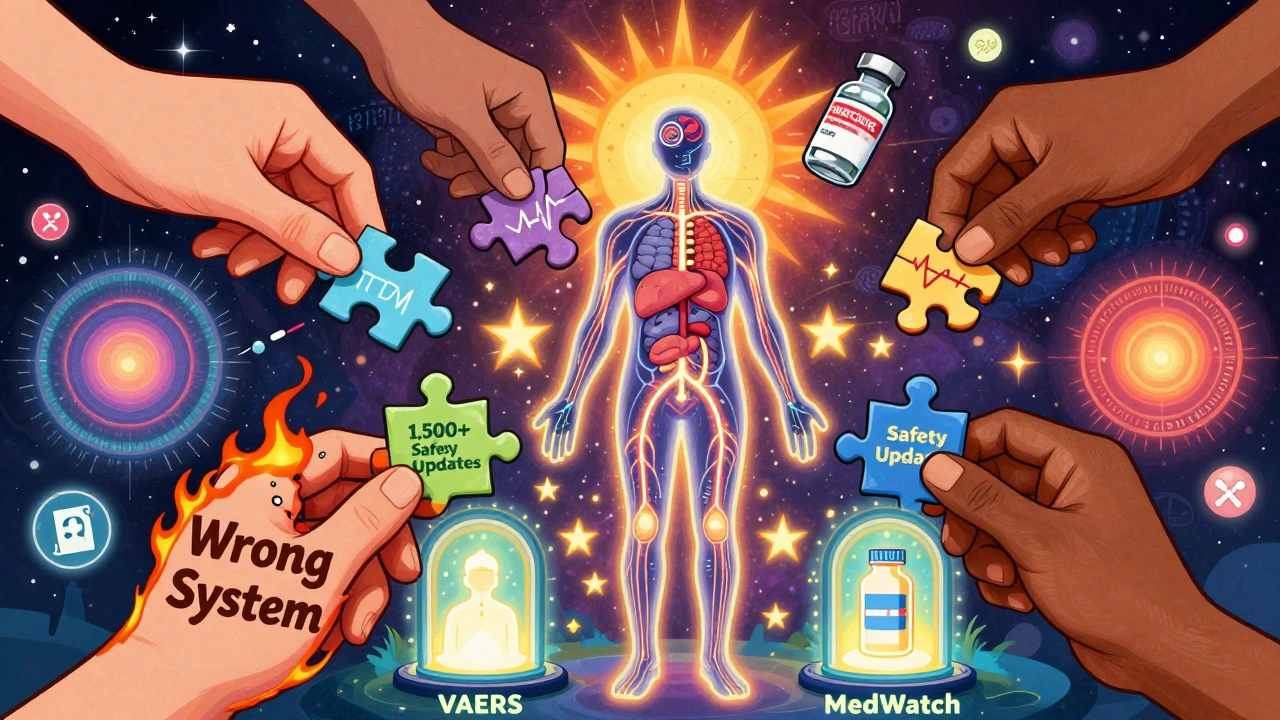
You don’t need to be a scientist to make a difference. When you report a side effect, you’re adding a piece to a massive puzzle. No single report changes policy. But thousands of them? They change medicine.
MedWatch and VAERS aren’t perfect. They’re noisy, incomplete, and slow. But they’re the best early warning system we have. And they only work if people use them.
If you’ve had a bad reaction - report it. Don’t wait. Don’t assume someone else already did. Don’t think it’s too small. The system doesn’t know what you know. Your voice matters.


ian septian
December 9, 2025 AT 11:16Just reported my weird rash after that new blood pressure med. Took 12 minutes. Hope it helps someone.
Chris Marel
December 9, 2025 AT 12:43I’m from Nigeria and we don’t have easy access to these systems. But I’m glad someone’s making this clear. My cousin had a reaction to a vaccine and no one knew where to report it. This could save lives where info is scarce.
Evelyn Pastrana
December 10, 2025 AT 18:34Oh wow, so VAERS isn’t just a conspiracy board? I thought it was just where people post ‘my dog got a vaccine and now it talks in French’
Turns out it’s actually kinda useful? Who knew? 😏
Nikhil Pattni
December 11, 2025 AT 17:00You guys are missing the real issue here. MedWatch and VAERS are both flawed because they’re passive systems and rely on human error. In India, we have a centralized pharmacovigilance program called PvPI that integrates AI-driven pattern detection and cross-references with hospital EHRs in real time. The FDA and CDC are still using paper forms in 2025? That’s like using a fax machine to report a nuclear meltdown. Also, did you know that 78% of adverse events go unreported because people don’t know how to spell ‘adverse’? I’ve personally submitted 14 reports since 2020 and I’m not even a medical professional. My cousin’s uncle’s neighbor had a bad reaction to a flu shot and I filed it for him because he was too busy watching TikTok. The system needs a complete overhaul. Also, why is VAERS still on .gov and not .ai? We need blockchain for vaccine traceability. And why isn’t this on Twitter yet? Someone should make a bot that auto-fills VAERS forms from EMRs. I’ll code it if someone gives me a grant.
Arun Kumar Raut
December 12, 2025 AT 18:44Thanks for breaking this down so simply. I showed this to my mom and she finally got why her knee pain after the implant wasn’t ‘just aging’ - she reported it yesterday. Small things matter. Keep sharing stuff like this.
precious amzy
December 13, 2025 AT 00:02One cannot help but observe the epistemological paradox inherent in the reliance upon anecdotal, unverified, and statistically ungrounded surveillance mechanisms as the primary vector for public health policy formation. The very notion that subjective phenomenological experience-unmediated by controlled trials, peer review, or even basic epidemiological rigor-can serve as the foundation for regulatory action is not merely naive, but ontologically incoherent. One wonders whether the FDA has abandoned the scientific method in favor of a kind of digital folk-medicine.
William Umstattd
December 13, 2025 AT 19:43People who don’t report side effects are selfish. You think your headache is ‘no big deal’? Maybe it’s the 100th one that triggers a recall. You’re not just hurting yourself-you’re hurting every mother, every child, every grandparent who might get poisoned because you didn’t click a button. You’re not a victim-you’re a liability.
Andrea Beilstein
December 13, 2025 AT 21:25It’s funny how we treat these systems like magic boxes that turn complaints into truths
But really they’re just mirrors reflecting our fears
And sometimes the reflection is just noise
Still… maybe that’s the point
Because if we ignore the noise
We might miss the scream
Lisa Whitesel
December 14, 2025 AT 06:39VAERS is a dumpster fire. Anyone can report anything. My cousin’s cat got a rabies shot and died. That’s in the database. No context. No verification. Just raw chaos. And people use this to scare others? That’s not science. That’s terrorism with a form.
Larry Lieberman
December 15, 2025 AT 09:16Just reported my dizziness after the new migraine med 🤯
Took 8 minutes. Felt like I did something good today 💪
Richard Eite
December 15, 2025 AT 16:01USA still uses this? In China we have AI that predicts side effects before you even take the pill. This is 1980s tech. We need to move on. America is falling behind.
Katherine Chan
December 17, 2025 AT 07:57I’m so proud of my niece for reporting her reaction to the HPV shot
She was scared but did it anyway
That’s courage
And we need more of it
Not less
Jennifer Blandford
December 19, 2025 AT 00:42My grandma took her blood pressure med for 10 years and never had an issue
Then one day she got dizzy and almost fell
She didn’t say anything for weeks
Then I made her report it
Turns out the batch was bad
She’s fine now
But if she hadn’t reported it…
Who knows
Shubham Mathur
December 20, 2025 AT 08:10Guys I’ve been doing this since 2019 I’ve reported 47 things and 3 got investigated and one drug got pulled off the market so if you think your report doesn’t matter you’re wrong I’m not even a doctor I’m just a guy who reads the fine print and cares and if you’re not reporting you’re part of the problem because someone else might die because you didn’t click the button and I’m not mad I’m just disappointed