

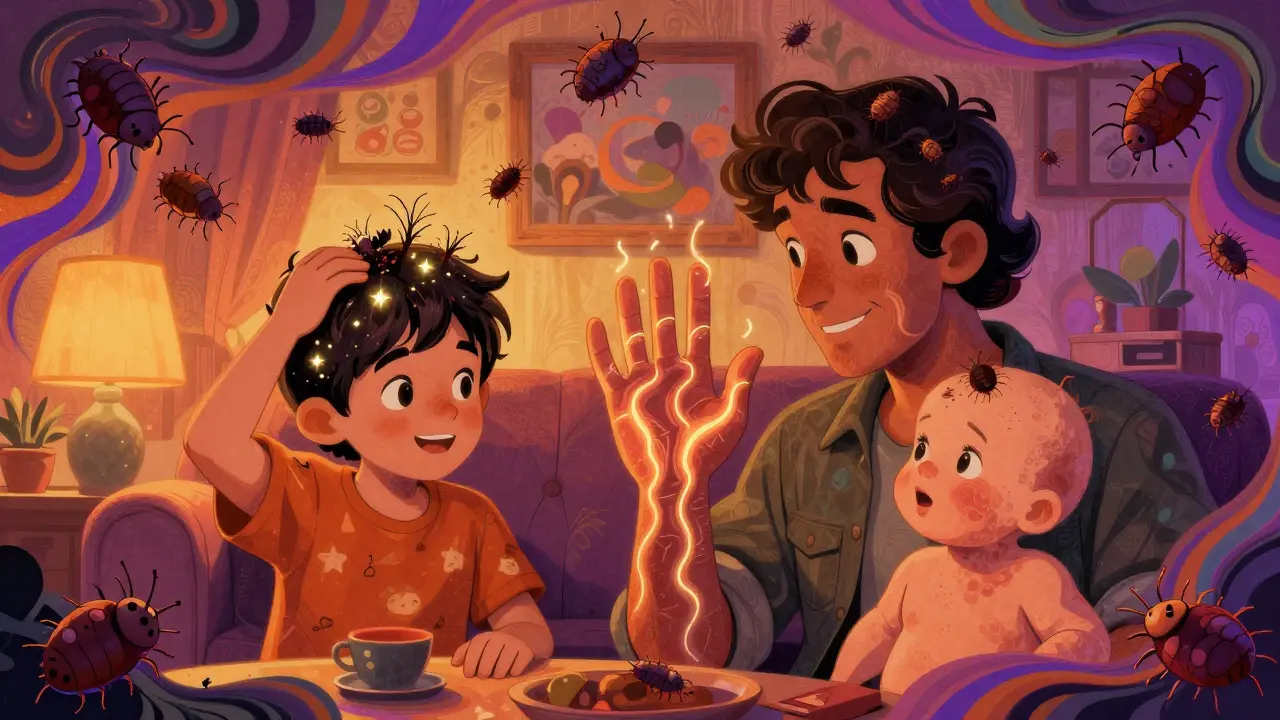
It’s December 2025, and the school year is winding down. You’ve noticed your child scratching their scalp nonstop. A few days later, your partner complains about a rash between their fingers that won’t go away. You check online - and suddenly, two words pop up: scabies and lice. Both are itchy, both spread fast, and both make you feel like you’re losing control of your home. The good news? You can beat them. But only if you know exactly what you’re dealing with - and how to treat it right.
Scabies Isn’t Just a Rash - It’s a Mite Invasion
Scabies isn’t dirt. It’s not an allergy. It’s not even contagious because someone didn’t wash their hands. It’s caused by a microscopic mite called Sarcoptes scabiei var. hominis that burrows under your skin to lay eggs. The itching? That’s your body’s allergic reaction to the mites, their poop, and their eggs. Symptoms don’t show up right away - it can take 2 to 6 weeks if it’s your first time. But if you’ve had it before, the itch can start in just 1 to 4 days.
You’ll see thin, wavy lines on your skin - usually between fingers, on wrists, underarms, around the waist, on genitals, or on the soles of feet. In babies, the rash can spread to the head and neck. In older adults or people with weak immune systems, it can turn into crusted (Norwegian) scabies - thick, scaly patches with millions of mites. That version is highly contagious and needs aggressive treatment.
Global health data shows 204 million people have scabies every year, mostly in crowded places like nursing homes, refugee camps, and schools. In Australia, outbreaks are common in Indigenous communities and remote areas. The World Health Organization classifies it as a neglected tropical disease - meaning it’s treatable, but often ignored until it spreads.
Lice Are More Common Than You Think
Lice are different. They don’t burrow. They crawl. And they live on the surface of your skin or hair. There are three types:
- Head lice (Pediculus humanus capitis) - most common in kids 3 to 11. They cling to hair shafts near the scalp.
- Body lice (Pediculus humanus corporis) - live in clothing and only move to the skin to feed. Seen in people without access to clean laundry.
- Pubic lice (Pthirus pubis) - also called crabs. They’re usually spread through sexual contact.
Head lice alone affect 6 to 12 million children in the U.S. each year. In Australia, schools report outbreaks every term. The itching comes from saliva when lice bite. You’ll find tiny white eggs (nits) glued to hair strands, especially behind the ears and at the nape of the neck. Unlike dandruff, nits don’t brush off easily.
Body lice are rarer now but still show up in homeless populations. Pubic lice are less common but can signal other STIs - so testing is often recommended.
How to Treat Scabies: The Only Proven Methods
There are only two first-line treatments for scabies that actually work: permethrin cream and oral ivermectin.
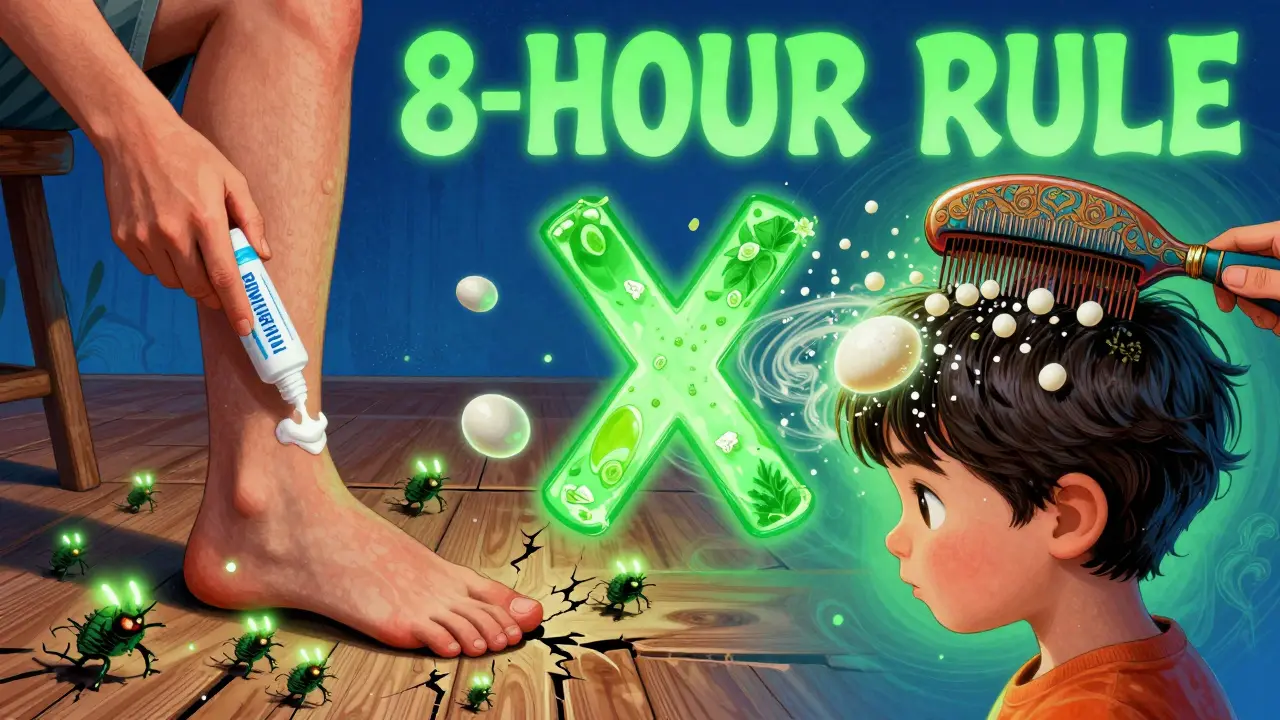
Permethrin 5% cream is the gold standard. You apply it from the neck down - yes, even between toes, under nails, and in skin folds. Leave it on for 8 to 14 hours, then wash it off. Repeat after 7 days. Why two doses? Because permethrin kills adult mites and nymphs - but not eggs. Eggs hatch in 3 to 4 days, so you need a second round to catch the new ones.
Studies show permethrin cures 92.5% of cases when used correctly. But here’s the catch: 12.3% of treatment failures come from people not applying it properly. They skip the webs between fingers. They don’t get behind the ears. They wash it off after 3 hours. That’s not enough.
Oral ivermectin is a pill. It’s not FDA-approved for scabies in the U.S., but doctors prescribe it off-label all the time - especially for crusted scabies, outbreaks in institutions, or when topical treatment fails. The dose is 200 micrograms per kilogram of body weight, taken with food (fat helps absorption). You take it once, then again 7 to 14 days later. One study in Iran showed a single dose cured 85.9% of patients. Two doses? 100%.
There’s a newer option: spinosad 0.9% liquid. Approved in 2019, it’s safe for kids as young as 4. It kills both mites and eggs in one application. No need for a second dose. It’s pricier than permethrin, but if you’ve tried everything else and failed, it’s worth considering.
Don’t use lindane. It’s banned in many places because it can damage the nervous system. Even the CDC says it’s a last-resort option.
How to Treat Lice: From Shampoos to Combing
For head lice, the first line is still permethrin 1% lotion (not the 5% cream used for scabies). Apply to dry hair, leave on 10 minutes, then rinse. Repeat in 7 days. But here’s the problem: resistance. In many U.S. states, up to 30% of lice are now resistant to permethrin.
If permethrin fails, try ivermectin 0.5% lotion (Sklice). One application, no combing needed. Or spinosad 0.9% suspension - same as for scabies. It kills lice and eggs in one go. Both are FDA-approved for head lice.
For people who hate chemicals, there’s wet combing. Use a fine-toothed nit comb on wet, conditioned hair every 2 to 3 days for 2 weeks. It’s time-consuming, but effective if done right. You’ll need to comb for 15 to 20 minutes per session. Don’t skip days - lice hatch every 7 to 10 days.
For body lice, clean clothes and bedding are the cure. Wash everything in hot water (at least 50°C) and dry on high heat. For pubic lice, shave the area and use permethrin or spinosad. Avoid sexual contact until cleared.
Why You Must Treat Everyone at Once
One of the biggest mistakes people make? Treating only the person who’s itching. Scabies and lice spread easily. If one child has head lice, 70% of their close contacts are already infested - even if they’re not itchy yet.
For scabies, everyone in the household must be treated on the same day. That includes partners, siblings, grandparents, even the babysitter who held your baby. If you don’t, you’ll go through the same treatment cycle again in 2 weeks. And again. And again.
Same for lice. If your daughter has head lice, treat her siblings. Check the parents. Wash all bedding, hats, and towels used in the last 48 hours. Lice can survive up to 2 days off the head. Nits can’t - they need warmth and blood to hatch.
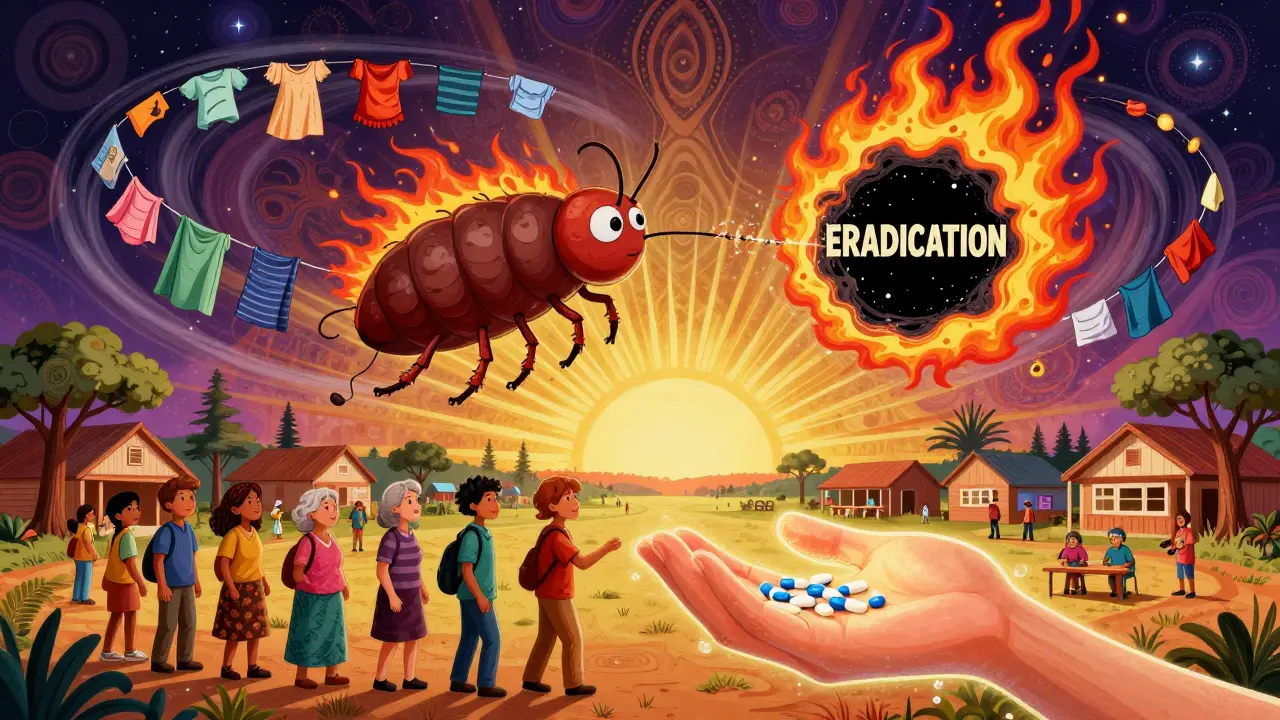
There’s a reason the Solomon Islands program succeeded. They didn’t just treat individuals. They treated entire villages at once - with azithromycin and ivermectin - and cut scabies rates by 95%. That’s the model. Community-wide action. Not individual fixes.
What Doesn’t Work - And Why
Home remedies? Tea tree oil, mayonnaise, coconut oil, vinegar rinses - none of them reliably kill mites or lice. Some might soothe itching, but they won’t stop the infestation.
Shaving your head? Doesn’t help if nits are still on the pillow. You need to kill the eggs.
Using too much permethrin? Dangerous. More doesn’t mean better. It can irritate skin or cause toxicity.
Ignoring the 8-hour rule for permethrin cream? That’s why so many people relapse. You need the full contact time to kill the mites deep in the skin.
And don’t throw out your mattress or furniture. Mites don’t live long off the body. Washing clothes and bedding is enough.
What to Do After Treatment
After treatment, you don’t need to deep-clean your whole house. But you do need to:
- Wash all bedding, towels, and clothes worn in the last 48 hours in hot water (50°C or higher) and dry on high heat.
- Seal non-washable items (stuffed animals, pillows) in plastic bags for 72 hours - mites die without a host.
- Vacuum carpets and furniture - not because mites live there, but because it removes loose hairs with nits.
- Don’t use insecticide sprays. They’re toxic and unnecessary.
Itching can last for weeks after treatment. That’s normal. Your skin is still reacting to dead mites. Use calamine lotion or antihistamines like cetirizine to help. If the rash returns after 2 weeks, you didn’t get them all - treat again.
When to Call a Doctor
See a doctor if:
- The rash or itching doesn’t improve after 2 weeks of treatment
- You see signs of infection - pus, swelling, red streaks
- You have crusted scabies (thick, scaly skin)
- You’re pregnant, breastfeeding, or treating a child under 2
- You’ve tried everything and keep getting reinfested
Doctors can prescribe stronger treatments or test for resistant strains. In remote areas of Australia, telehealth services now offer video consultations for scabies diagnosis - no need to wait weeks for a skin clinic.
What’s Next in Treatment?
Researchers are working on new drugs that kill mite eggs - something current treatments can’t do. Three compounds are in Phase II trials as of late 2025. One is a topical spray that lasts 24 hours. Another is a single-dose oral pill that works on both lice and scabies.
Mass treatment programs are expanding. In parts of Papua New Guinea and the Northern Territory, health workers now give ivermectin to entire communities every 6 months - not just for scabies, but for other parasitic diseases too. The goal? Cut transmission so low that outbreaks become rare.
For now, though, the answer is simple: know the signs, treat everyone at once, follow the instructions exactly, and don’t panic. These parasites are annoying - but they’re not deadly. And with the right approach, you can end them for good.
Can scabies spread through swimming pools?
No. Scabies mites die quickly in water and can’t survive in chlorinated pools. Transmission happens through prolonged skin-to-skin contact - like hugging, holding hands, or sleeping in the same bed. Casual contact, like sharing a towel or sitting on a bench, rarely spreads it.
How long does it take for lice to spread to other people?
Head lice can crawl from one person to another in under 30 seconds during direct head-to-head contact. They can’t jump or fly. Sharing combs, hats, or headphones can spread them, but it’s less common than direct contact. Lice need a human host to survive - they die within 2 days off the scalp.
Is ivermectin safe for young children?
Oral ivermectin is not approved for children under 15 kg (about 33 pounds) or under 5 years old in the U.S. because safety data is limited. Topical permethrin or spinosad are preferred for young kids. Always check weight and age guidelines with your doctor before giving ivermectin.
Can you get scabies from pets?
No. Animal mites (like those from dogs or cats) can’t live on humans. They may cause temporary itching if you’ve been in close contact with an infested pet, but they’ll die within a few days. You won’t get a true scabies infestation from pets. The mite that causes human scabies only lives on people.
Do I need to stay home from work or school after treatment?
No. Once you’ve applied the treatment, you’re no longer contagious after 24 hours. You can return to school or work the next day. The CDC and WHO both confirm this. The myth that you need to quarantine for days is outdated. What matters is that everyone in your household was treated on the same day.
Why does itching last so long after treatment?
The mites are dead, but your immune system is still reacting to their remains - eggs, poop, and body parts left under your skin. This can cause itching for 2 to 6 weeks. Use soothing lotions, antihistamines, or cool compresses. If the itching returns after 2 weeks with new bumps or burrows, you need another round of treatment.





Emma Duquemin
December 31, 2025 AT 00:12OMG I just went through this with my 7-year-old last month 😭 We thought it was dandruff until she started scratching like a rabid raccoon at 3 a.m. Permethrin cream? Total game-changer. But I swear I applied it like I was painting a masterpiece - between every toe, under the nails, even the back of her ears. And guess what? We did the whole house on the same day. No more nightmares. 🙌
Kevin Lopez
December 31, 2025 AT 06:06Permethrin 5% QID? No. Standard protocol is single application with repeat at 7d. Ivermectin off-label use requires weight-based dosing - 200 mcg/kg PO, fasting? No, with fat. Compliance failure rate is 12.3% due to inadequate application. Evidence-based: permethrin > spinosad > lindane (banned). Lice resistance: 30% in 12 states. Nits ≠ live lice. Combing is adjunctive, not curative.
Duncan Careless
December 31, 2025 AT 16:22Just wanted to say thanks for this - really clear breakdown. I’m in the UK and we had a tiny outbreak at my kid’s school. We did the permethrin thing, washed everything, treated everyone at once. It felt like a war zone, honestly. But it worked. I wish I’d known about the 8-hour rule before - I washed mine off after 4 and nearly lost my mind when it came back. Lesson learned. 🙏
Samar Khan
January 2, 2026 AT 05:57My ex gave me scabies 😭😭😭 and then blamed ME for being ‘unclean’?? Like?? I work at a hospital, I shower twice a day. I cried for 3 days. Then I found out he had it for MONTHS and never told anyone. I had to throw out my entire wardrobe. Even my stuffed bunny. 😭💔 Now I check every new partner’s skin like a forensic detective. #scabiesisnotashame
Russell Thomas
January 2, 2026 AT 17:47So let me get this straight - you’re telling me I don’t have to burn my house down after this? 😂 I spent $200 on ‘mite-zapping’ sprays and a new mattress because my aunt told me scabies lives in couches. Turns out? Just wash your sheets. And don’t be a hero with permethrin. I used the whole tube. My skin looked like a lobster. Worth it? No. But at least I’m not itching anymore. 🤢
Joe Kwon
January 3, 2026 AT 04:48Big thanks for the breakdown - especially the part about treating everyone at once. My wife and I had lice last year, and we only treated the kids. Big mistake. We cycled through three rounds of treatment before we realized we were reinfesting each other. Ivermectin lotion was a miracle. No combing. No stress. Just apply, wait, rinse. Also, the 24-hour contagious rule? Huge relief. We sent the kids back to school the next day. No drama. Just common sense. 👏
Nicole K.
January 4, 2026 AT 15:14People need to stop being so careless. If your kid has lice, keep them home. Don’t risk other kids. And wash everything. EVERYTHING. I don’t care if it’s ‘too much work.’ You think it’s hard to do laundry? Try explaining to a teacher why your kid’s head is crawling. It’s not rocket science. Basic hygiene. 🙄
Fabian Riewe
January 5, 2026 AT 21:40Hey, just wanted to add - if you’re reading this and feeling overwhelmed? You’re not alone. I thought I was the only one dealing with this. But honestly? This post saved my sanity. I didn’t know about spinosad being one-and-done. My daughter’s been itch-free for 3 weeks now. And yeah, the itching lingers - but it’s not the mites. It’s your body healing. Be gentle with yourself. You got this. 💪