

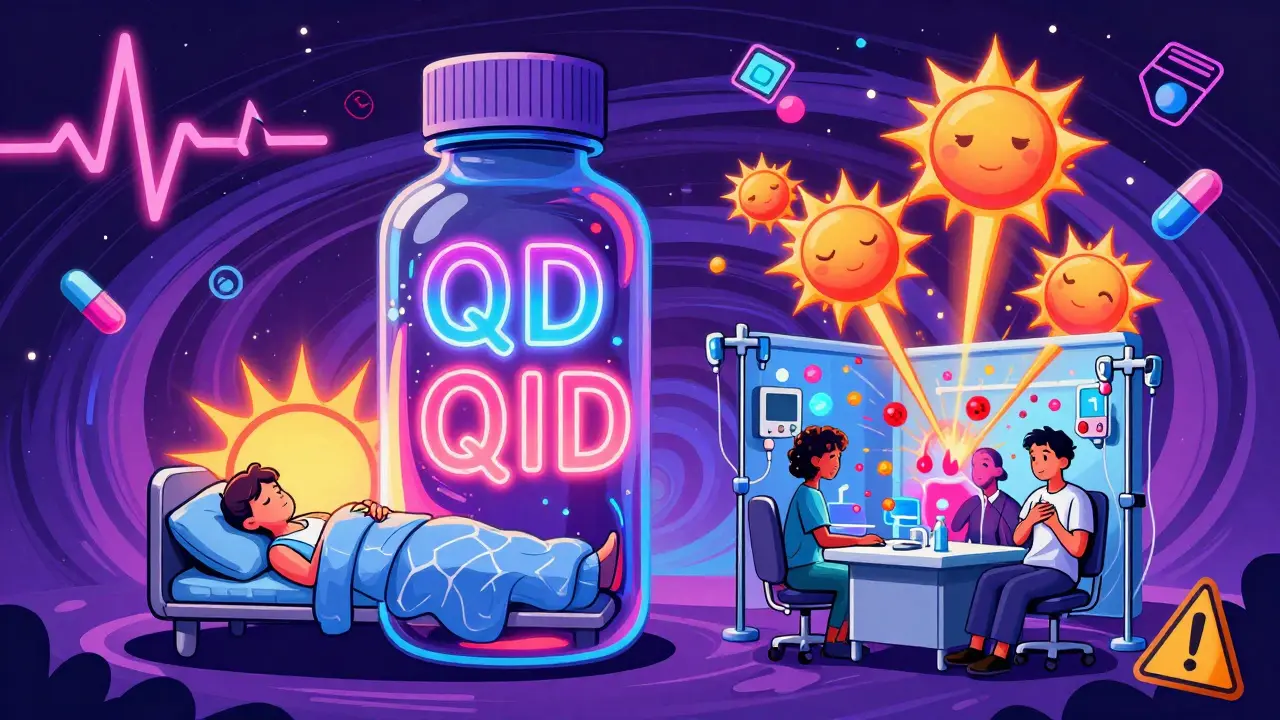
QD vs. QID isn’t just a tiny typo on a prescription slip-it’s a silent killer in hospitals, pharmacies, and homes across the country. What looks like a simple abbreviation can mean the difference between taking one pill a day and four. And when that mistake happens, people don’t just get sick-they end up in the ER, in the ICU, or worse.
What QD and QID Really Mean (And Why It Matters)
QD stands for quaque die, Latin for "once daily." QID means quater in die, or "four times daily." These abbreviations have been used for over a century. But in today’s world, where a single mistake can lead to a stroke, internal bleeding, or organ failure, using Latin shorthand is no longer acceptable. The problem isn’t that doctors or pharmacists are careless. It’s that these symbols look too similar. A quick glance, a smudged ink mark, a tired night shift-any of these can turn a safe dose into a deadly one.
Take a patient prescribed warfarin for blood thinning. If they’re told to take "1 tab QD," they should take one pill every 24 hours. But if a pharmacist misreads it as QID, they might label the bottle: "Take four times daily." That’s four times the anticoagulant. The result? An INR of 12.3-far above the safe range of 2-3. One nurse on Reddit described a patient who nearly bled out from this exact error. She spent three days in the hospital. Her family still doesn’t know how close they came to losing her.
Who’s Most at Risk?
It’s not just elderly patients who get confused. It’s everyone. But those over 65 are the most vulnerable. Why? They’re juggling five, six, even ten different medications. A pill bottle labeled "QD" might sit next to one labeled "TID" and "QID." Without clear labels, it’s easy to mix them up. According to the American Geriatrics Society, 68% of all documented QD/QID errors involve patients 65 and older.
But the problem starts before the patient even sees the bottle. A 2020 study from the University of California, San Francisco found that healthcare workers with less than five years of experience misread QD as QID in 18.2% of cases. That’s nearly one in five. Even experienced staff aren’t immune. A 2018 study in the Journal of Patient Safety showed that QD was mistaken for QID in 12.7% of simulated prescription reviews-far higher than any other abbreviation error.
Why Do These Errors Keep Happening?
It’s not just handwriting. Even in digital systems, the problem lingers. In 2023, a survey by the American Society of Health-System Pharmacists found that 31% of community pharmacies still receive handwritten prescriptions with QD or QID. These come mostly from small clinics, rural doctors, or specialists who haven’t fully switched to electronic systems. When a provider types "QD," the system doesn’t always flag it. Some EHRs still allow it as a dropdown option.
And here’s the scary part: even when systems block QD and QID, providers sometimes override the warning. A 2021 analysis by the Agency for Healthcare Research and Quality found that 3.8% of electronic prescriptions still contained these abbreviations because the clinician clicked "ignore" to save time. Three percent might sound small. But in a hospital that dispenses 5,000 prescriptions a week, that’s 190 dangerous errors every single week.
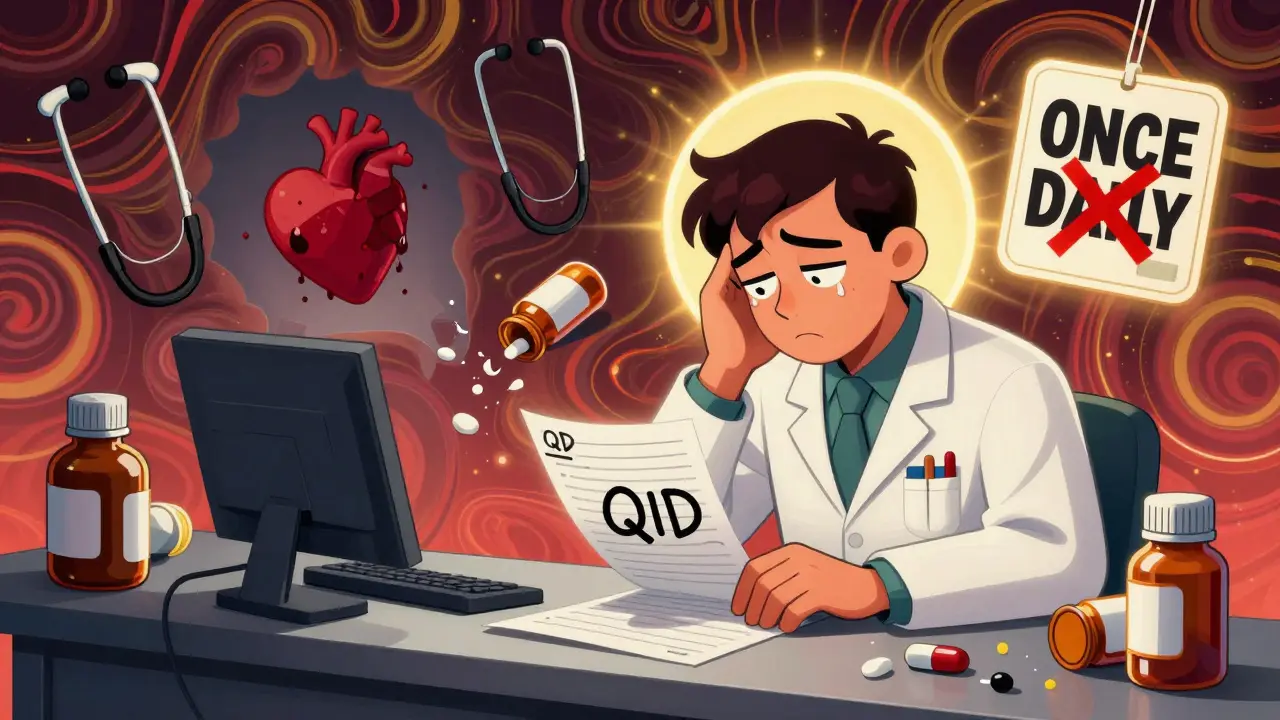
The Real Cost of a Single Mistake
One error doesn’t just hurt one person. It ripples through the system. The Medicare Payment Advisory Commission estimates that prescription abbreviation errors cost the U.S. healthcare system $780 million a year-just from dosing mistakes. That includes emergency visits, hospital stays, extended care, and legal claims. And that’s only the documented cases.
Then there’s the human cost. The FDA’s MedWatch system logs that 5% of all medication errors involve abbreviation confusion. QD/QID is one of the top three culprits. The National Coordinating Council for Medication Error Reporting and Prevention classifies these errors as "Category E"-meaning they caused harm requiring intervention-in 78% of cases. That’s not a near-miss. That’s a patient who got sick because someone misread a two-letter code.
What’s Being Done to Fix It
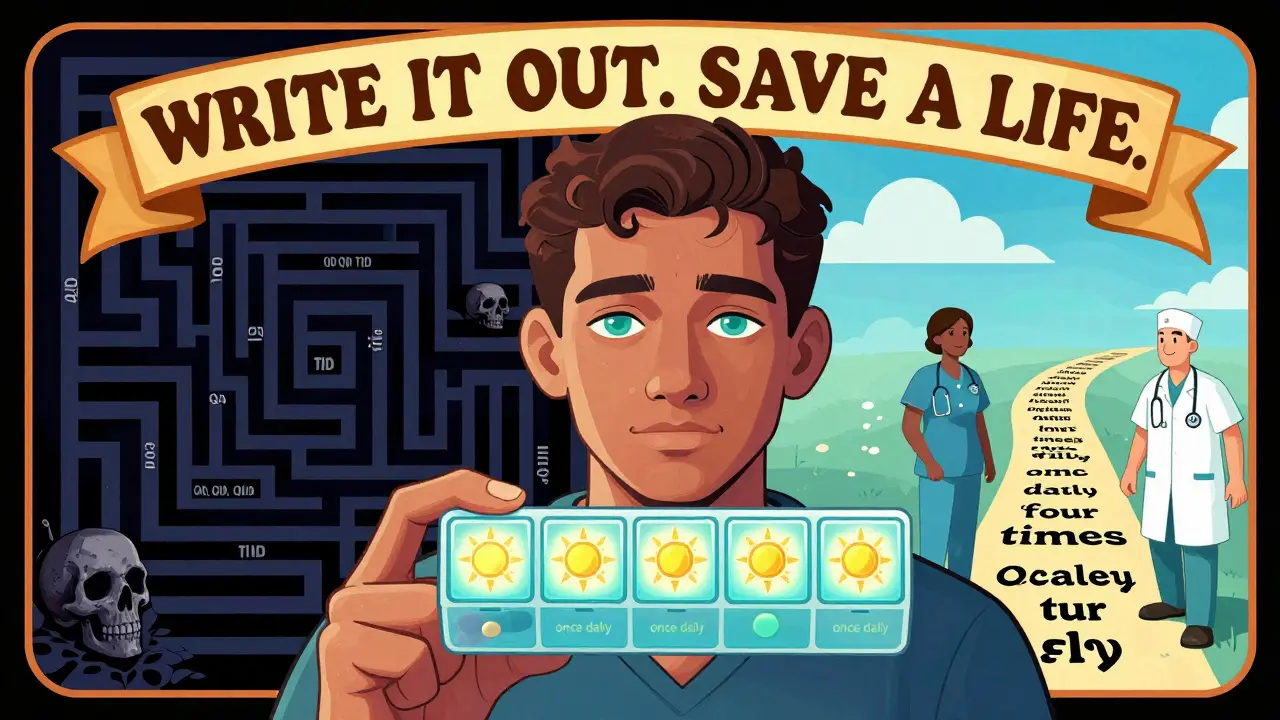
The fix isn’t complicated. It’s simple: write it out.
Instead of "QD," write "once daily." Instead of "QID," write "four times daily." It takes three extra letters. That’s it. Dr. Jerry Phillips from ISMP put it bluntly: "With only three more letters than the abbreviation it replaces, [writing 'daily'] offers a much safer alternative."
In 2023, the American Medical Association made it official: all prescriptions must use plain language. No more Latin. No more shortcuts. Epic and Cerner-the two biggest EHR systems in the U.S.-now have "hard stops." If you type QD or QID, the system won’t let you save the prescription. You have to type out the full instruction.
Hospitals that made this switch saw a 42% drop in dosing errors within a year. The University of Michigan Health System cut errors by 67% by requiring pharmacists to verbally confirm dosing with every patient. Not just ask, "Do you know how often to take this?"-but ask, "Can you tell me in your own words how many times a day you’re supposed to take this pill?"
What You Can Do Right Now
If you’re a patient-or the caregiver of someone who takes multiple medications-here’s what to do:
- Always read the label on your pill bottle. If it says "QD" or "QID," ask the pharmacist to explain it in plain English.
- Keep a written list of all your medications, including how often you take them. Bring it to every appointment.
- When a new prescription comes in, ask: "Is this supposed to be once a day or four times a day?" Don’t assume.
- Use a pill organizer with clearly labeled time slots. If you’re supposed to take something once daily, make sure it goes in the same slot every day.
- If you’re confused, call your pharmacist. They’re trained to catch these errors.
If you’re a healthcare provider:
- Stop using QD, QID, BID, TID. Period. Write "once daily," "twice daily," "three times daily," "four times daily."
- Train your team. Make it part of orientation. Run quarterly refreshers.
- Use your EHR’s safety alerts. Don’t override them.
- Ask patients to repeat instructions back to you. If they say "I take it in the morning and at night," and you prescribed "once daily," you’ve caught a mistake before it happens.
The Future Is Clear
The push to eliminate these abbreviations isn’t just policy-it’s momentum. In April 2023, the National Action Alliance for Patient Safety launched the "Clear Communication Campaign," backed by $45 million from CMS. Their goal? Reduce abbreviation-related errors by 90% by 2026.
And it’s working. A Johns Hopkins study published in JAMA Internal Medicine in October 2023 showed that adding simple icons to prescriptions-like a sun for "once daily" or four suns for "four times daily"-reduced confusion by 82%. Visual cues work. Plain language works. Training works.
There’s no excuse anymore. We have the tools. We have the data. We know what works. The question isn’t whether we can stop these errors. It’s whether we’re willing to.
What do QD and QID mean on a prescription?
QD stands for "once daily" (from the Latin "quaque die"). QID stands for "four times daily" (from "quater in die"). Both are outdated abbreviations that can be easily confused, leading to dangerous dosing errors. They should be replaced with plain language: "once daily" and "four times daily."
Why are QD and QID considered dangerous?
QD and QID look very similar, especially in handwritten prescriptions or when scanned. A small smudge or poor handwriting can turn a "D" into an "I," making a once-daily dose look like a four-times-daily dose. This has led to patients taking four times the intended medication, causing serious harm like internal bleeding, organ failure, or death. The Institute for Safe Medication Practices and the Joint Commission have listed these abbreviations as "Do Not Use" for over 20 years.
Who is most at risk from QD/QID confusion?
Older adults (65+) are the most at risk because they often take multiple medications and may have trouble reading small print or remembering complex instructions. However, healthcare workers with less than five years of experience are also more likely to misread these abbreviations. Studies show that 68% of documented errors involve patients over 65, and inexperienced staff misread QD as QID in over 18% of cases.
Are electronic prescriptions safer than handwritten ones?
Yes, but not always. Most modern electronic health record (EHR) systems now block QD and QID abbreviations and require providers to write out the full instruction. However, some providers still override these safety alerts to save time. A 2021 study found that 3.8% of electronic prescriptions still contained these dangerous abbreviations because the provider clicked past the warning. Handwritten prescriptions remain a major source of error, especially in small clinics and rural areas.
What should I do if I’m unsure about my medication instructions?
Never guess. Call your pharmacist or prescriber and ask: "Can you please explain how often I’m supposed to take this pill?" Ask them to write it out in plain language: "once daily," "twice daily," etc. Keep a written list of all your medications and review it with your doctor at every visit. If a label says "QD" or "QID," ask for clarification before taking it.
Has anything changed recently to prevent these errors?
Yes. As of 2023, the American Medical Association now requires all prescriptions to use plain language instead of abbreviations. Major EHR systems like Epic and Cerner have "hard stops" that prevent providers from saving prescriptions with QD or QID. The FDA and CMS have also updated guidelines to ban Latin abbreviations. In April 2023, a national campaign called the "Clear Communication Campaign" was launched with $45 million in funding to eliminate these errors by 2026.



Tim Hnatko
March 7, 2026 AT 15:53Just read this whole thing and I’m shaking. I work in a pharmacy and we had a near-miss last year with QD vs QID. The patient was on warfarin too. We caught it because the automated system flagged the dose, but the prescriber had overridden the warning. I’ve been pushing for plain language training since then. It’s not hard. It’s just about caring enough to type out the words.
Aaron Pace
March 8, 2026 AT 19:19OMG this is wild 😱 I had no idea QD and QID could kill someone. My grandma took a pill labeled QID and thought it was once a day. She ended up in the hospital. I’m telling everyone I know. This needs to be on TV.
Joey Pearson
March 9, 2026 AT 10:58You’re not alone. I’ve been asking my doctors to write out 'once daily' since 2020. They roll their eyes but they do it. And guess what? No one’s died. Simple changes save lives. Keep pushing. You’re making a difference.
Roland Silber
March 11, 2026 AT 04:03There’s a deeper layer here. The problem isn’t just the abbreviations-it’s the systemic normalization of risk. We’ve accepted sloppy communication as part of healthcare because it’s ‘always been done that way.’ But when you’re dealing with anticoagulants, ‘always’ doesn’t matter. What matters is that we now have the tools to fix this. The question is whether we’ll use them. The data says yes. The culture says maybe. We need to change the culture.
Also, the Johns Hopkins icon study? Brilliant. A sun for once daily, four suns for four times. Visuals bypass language barriers. We should standardize those across all EHRs. And train nurses to teach patients the icons-not just the words.
Patrick Jackson
March 12, 2026 AT 06:36My heart just stopped reading about that nurse on Reddit. One typo. One smudge. One moment of tired eyes. And a whole life nearly ended. We talk about AI and algorithms saving medicine, but the real hero here is the pharmacist who double-checked the label. The real revolution isn’t tech-it’s humility. It’s saying, ‘I don’t know. Let me check again.’
And honestly? The fact that we still allow QD/QID in 2024 is a moral failure. Not a technical one. We know better. So why do we keep doing it? Because we’re tired? Because we’re busy? Because we’ve forgotten what ‘patient’ means?
Let’s stop pretending this is about handwriting. It’s about love. Or the lack of it.
Pranay Roy
March 12, 2026 AT 20:19Whoa hold up. This whole thing is a distraction. The real problem is Big Pharma. They push these abbreviations so hospitals have to hire more pharmacists to catch the mistakes. More staff = more billing codes. This is all a money scheme. And don’t get me started on CMS funding-$45 million? That’s just to keep the system running. The real fix? Ban all prescriptions. Let people self-medicate with herbs. I’ve been doing it for years. No side effects.
Bridget Verwey
March 13, 2026 AT 20:52Oh honey, you think this is bad? Wait till you see what ‘BID’ and ‘TID’ do to people with dementia. I work in geriatrics. Last week, a woman took her ‘TID’ pill at 8am, 4pm, and 11pm. She didn’t know what ‘three times a day’ meant. Her daughter had to quit her job to care for her. So yeah. Write it out. Say it loud. Make them repeat it. No shortcuts. Ever.
Andrew Poulin
March 14, 2026 AT 14:50Just stop using abbreviations. Period. No debate. No exceptions. If your EHR lets you type QD, punch the screen. Then type it out. Simple. Done. Stop making excuses. People are dying because you’re lazy.