

Telepharmacy Safety Calculator
How This Calculator Works
Enter key implementation factors to see projected safety outcomes compared to traditional pharmacies based on recent studies.
Projected Safety Outcomes
0.00%
0.00%
0.00%
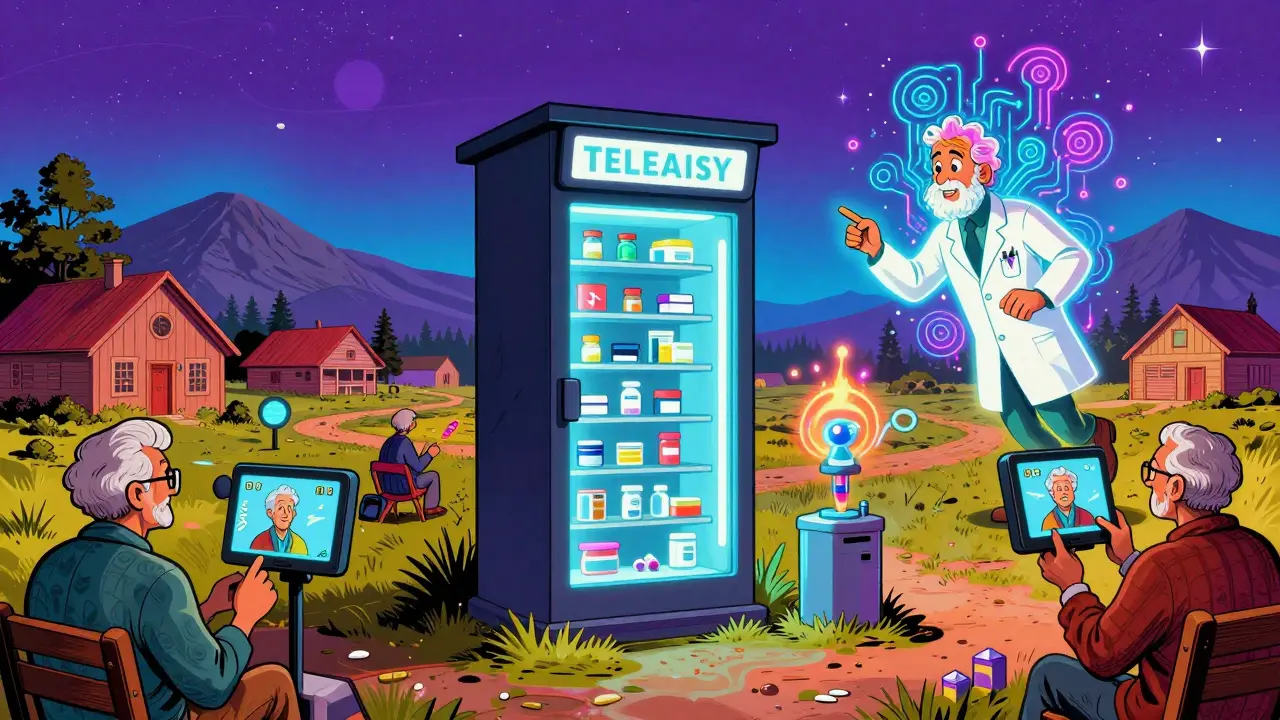
Telepharmacy isn’t just about convenience-it’s changing how people get their meds, especially in places where pharmacies have vanished.
In rural towns across the U.S., driving 40 miles just to pick up a prescription used to be normal. For older adults, people without cars, or those with mobility issues, that trip wasn’t just inconvenient-it was a barrier to health. Telepharmacy emerged as a real solution: pharmacists providing services remotely via video, secure systems, and automated dispensers. But the big question isn’t whether it’s possible-it’s whether it’s safe.
Studies from the last five years show something surprising: telepharmacy matches traditional pharmacies in accuracy, and in some cases, beats them at preventing dangerous errors. But it’s not perfect. The tech can glitch. The training can be inconsistent. And sometimes, a pharmacist misses a subtle sign because they can’t see the patient’s hands shaking or their skin pale.
How telepharmacy actually works
Most telepharmacy setups follow a hub-and-spoke model. A central pharmacy-often in a city-has licensed pharmacists who oversee multiple remote locations, like small clinics or rural drugstores. These remote sites have automated dispensing machines, video cameras, and secure connections to electronic health records. When a patient walks in, a pharmacy technician takes their information, the prescription is sent digitally to the remote hub, and a pharmacist reviews it live via video. If everything checks out, the pharmacist approves the fill and the machine dispenses the meds.
Some services skip the physical site entirely. Patients in remote areas video-call a pharmacist directly for counseling, refill requests, or even medication reviews. These direct-to-patient models are growing fast, especially since Medicare started covering them in late 2022.
It’s not sci-fi. It’s regulated. Most states require video quality to be at least 720p, encrypted connections, and backup systems in case the internet drops. The American Society of Health-System Pharmacists (ASHP) says pharmacists need 16 to 24 hours of special training before they can do this work. That includes learning how to assess patients remotely, how to handle emergencies, and how to spot red flags without physical cues.
Is telepharmacy as safe as the corner pharmacy?
A 2021 systematic review by Pathak et al., analyzing six major studies, found that telepharmacy medication dispensing accuracy hovered between 99.2% and 99.8%. Traditional pharmacies? 99.3% to 99.9%. The difference? Statistically meaningless.
But safety isn’t just about getting the right pill. It’s about catching mistakes before they hurt someone. In one study, telepharmacy sites caught 1.2 medication errors per 100 prescriptions-same as traditional pharmacies. But here’s the twist: telepharmacy reduced after-hours approval times from hours down to 14-20 minutes. That means fewer delays in critical meds like insulin or blood thinners, which can prevent hospital visits.
A 2021 study in Telemedicine and e-Health tracked 3,782 patients. Those with telepharmacy access had a 12.9% increase in hospitalizations over a year. Those without? 40.2%. That’s not because telepharmacy caused harm-it’s because it prevented worse outcomes. People got their meds faster, got better counseling, and avoided complications.
And then there’s the access angle. A 2023 study by Urick showed that states with strong telepharmacy laws saw a 4.5% drop in pharmacy deserts-areas with no pharmacy within 10 miles. In some places, that number jumped to 11.1%. That’s not just convenience. That’s life or death.

Where things go wrong
Telepharmacy isn’t magic. It’s only as good as its weakest link.
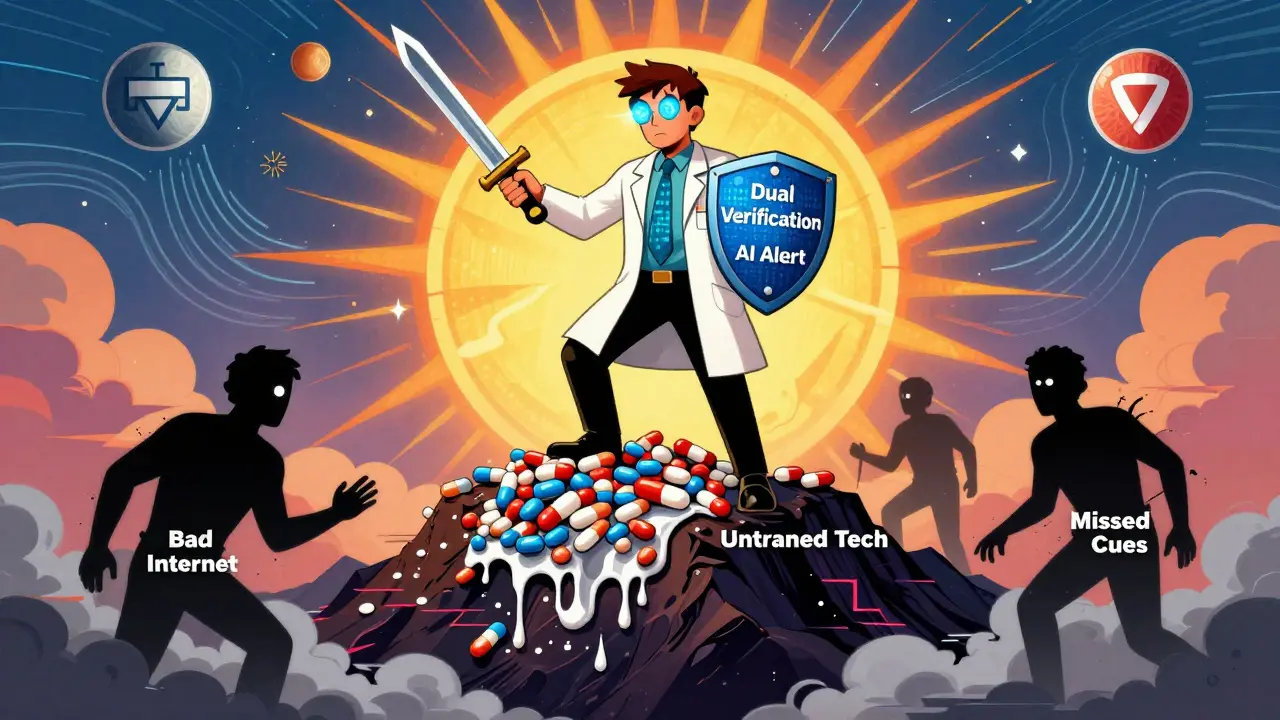
One Reddit user from North Dakota shared how a poor video connection led to a missed insulin allergy. The technician couldn’t see the patient’s skin reaction during the initial consult. The patient ended up in the ER. That’s not a flaw in the system-it’s a flaw in execution. Poor lighting, bad internet, rushed interactions-these aren’t theoretical risks. They’re documented.
A 2022 survey by the National Community Pharmacists Association found that 35% of telepharmacy sites had ongoing issues with stable video connections. In rural areas with spotty broadband, that’s a dealbreaker.
Another concern? Training. Not all remote sites invest in it. Studies show telepharmacy sites with strong technician training had 22% fewer dispensing errors than those without. Some sites still use unlicensed staff to handle basic tasks, with pharmacists reviewing remotely. That’s legal in some states-but risky if the technician doesn’t know what to look for.
And then there’s the human factor. Dr. Jerry Fahrni pointed out in the Journal of the American Pharmacists Association that pharmacists lose the ability to read body language. A patient who says they’re fine but won’t make eye contact? A trembling hand? A slow, slurred speech? Those are signs of something serious. In person, a pharmacist sees them. On video? They might miss it.
What’s working-and what’s being fixed
The Indian Health Service’s telepharmacy program for Navajo Nation communities is a model. They require dual verification for high-risk drugs like warfarin and opioids. If something’s unclear, the patient is immediately referred to an in-person pharmacist. Their error rate? 0.45%. The national average? 0.67%. That’s not luck. That’s protocol.
Some companies are using AI to help. MedsAI, a startup that raised $22 million in early 2023, built an algorithm that flags potential drug interactions or dosage errors before a pharmacist even reviews the script. In early trials, it cut adverse drug events by 18.7%. It’s not replacing pharmacists-it’s giving them better tools.
The FDA launched its Sentinel Initiative in January 2023 to track adverse events linked to telepharmacy. The Patient-Centered Outcomes Research Institute (PCORI) is funding a $3.2 million, three-year randomized trial comparing telepharmacy and traditional pharmacy safety across 12 rural communities. Results are expected by 2026.
And in November 2022, Medicare expanded reimbursement for telepharmacy services. That’s a big deal. It means more clinics can afford the tech, more pharmacists can get paid to do this work, and more patients can access it.
What patients really think
A 2022 survey of 450 telepharmacy users found 76.4% were highly satisfied. But 28.7% still worried the pharmacist couldn’t fully understand their condition without being there in person.
One patient in rural Montana said video chats about her warfarin dose had likely prevented two ER visits. Another in Arizona said she finally got her pain meds on time after her local pharmacy closed. But then there’s the counterpoint: a nurse in South Dakota told Pharmacy Today that complex cases-like someone with five chronic conditions and a new drug reaction-still need an in-person visit. Telepharmacy works best for refills, basic counseling, and routine checks. It’s not a full replacement for face-to-face care… yet.
The future: better tech, better standards
By 2026, experts predict telepharmacy will match traditional pharmacy safety levels across the board. But that’s only if we fix the gaps.
States need consistent rules. Right now, 28 states have clear telepharmacy laws. 22 don’t. That’s a mess for pharmacists who work across borders. The American Pharmacists Association has set a goal to establish national safety standards by 2025. That’s the next big step.
Broadband access remains the biggest barrier. No amount of AI or video tech helps if the internet cuts out during a medication review. Federal funding for rural broadband is now tied to telehealth expansion-something that could change the game.
Training will improve, too. Pharmacy schools are starting to include telepharmacy simulations in their curricula. Students are learning how to conduct remote consultations, spot red flags on screen, and communicate clearly without body language.
Telepharmacy isn’t the future of pharmacy. It’s the present. And it’s working-when done right.
Is telepharmacy legal in all U.S. states?
No. As of early 2026, 28 states have specific laws regulating telepharmacy, covering video standards, pharmacist licensing, and remote dispensing rules. The other 22 states either have no clear rules or rely on general telehealth laws, which can create legal gray areas. Pharmacists working across state lines must comply with the rules of both their home state and the state where the patient is located.
Can telepharmacy reduce medication errors?
Yes-when implemented well. Studies show telepharmacy reduces medication errors by 15-20% compared to under-staffed rural pharmacies. Remote pharmacists often have better access to drug databases and can review prescriptions more thoroughly than overworked local staff. The key is having trained technicians and reliable tech. Sites with dual verification for high-risk drugs have error rates as low as 0.45%, below the national average of 0.67%.
Are telepharmacy services covered by insurance?
Medicare Part D began covering telepharmacy consultations and medication management services in November 2022. Many private insurers followed suit in 2023-2024. However, coverage varies by plan. Patients should check if their plan includes telepharmacy under "telehealth services" or "pharmacy benefits." Some plans require the service to be provided through a network pharmacy.
What’s the biggest risk in telepharmacy?
The biggest risk isn’t the technology-it’s inconsistent implementation. Poor video quality, undertrained staff, lack of backup systems, and rushed consultations can lead to missed allergies, wrong dosages, or undetected side effects. A 2022 survey found 35% of telepharmacy sites had ongoing tech issues. Safety depends on protocols, not just software.
Can telepharmacy replace in-person pharmacies entirely?
Not yet-and probably not fully. Telepharmacy excels at refills, routine counseling, and managing stable conditions like hypertension or diabetes. But for complex cases-new drug regimens, suspected adverse reactions, or patients with cognitive decline-face-to-face care is still essential. The best model combines both: telepharmacy for routine care, in-person for emergencies or high-risk situations.
How is AI being used in telepharmacy today?
AI tools are being used to flag potential drug interactions, dosage errors, and duplicate prescriptions before a pharmacist reviews them. Companies like MedsAI have developed algorithms that analyze patient histories and current prescriptions to predict adverse events. In early trials, these tools improved detection of risky combinations by 18.7%. They don’t replace pharmacists-they give them real-time alerts so they can act faster and more accurately.


Alex Flores Gomez
January 29, 2026 AT 04:07Jasneet Minhas
January 29, 2026 AT 11:58Megan Brooks
January 29, 2026 AT 17:29Robin Keith
January 30, 2026 AT 05:38Sheryl Dhlamini
January 30, 2026 AT 19:21Doug Gray
February 1, 2026 AT 15:35Kristie Horst
February 2, 2026 AT 23:31LOUIS YOUANES
February 3, 2026 AT 20:18Laia Freeman
February 5, 2026 AT 02:51rajaneesh s rajan
February 6, 2026 AT 23:12paul walker
February 7, 2026 AT 13:34Frank Declemij
February 9, 2026 AT 13:24Pawan Kumar
February 11, 2026 AT 06:13Keith Oliver
February 12, 2026 AT 00:05kabir das
February 13, 2026 AT 16:05