

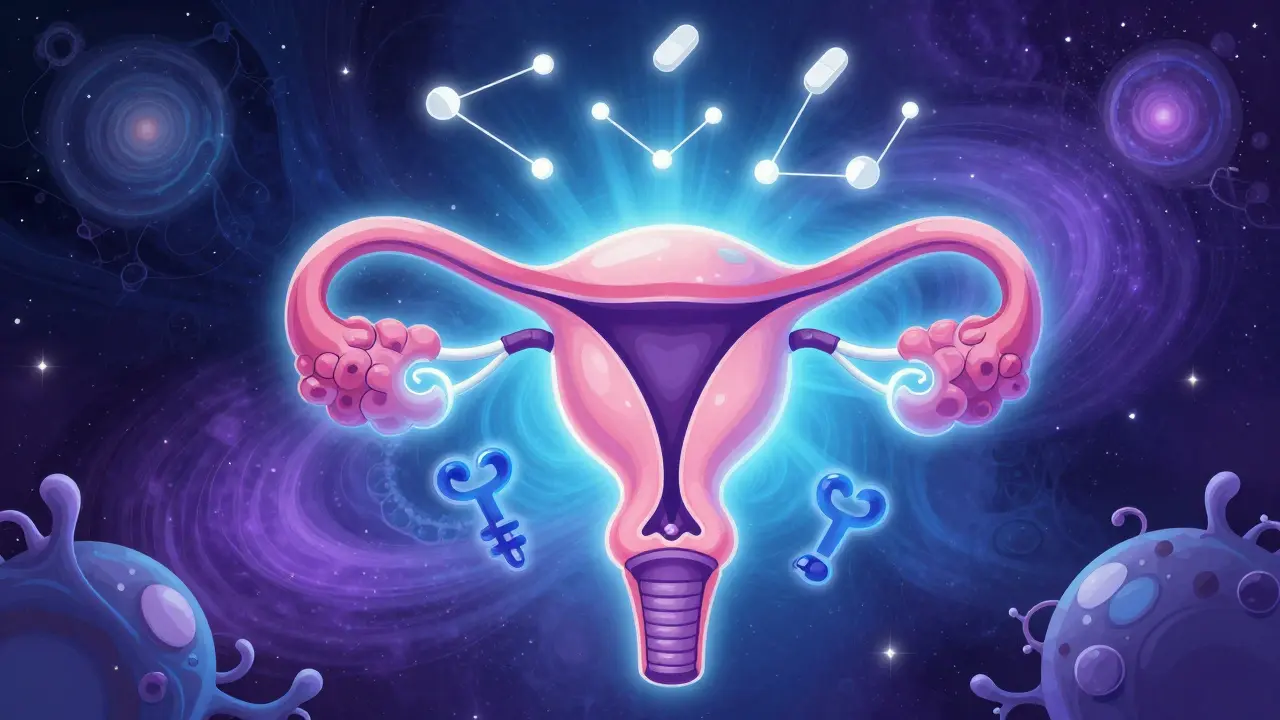
For many women with PCOS, getting pregnant isn’t just about timing-it’s about fixing something broken inside. Irregular periods, stubborn weight gain, acne, and hair growth aren’t just annoying symptoms. They’re signs that your body’s insulin system is stuck in overdrive. And that’s where metformin comes in.
What Metformin Actually Does in PCOS
Metformin isn’t a fertility drug. It doesn’t trick your ovaries into releasing eggs. Instead, it fixes the root problem: insulin resistance. About 70% of women with PCOS have it, even if they’re not overweight. When your cells don’t respond well to insulin, your pancreas pumps out more of it. High insulin levels tell your ovaries to make more testosterone, which shuts down ovulation and causes those classic PCOS symptoms.
Metformin works in three ways: it slows down how much sugar your gut absorbs, tells your liver to stop making extra glucose, and helps your muscles use insulin better. The result? Lower insulin levels. And when insulin drops, so does testosterone. That’s the key to unlocking ovulation.
It’s not magic. But it’s science that’s been around since the 1950s. Originally used for diabetes, doctors noticed women with PCOS who took metformin started getting their periods again. That’s when the real shift began.
Does Metformin Really Help You Ovulate?
Yes-but not always on its own. A 2012 Cochrane review of 44 studies found women taking metformin were 2.5 times more likely to ovulate than those on placebo. That’s a big jump. But here’s the catch: in real-world clinics, metformin alone gets you pregnant about 19% of the time. That’s better than nothing, but it’s not the best option.
Compare that to letrozole, the current gold standard for ovulation induction in PCOS. When used alone, letrozole gets you pregnant in about 30% of cycles. Add metformin to letrozole? That number jumps to nearly 40%. The same goes for clomiphene citrate. Metformin doesn’t beat them-it boosts them.
Why does this matter? Because if you’ve tried clomiphene and it didn’t work, adding metformin can turn failure into success. Many fertility clinics now start with metformin for three months before adding other drugs. Why? Because it makes your body more responsive. It’s like cleaning out a clogged pipe before turning on the water.
Who Benefits Most From Metformin?
Not every woman with PCOS responds the same way. The biggest factor? Insulin resistance. If your body is struggling to use insulin, metformin helps. If you’re lean but still have high insulin levels (yes, that’s possible), you’re actually a better candidate than someone who’s overweight but insulin-sensitive.
Recent studies, including one from 2023 in the Annals of Translational Medicine, suggest that non-obese women with PCOS may benefit more from metformin than clomiphene. That’s a big deal. For years, guidelines told doctors to start with clomiphene. Now, some experts say: if you’re insulin resistant, start with metformin.
It’s not about weight. It’s about your blood work. Fasting insulin, HOMA-IR scores, even triglyceride levels can tell you if metformin might work for you. If your doctor doesn’t test these, ask. You deserve to know if your treatment is targeting the real issue.

How It Compares to Other Treatments
Let’s cut through the noise. Here’s how metformin stacks up:
| Treatment | Ovulation Rate | Live Birth Rate | Side Effects | Cost (Monthly) |
|---|---|---|---|---|
| Metformin alone | ~60% | 19-37% | Stomach upset (20-30%) | $4-$10 |
| Letrozole alone | ~80% | ~30% | Mild headache, hot flashes | $50-$100 |
| Clomiphene alone | ~70% | ~25% | Mood swings, bloating | $30-$50 |
| Letrozole + Metformin | ~89% | ~40% | Combined side effects | $54-$110 |
| Clomiphene + Metformin | ~75% | ~32% | Combined side effects | $34-$60 |
Metformin wins on cost and safety. It’s not the fastest path to pregnancy, but it’s the safest long-term. Letrozole gets you pregnant faster. But metformin protects your heart, your metabolism, and your future risk of diabetes.
What About Pregnancy and Safety?
Many women stop metformin as soon as they get a positive pregnancy test. But here’s what the data says: continuing it through the first trimester may improve your chances of a healthy pregnancy. A 2023 meta-analysis of 12 trials found higher clinical pregnancy rates when women stayed on metformin after conception.
It’s classified as Category B-meaning no harm was found in animal studies, and human data shows no increased risk of birth defects. That’s reassuring. Still, some doctors prefer to stop it, especially if you’re not insulin resistant. Talk to your provider. Don’t assume you need to quit.
And if you’re going through IVF? Metformin cuts your risk of ovarian hyperstimulation syndrome (OHSS) by 73%. That’s huge. OHSS can be dangerous. Metformin isn’t just helping you get pregnant-it’s helping you stay safe while you do it.
Side Effects and How to Handle Them
The #1 reason women quit metformin? Stomach issues. Nausea, bloating, diarrhea. About 1 in 3 people get them. But here’s the good news: they usually fade after 2-4 weeks. And there are ways to make them worse-or better.
- Start low: 500mg once a day with dinner. Wait a week.
- Slowly increase: Add another 500mg after a week, then another if needed.
- Use extended-release (XR): Glucophage XR causes 50% fewer stomach problems than regular metformin.
- Take with food: Always. Never on an empty stomach.
- Don’t rush: It takes 3 months to see full effects on ovulation.
Some women swear by taking it with a small snack before bed. Others find splitting the dose helps. There’s no one-size-fits-all. But most people who stick with it for 90 days say the side effects become manageable-or disappear.

It’s Not Just About Fertility
Metformin doesn’t just help you ovulate. It helps you feel better. Women report fewer acne breakouts, less facial hair growth, and more regular periods-even without trying to get pregnant.
That’s because lowering insulin lowers testosterone. And that’s the core of PCOS. So even if you’re not planning a baby, metformin can be a powerful tool to manage symptoms without birth control pills. For women who can’t or won’t take OCPs, it’s often the best alternative.
And long-term? It might protect you. The REPOSE trial showed metformin reduced diabetes risk in women with PCOS by nearly 50% over five years. That’s not just about fertility. That’s about living longer, healthier.
How to Get Started
If you’re considering metformin, here’s what to do:
- Ask your doctor for a fasting insulin test and HOMA-IR calculation. Don’t rely on glucose alone.
- If you’re insulin resistant, ask if metformin is right for you-even if you’re thin.
- Start with 500mg daily of extended-release, taken with your evening meal.
- Give it at least 3 months before expecting ovulation.
- Track your cycles with ovulation tests or basal body temperature.
- Confirm ovulation with a progesterone test around day 21 of your cycle.
- Consider combining it with letrozole if you’re not ovulating after 3-4 months.
Don’t wait for your period to return. If you’re not ovulating, you won’t get a period that’s truly fertile. Ovulation is the goal-not just bleeding.
The Bottom Line
Metformin isn’t a miracle drug. But it’s the only PCOS treatment that fixes the underlying problem-not just the symptoms. It’s cheap, safe, and backed by decades of research. It doesn’t work for everyone, but for a lot of women, it’s the missing piece.
If you have PCOS and you’re struggling to ovulate, ask your doctor: "Could insulin resistance be holding me back?" If the answer is yes, metformin might be the quiet, powerful solution you’ve been overlooking.


swarnima singh
January 17, 2026 AT 17:01Isabella Reid
January 18, 2026 AT 10:44Jody Fahrenkrug
January 20, 2026 AT 06:56Allen Davidson
January 21, 2026 AT 10:17john Mccoskey
January 23, 2026 AT 06:22Joie Cregin
January 23, 2026 AT 23:35Christina Bilotti
January 25, 2026 AT 07:36waneta rozwan
January 27, 2026 AT 02:51