

When you pick up a prescription, you might see two options: the familiar brand-name pill, or a cheaper generic version. You’ve probably wondered - does the generic really work the same? Is it just a copycat, or is it scientifically proven to do the job? The answer isn’t as simple as ‘yes’ or ‘no,’ but the science is clear on one thing: generic drugs are not inferior. For the vast majority of people, they work just as well - and save you a fortune.
What Makes a Generic Drug ‘Equal’?
Generic drugs aren’t knockoffs. They’re exact copies in terms of active ingredients, strength, and how they’re taken - whether it’s a pill, injection, or cream. The U.S. Food and Drug Administration (FDA) doesn’t approve them unless they meet the same strict standards as the original brand-name drug. That means the same chemical compound, same dose, same way it enters your body.
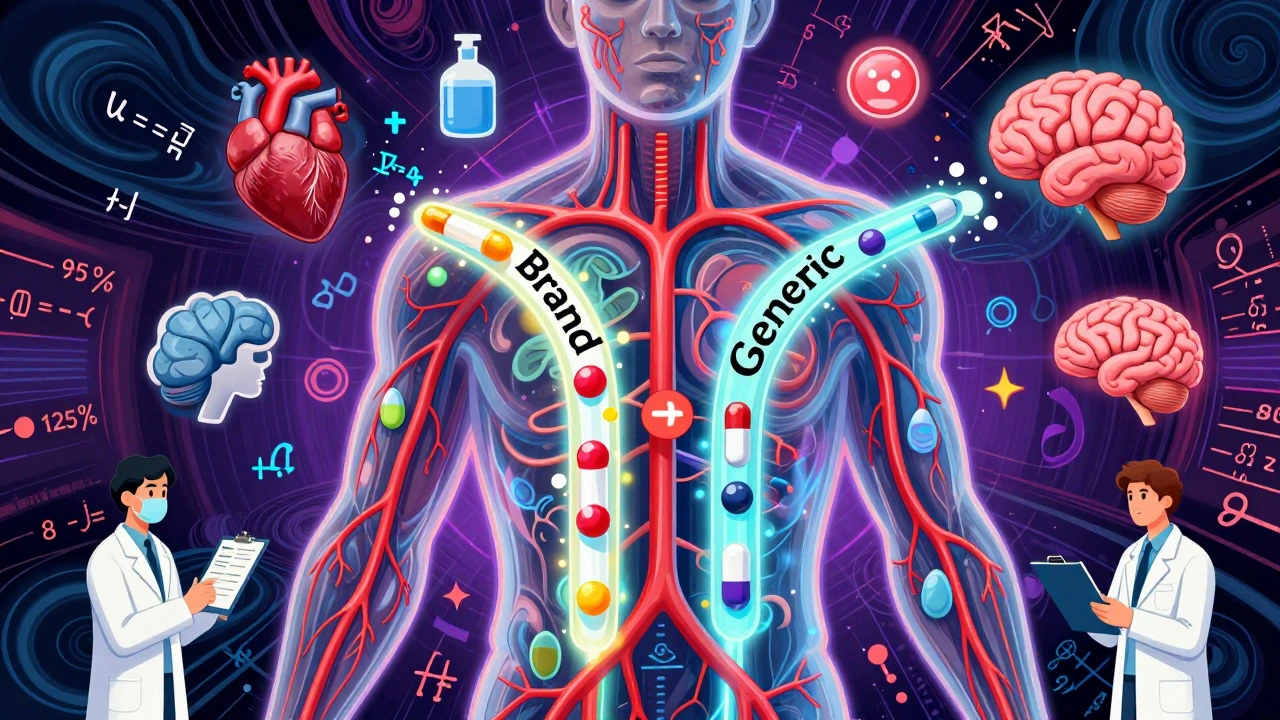
The key test is called bioequivalence. Before a generic can be sold, manufacturers must prove that your body absorbs the drug at the same rate and to the same extent as the brand version. This is measured using two numbers: Cmax (the highest concentration in your blood) and AUC (how much of the drug your body takes in over time). The FDA requires these values to fall within 80% to 125% of the brand-name drug’s numbers. That’s not a wide gap - it’s a tight band designed to ensure no meaningful difference in how the drug works.
These tests aren’t theoretical. They’re done on real people - usually 24 to 36 healthy volunteers - in controlled crossover studies. One group gets the brand drug first, then switches to the generic. Another group does the reverse. The results are analyzed statistically. If the data shows no clinically significant difference, the generic gets approved.
What Do Real-World Studies Say?
Over the past 30 years, hundreds of large-scale studies have looked at whether generics perform the same as brand-name drugs in real patients. The results are overwhelming.
A 2020 study published in Scientific Reports analyzed data from nearly all insured people in Austria between 2007 and 2012. It compared 17 brand-name drugs with their generic versions for chronic conditions like high blood pressure, diabetes, and heart disease. The study found that patients taking generics had fewer deaths and fewer major heart events than those on brand-name versions - even after adjusting for age, income, and other factors. The five-year survival rate for generic users was 82.7%, compared to 79.8% for brand-name users.
Another massive analysis in 2019, published in PLoS ONE, looked at 3.5 million patients across two U.S. databases. It focused on common drugs like amlodipine (for high blood pressure), glipizide (for diabetes), and escitalopram (for depression). The results? No difference in hospitalizations, emergency visits, or treatment failure. In fact, for amlodipine, patients on the generic had a 9% lower risk of heart-related problems.
Even in complex areas like cardiovascular care, generics hold up. A 2022 study in JAMA Internal Medicine tracked 1.2 million patients with high blood pressure on ACE inhibitors. There was no difference in hospitalization rates between those taking brand-name and generic versions.
When Might Generics Not Work the Same?
There’s a small but important exception: drugs with a narrow therapeutic index (NTI). These are medications where even a tiny change in blood levels can cause serious side effects or make the drug stop working. Think blood thinners like warfarin, seizure meds like phenytoin, or thyroid hormone like levothyroxine.
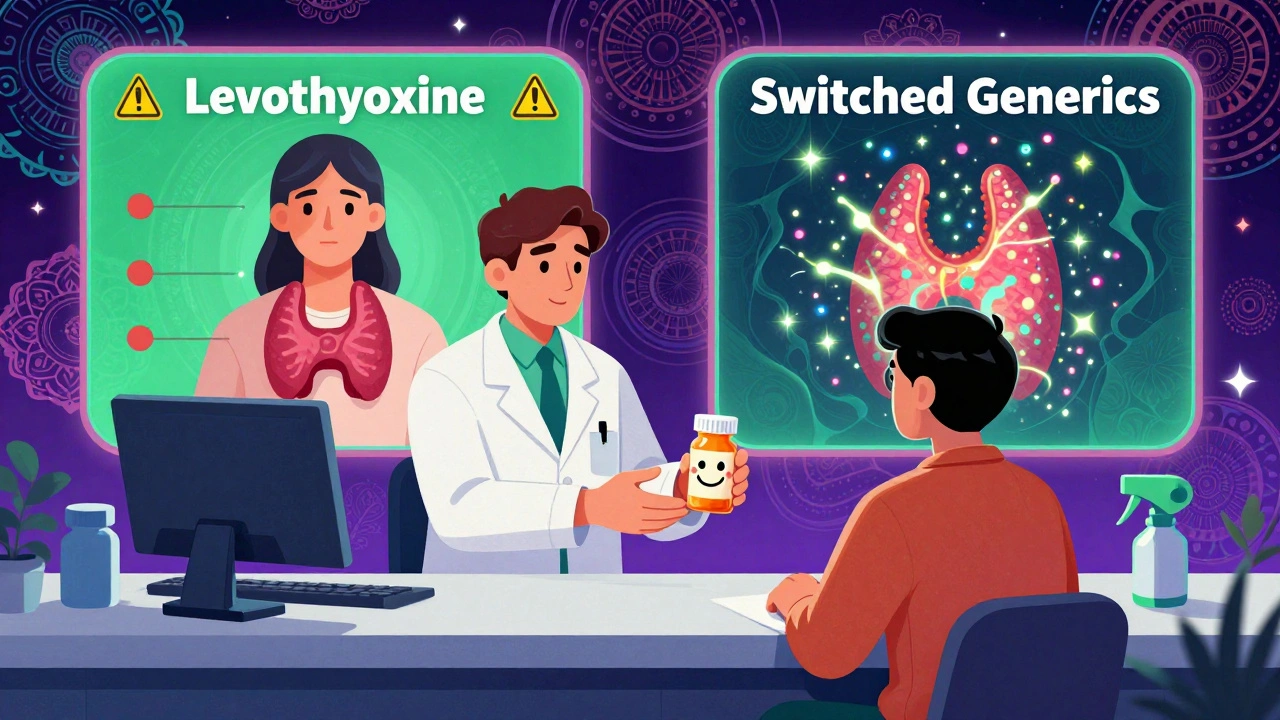
For these drugs, small differences in how the body absorbs the drug - even within FDA’s 80-125% range - can matter. That’s why some doctors and patients report issues when switching between generic versions, especially if they’re made by different manufacturers.
A 2023 study in Epilepsia found that patients switching between different generic versions of levetiracetam had an 18% higher chance of seizure recurrence. Similarly, patients on levothyroxine often report that one generic brand works perfectly, but another causes fatigue or heart palpitations. That’s not because generics are unsafe - it’s because the body is sensitive to minute variations in absorption. The FDA acknowledges this and recommends sticking with the same manufacturer when possible for NTI drugs.
There are also rare cases where patients report feeling worse after switching. A 2013 study documented a patient whose symptoms from a bacterial infection didn’t improve on a generic version of levofloxacin - until they switched back to the brand name. That doesn’t mean generics fail often. It means that for a small group of people, individual biology matters.
What Do Patients and Pharmacists Really Think?
Surveys show most people don’t notice a difference. A Medicare survey in 2021 found that 68% of seniors on generic cardiovascular drugs said they felt no change in effectiveness. GoodRx reviews from over 12,000 users showed 78% said generics were just as effective as brand names - and they loved the lower price.
But not everyone is convinced. A 2021 survey by the American Pharmacists Association found that 42% of pharmacists hear patients worry about generic quality. Many of these concerns come from anecdotes - someone’s uncle had a bad reaction, or a friend’s thyroid levels went off after switching.
On Reddit and pharmacy forums, users frequently share stories about switching generics for epilepsy or thyroid meds and having problems. One user wrote: “I tried three different generics for Synthroid. Only one kept my levels stable.” That’s not a flaw in the system - it’s a reminder that biology isn’t uniform. What works for 99% of people might not work for you.
Why Do Pharmacists Substitute Generics Automatically?
In most states, pharmacists are allowed - and often required - to substitute a generic unless the doctor writes “dispense as written.” In 2022, only 3.2% of prescriptions had that restriction. Why? Because generics save the system billions. In the U.S., generics make up 90% of prescriptions but only 23% of drug spending. Between 2012 and 2021, they saved the country $612 billion.
Doctors know this. A 2020 study by the Generic Pharmaceutical Association found that 87% of physicians trust generics. But specialists - like neurologists treating epilepsy or cardiologists managing anticoagulants - are more cautious. They know the stakes are higher for NTI drugs. That’s why they sometimes choose to stick with the brand name.
What Should You Do?
If you’re prescribed a generic drug, don’t assume it’s second-rate. The science is solid. For most medications - antibiotics, statins, blood pressure pills, antidepressants - generics are just as safe and effective.
But if you’re taking a drug with a narrow therapeutic index - like levothyroxine, warfarin, phenytoin, or seizure meds - pay attention. If you feel different after switching brands, tell your doctor. Keep track of how you feel, your lab results, and which manufacturer made your pills. Don’t switch manufacturers unless you have to.
Don’t let fear stop you from saving money. For the vast majority of people, the generic is the smarter choice. It’s not a compromise - it’s a scientifically proven alternative.
How to Stay Informed
The FDA’s Orange Book lists every approved drug and its therapeutic equivalence rating. Look for “A-rated” generics - they’re considered interchangeable with the brand. Avoid switching between B-rated generics unless your doctor says it’s safe.
Check your pharmacy’s label. It will list the manufacturer. If you find one that works well, stick with it. If you notice side effects or a drop in effectiveness after switching, don’t ignore it. Bring it up with your prescriber.
Remember: the goal isn’t to avoid generics. It’s to use them wisely. For most drugs, they’re the best option. For a few, they require extra care. The data supports both.
Are generic drugs as safe as brand-name drugs?
Yes. Generic drugs must meet the same FDA standards for safety, purity, and strength as brand-name drugs. They contain the same active ingredient and are manufactured under the same quality controls. The FDA inspects generic manufacturing facilities just as often as brand-name ones. Any safety issue with a brand-name drug is also a potential issue for its generic version - but that doesn’t mean generics are less safe.
Why do some people say generics don’t work for them?
For most people, generics work just as well. But for a small number of patients - especially those on drugs with a narrow therapeutic index like levothyroxine or seizure medications - tiny differences in how the body absorbs the drug can cause noticeable changes. This isn’t because generics are inferior, but because these drugs require very precise blood levels. Switching between different generic manufacturers can sometimes trigger this. If you feel different after switching, talk to your doctor and stick with the brand that works.
Can I switch between different generic brands?
For most medications, yes. But for drugs with a narrow therapeutic index - like warfarin, levothyroxine, or phenytoin - it’s best to avoid switching unless your doctor approves it. Even though all generics are approved as bioequivalent, different manufacturers use slightly different inactive ingredients or manufacturing processes that can affect absorption in sensitive individuals. If you’ve found a generic that works, stick with it.
Why are generics so much cheaper?
Generics are cheaper because they don’t have to repeat the expensive clinical trials that brand-name drugs do. The original drug company spent years and hundreds of millions developing and testing the drug. Generic manufacturers only need to prove their version is bioequivalent - a much simpler and cheaper process. They also face competition from multiple manufacturers, which drives prices down. That’s why generics cost 80-85% less than brand names on average.
Do all countries approve generics the same way?
Most developed countries follow similar standards. The FDA in the U.S. and the EMA in Europe both require bioequivalence testing with the same 80-125% range. Studies show that over 98% of generics approved in Europe are therapeutically equivalent to their brand-name counterparts. Some countries may have less rigorous oversight, but in the U.S., Canada, Australia, and EU nations, the rules are strict and well-enforced.




John Filby
December 5, 2025 AT 08:28Just took my generic lisinopril for 3 years now. Zero issues. My BP is better than when I was on the brand. Saved me like $40 a month. Why pay more when it’s literally the same chemical? 🤷♂️
Elizabeth Crutchfield
December 5, 2025 AT 22:45i switched my synthroid to generic and my energy just DROPPED. like, i was napping after lunch and my hair was falling out. switched back to brand and boom, back to normal. not saying generics are bad, but my body hates the ones from teva. 😔
Ben Choy
December 7, 2025 AT 21:41Love how this post breaks it down. I work in a pharmacy and people always freak out about generics. I show ‘em the FDA’s Orange Book and they’re like ‘wait… it’s literally the same?’ 😅 The science is solid. For 99% of meds? Go generic. For warfarin or levothyroxine? Stick with what works. Simple as that. 🙌
Emmanuel Peter
December 9, 2025 AT 03:53Let’s be real - the FDA’s 80-125% range is a joke. That’s a 45% window. If my blood pressure med drops to 80% absorption, I’m gonna have a stroke. And don’t get me started on how generic manufacturers cut corners on fillers and binders. I’ve seen people get sick after switching. This isn’t ‘science,’ it’s corporate greed disguised as cost-saving. 🤡
Chad Handy
December 10, 2025 AT 10:43Look, I get it - generics save money. But let’s not pretend this is all black and white. I’m a nurse. I’ve had patients on levetiracetam switch generics and go from seizure-free to having 3 grand mal episodes in 2 weeks. The manufacturer changed the coating. The pill dissolved 0.2 seconds faster. That’s all it took. And now they’re stuck in a cycle of switching back and forth because insurance won’t cover the brand. The system is broken. We’re treating people like data points. And when you’re talking about brain chemistry? A 0.2-second difference can mean life or death. The FDA’s numbers look good on paper, but real human bodies aren’t test tubes. I’ve seen too many people suffer because someone in a boardroom decided ‘close enough’ is good enough. It’s not.
Augusta Barlow
December 11, 2025 AT 01:55Who funds these ‘studies’? Big Pharma doesn’t want you to know that generics are just repackaged crap. The FDA is a revolving door - ex-pharma execs running the agency. They approve generics based on lab rats, not real people. And don’t even get me started on the ‘inactive ingredients’ - they’re full of carcinogens and fillers that trigger autoimmune flares. My cousin got diagnosed with lupus after switching to generic metformin. Coincidence? I think not. The truth is being buried. You think this is about health? It’s about profits. Always has been.
Jessica Baydowicz
December 11, 2025 AT 12:55Y’all are overthinking this. I’ve been on generic antidepressants for 8 years. No mood swings, no side effects, and I’m finally sleeping through the night. 💪 If it works, it works. Don’t let fear of ‘what ifs’ cost you your peace of mind - or your paycheck. Generics are a gift. Use ‘em. Save cash. Live better. 🌈
Shofner Lehto
December 12, 2025 AT 17:25For anyone scared of switching: start with a 30-day supply. Track how you feel. Check your labs if it’s a thyroid or anticoagulant. If you notice changes, go back to the brand or stick with the generic manufacturer that worked. No shame in that. The goal isn’t to be a hero - it’s to stay healthy. And if your pharmacist asks if you want the generic? Say yes. You’re not losing anything - you’re gaining freedom from financial stress.
Yasmine Hajar
December 14, 2025 AT 14:14As a Black woman with sickle cell, I’ve had to fight for brand-name hydroxyurea because my docs thought generics ‘might not work.’ Turns out? The generic was fine. But the bias? Real. We need to stop assuming people of color can’t handle generics - or that we’re too ‘complicated’ for them. The science doesn’t care about your race or income. What matters is the pill in your hand. And if it’s A-rated? Take it. Save your money. Fight the stigma. 💥