

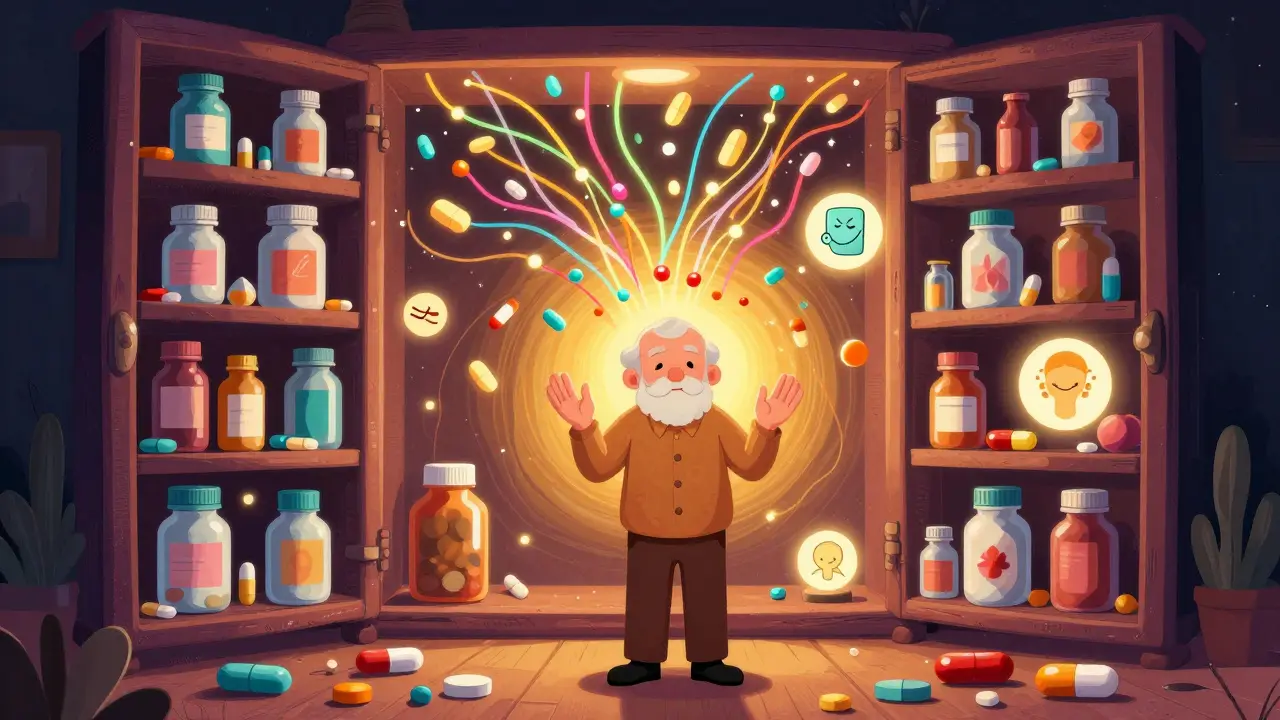
More than half of Australians over 65 take five or more medications every day. Some of those pills might not be helping anymore - and could even be hurting. It’s not laziness or forgetfulness. It’s not that doctors aren’t paying attention. It’s that medicine often keeps getting added, but rarely gets taken away. That’s where deprescribing comes in - the intentional, careful process of stopping medicines that no longer serve the person’s goals or safety.
Why Stopping Medicines Can Be Healthier Than Keeping Them
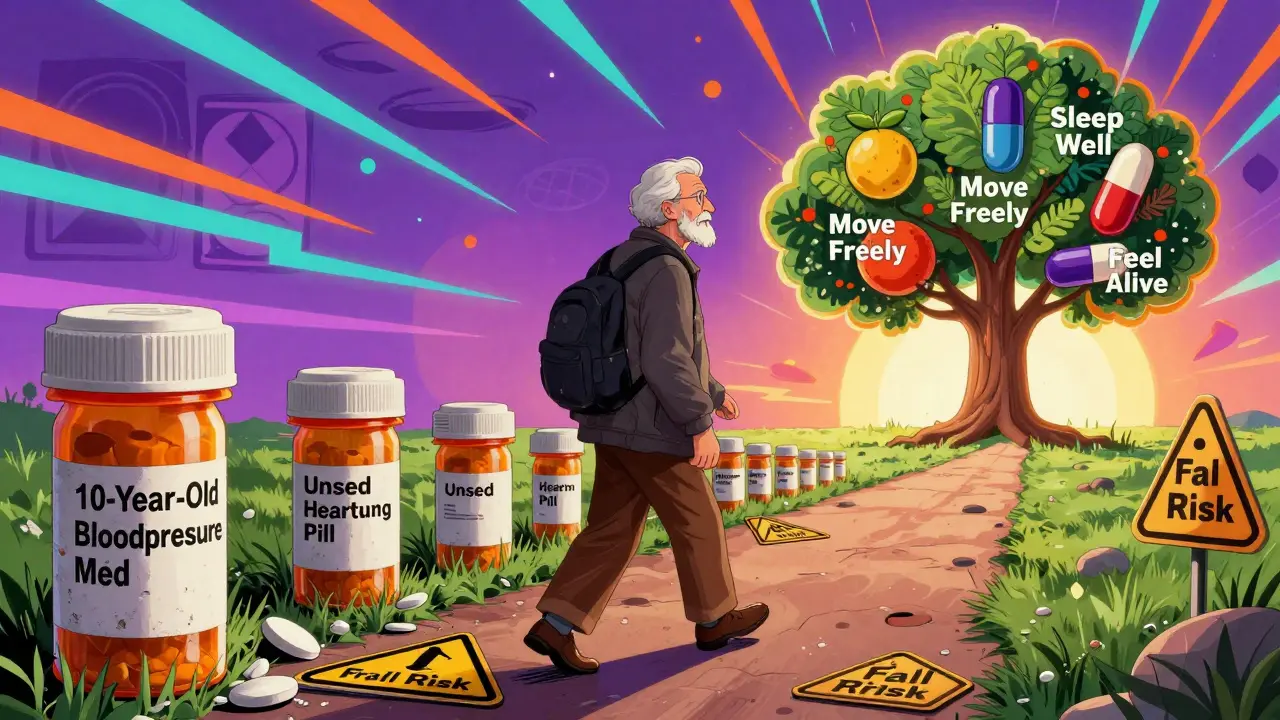
We’re taught that taking medicine is always good. But for older adults, especially those with multiple health issues, each new pill adds risk. The more drugs someone takes, the higher the chance of side effects, falls, confusion, kidney damage, or dangerous interactions. In Australia, the number of seniors on five or more medications jumped from 33% to 36% between 2006 and 2017. In the U.S., it tripled over the same period. This isn’t progress - it’s a safety crisis. Deprescribing isn’t about cutting corners. It’s about precision. Think of it like cleaning out a cluttered garage. Just because something is there doesn’t mean it’s useful. A blood pressure pill from 10 years ago? A statin for someone with advanced dementia? A proton pump inhibitor (PPI) for heartburn that hasn’t bothered them in years? These aren’t necessarily helping anymore. They’re just taking up space - in the medicine cabinet, in the body, and in the daily routine.When It’s Time to Consider Stopping a Medication
There are clear signs that a medication may need to be reviewed - or stopped. You don’t need to wait for a crisis. Here’s when to act:- New symptoms appear - dizziness, confusion, fatigue, nausea, or muscle weakness. These aren’t just ‘getting older.’ They could be drug side effects. For example, benzodiazepines for sleep can cause falls in seniors. Anticholinergics for overactive bladder can fog thinking. Stopping them often reverses the problem.
- Life goals have changed - if someone has advanced dementia, is in hospice, or is no longer able to live independently, the goal shifts from long-term prevention to comfort and quality of life. Taking a cholesterol-lowering drug for 10 years to prevent a heart attack doesn’t make sense if they have less than a year to live. The risks still apply; the benefit disappears.
- High-risk drugs are being used - certain medications are known to be dangerous for older adults. The Beers Criteria, updated regularly by the American Geriatrics Society, lists drugs like long-term PPIs, sleeping pills like zolpidem, and certain antipsychotics that should be avoided unless absolutely necessary.
- Preventive drugs are no longer practical - statins, aspirin, or osteoporosis meds are meant to prevent future problems. But if someone’s life expectancy is short, or they can’t swallow pills, the benefit is theoretical. The daily burden? Very real.
How Deprescribing Works - Step by Step
Deprescribing isn’t a one-time decision. It’s a process. Here’s how it actually works in practice:- Review the full list - gather every pill, patch, inhaler, and supplement. Include over-the-counter drugs and herbal remedies. Many seniors don’t tell their doctor about aspirin they take daily or turmeric capsules they think are ‘harmless.’
- Identify the purpose of each - why was this prescribed? Is the original condition still present? Has it been treated? Is the medication still needed?
- Assess risks vs. benefits - does the drug still help? Or is it causing more harm? Use tools like STOPP (Screening Tool of Older Persons’ Potentially Inappropriate Prescriptions) or Beers Criteria to spot red flags.
- Start with one - never stop multiple drugs at once. If you stop two and the person feels worse, you won’t know which one caused the change. Pick the most likely culprit - often a sleep aid, acid reducer, or antihypertensive.
- Taper slowly - some drugs, like antidepressants or beta-blockers, can’t be stopped cold turkey. A gradual reduction over weeks or months is safer and more comfortable.
- Watch and listen - track how the person feels. Are they sleeping better? More alert? Less dizzy? Are old symptoms coming back? Report changes to the doctor right away.
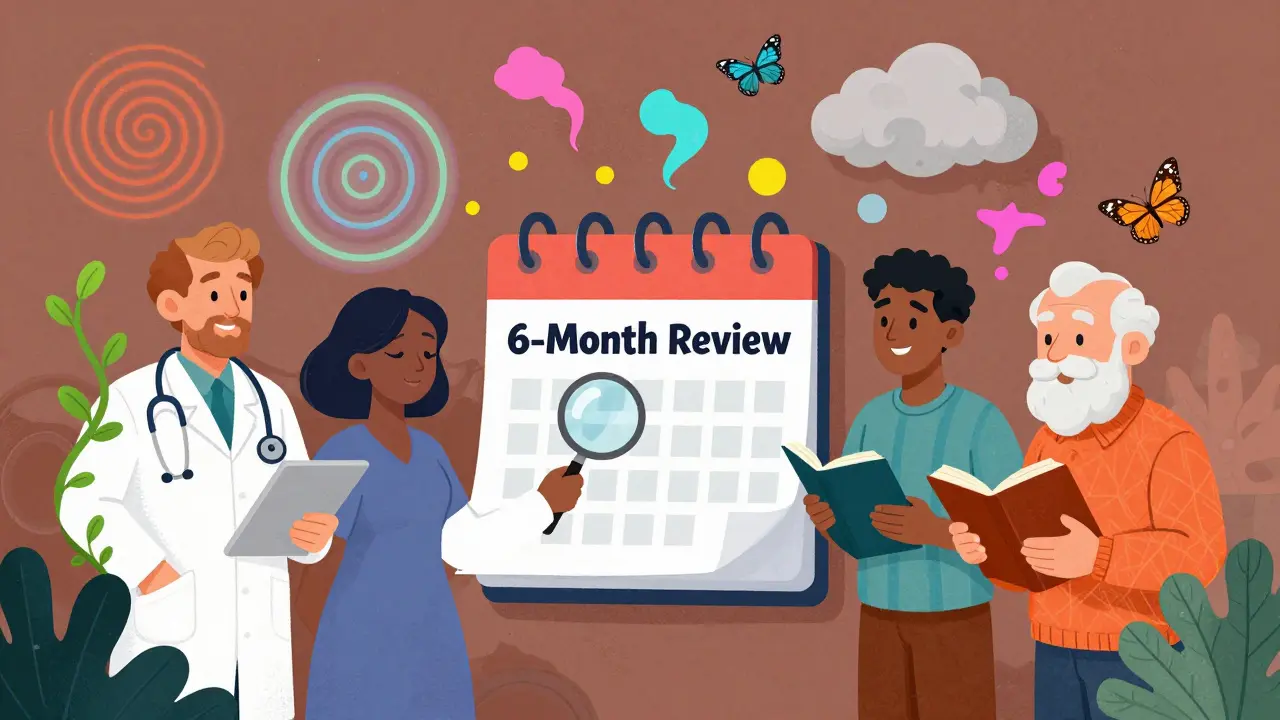
- Reassess regularly - even if nothing changed, review the list every 6 to 12 months. Health changes. Goals change. So should the meds.
Who Should Lead the Conversation?
This isn’t something a senior should do alone. It’s a team effort. The best outcomes happen when:- Pharmacists - especially clinical pharmacists - review the full list. They spot interactions, duplicates, and outdated prescriptions. In Australia, community pharmacists are increasingly involved in medication reviews funded through the government’s Home Medicines Review program.
- Doctors - GPs or geriatricians must agree to stop or reduce a drug. They’re the ones who can write the new prescription or order the taper.
- The patient and family - the person taking the medicine must be part of the decision. They know how they feel. They know what matters to them. Do they want to avoid hospital trips? Sleep through the night? Eat without nausea? Their goals drive the plan.
What Happens When You Stop a Drug?
Fear of withdrawal or rebound symptoms keeps many people on unnecessary meds. But here’s the truth: most side effects disappear within days or weeks after stopping. And many symptoms thought to be ‘disease progression’ are actually drug-induced. For example:- Stopping a PPI (like omeprazole) for heartburn? Some people get temporary reflux - but it usually fades in 2-4 weeks. And many never needed it in the first place.
- Stopping a sleeping pill like zolpidem? Sleep may be worse for a few nights, but natural sleep often returns. And without the fall risk, it’s safer.
- Stopping an antipsychotic for agitation in dementia? Agitation may return - but often less than expected. And without the sedation and tremors, quality of life improves.
What’s Holding Deprescribing Back?
The science is clear. The tools exist. So why isn’t this happening more?- Doctors aren’t trained to stop things - medical education focuses on starting treatments, not stopping them. No one teaches you how to say, ‘Let’s try going off this.’
- Patients are scared - they worry stopping a pill will make them sicker. Or they think their doctor will think they’re ‘difficult’ if they ask.
- Systems don’t support it - electronic health records don’t flag outdated meds. Refill reminders keep coming. Insurance doesn’t pay for medication reviews unless they’re part of a formal program.
What You Can Do Right Now
You don’t need to wait for a perfect system. Here’s how to start today:- Bring your full medication list - including supplements - to your next doctor’s visit. Write it down. Don’t rely on memory.
- Ask: ‘Is this still needed? What’s the benefit now? What are the risks?’
- Ask: ‘If I stopped this, what would happen? Would I feel better?’
- Ask your pharmacist for a free medication review. Many offer this in-store.
- Don’t be afraid to say, ‘I’d like to try going off this.’
Is deprescribing the same as stopping all my meds?
No. Deprescribing means stopping only the medicines that no longer help - or that may be causing harm. It doesn’t mean stopping everything. Essential medications for heart disease, diabetes, or high blood pressure are usually kept unless there’s a clear reason to change them. The goal is to reduce unnecessary drugs, not essential ones.
Can I stop a medication on my own if I think it’s not helping?
No. Some medications, like blood pressure pills, antidepressants, or steroids, can cause serious withdrawal effects if stopped suddenly. Always talk to your doctor or pharmacist first. They can help you taper safely and monitor for side effects. Never stop a prescription without professional guidance.
What if my symptoms come back after stopping a drug?
That’s why deprescribing is done one drug at a time and with close monitoring. If symptoms return, it helps identify whether the drug was truly needed. Sometimes, the original problem comes back - but often, the symptoms were caused by the medication itself. Your doctor can then decide whether to restart it, try a different treatment, or accept that the symptom isn’t dangerous.
Are there free tools or resources to help with deprescribing?
Yes. Deprescribing.org offers free, evidence-based guides for common drugs like proton pump inhibitors, sleeping pills, and antipsychotics. Each includes a patient pamphlet, infographic, and video. In Australia, the Home Medicines Review program provides free pharmacist-led reviews for eligible seniors. Talk to your GP or pharmacist about accessing these.
How often should a senior have a medication review?
At least once a year - or anytime there’s a change in health, hospital stay, or living situation. If someone starts feeling more tired, confused, or unsteady, that’s a red flag to review all meds right away. Regular reviews aren’t optional - they’re part of safe aging.



Jeffrey Frye
December 23, 2025 AT 04:32man i’ve seen so many grandpas on statins they can barely walk, and their doc just keeps refilling it like it’s a subscription. i had my old man on 12 meds last year-now he’s down to 4 and actually remembers my birthday. deprescribing ain’t lazy, it’s just common sense.
also, why do pharmacies still send us refill reminders for pills we stopped 3 years ago? someone’s algorithm is clearly running on autopilot.
bharath vinay
December 23, 2025 AT 18:01they don’t want you to stop the meds because the pharmaceutical industry owns the system. they profit from lifelong dependency. you think this is about health? it’s about stock prices. watch how fast they silence anyone who talks about deprescribing-big pharma has lobbyists in every statehouse.
they’ll call you a ‘quack’ if you suggest natural alternatives, but give you a new prescription for a drug that causes hallucinations in seniors? classic.
Usha Sundar
December 24, 2025 AT 04:06i told my mum to stop her PPI. she was scared. now she eats pizza without fear. and no, she didn’t die. just got her life back.
also, why do doctors act like we’re dumb if we ask questions? we’re not idiots. we’re just tired of being treated like pill receptacles.
claire davies
December 25, 2025 AT 09:56oh my goodness, this post made me cry a little. i’ve been watching my 84-year-old neighbour, marjorie, take 11 different pills every morning. some for conditions that haven’t existed since 2012. she told me last week she feels ‘foggy all the time’ but thought it was just ‘getting old.’
when i gently suggested she bring her meds to the pharmacist for a review, she looked at me like i’d offered her a magic wand. turns out, the pharmacist found three duplicates, two that were contraindicated with her kidney function, and a sleeping pill that was making her dizzy. she’s down to six now. walks her dog every morning again. smiles more.
it’s not about cutting corners-it’s about cutting the clutter. like decluttering your house but for your bloodstream. and honestly? if we treated our elders like they’re still whole people with dignity, not just medical case files, we’d be doing better.
also, the deprescribing.org guides? absolute gold. printed them out for my aunt. she’s got dementia, but she still remembers to ask, ‘is this still helping?’ and that’s everything.
Harsh Khandelwal
December 26, 2025 AT 06:25lol who even decided meds are a good idea? doctors are just glorified pill pushers. they get kickbacks from pharma, you know. and now they want us to believe they’re ‘careful’ about stopping stuff? yeah right. they don’t even know what half these drugs do.
just stop taking everything and eat more turmeric. problem solved. also, your phone is probably spying on you through your pill bottle barcode.
Andy Grace
December 27, 2025 AT 16:32worked in aged care for 18 years. saw too many people on meds they didn’t need. one guy was on five antihypertensives. his BP was 90/60. he kept falling. we stopped three. he stopped falling. no drama. no crisis. just… better.
the system’s broken, but it’s not hopeless. talk to your pharmacist. they’re the real heroes here. and yeah, ask the hard questions. your life’s worth it.
Abby Polhill
December 28, 2025 AT 21:55the pharmacoeconomic burden of polypharmacy in geriatric populations is staggering-especially when considering the increased risk of adverse drug events, hospitalizations, and diminished functional status. current clinical guidelines, including the Beers Criteria and STOPP/START, are underutilized in primary care due to fragmented EHR systems and lack of time in consults.
deprescribing protocols require structured medication reconciliation, shared decision-making, and longitudinal monitoring. without integrated clinical decision support tools, we’re essentially flying blind.
Austin LeBlanc
December 30, 2025 AT 13:28you people are so naive. you think your grandma’s meds are the problem? try asking why she was prescribed them in the first place. someone’s got to make money off this. and if you stop the pills, who’s gonna pay for the hospital stay when she drops dead? you? your family? the system’s rigged, and you’re just playing along.
also, why do you think they call it ‘deprescribing’ and not ‘stopping’? because they want you to think it’s a medical act, not a rebellion.
niharika hardikar
December 31, 2025 AT 16:44it is imperative that deprescribing be conducted under the supervision of qualified healthcare professionals, as unsupervised discontinuation of pharmacological agents may result in iatrogenic harm, including rebound hypertension, withdrawal syndromes, and destabilization of chronic conditions. the ethical imperative to preserve patient autonomy must be balanced with the duty of non-maleficence.
the Beers Criteria, while useful, are not universally applicable across diverse geriatric populations, particularly in low-resource settings where diagnostic capabilities are limited.
Rachel Cericola
January 1, 2026 AT 04:09i’m a geriatric pharmacist and i’ve led over 200 deprescribing reviews. let me tell you-this isn’t theoretical. i’ve seen people wake up after 15 years of being ‘too tired to get out of bed’ because we stopped their anticholinergic bladder med. one woman stopped her benzo and started reading to her grandkids again. another guy stopped his statin-he’d been on it since 2007 for ‘prevention’-and his muscle pain vanished. he started gardening again.
the fear? it’s real. but the relief? it’s louder.
here’s what you do: print out the deprescribing.org guide for whatever med you’re worried about. take it to your next appointment. ask: ‘if i stop this, what’s the worst that could happen? and what’s the best?’
and if your doctor rolls their eyes? find a new one. your body isn’t a pharmacy shelf. it’s your life.
Ajay Sangani
January 2, 2026 AT 15:05we treat aging like a disease to be managed with pills, but maybe it’s just… life. what if the body isn’t broken? what if it’s just tired? we keep adding things to fix symptoms, but never ask why the symptoms appeared in the first place.
maybe the answer isn’t less medicine. maybe it’s more rest. more quiet. less rushing. more soup. less pills.
i don’t have a degree. but i’ve watched my dad fade under a mountain of scripts. he didn’t die of old age. he died of over-treatment.
Pankaj Chaudhary IPS
January 4, 2026 AT 13:07as an officer who has served in rural communities, i’ve seen firsthand how elderly citizens are left behind by bureaucratic systems. deprescribing is not just medical-it’s moral. every pill stopped is a step toward dignity.
we must empower seniors with knowledge, not fear. community health workers, pharmacists, and local clinics must be equipped with tools and training. the government must fund medication reviews as standard care-not an exception.
to every senior reading this: your voice matters. ask. challenge. request a review. you are not a burden. you are a legacy.
Gray Dedoiko
January 5, 2026 AT 12:12my mom’s on three meds now. down from nine. she says she feels like herself again. not ‘the woman who takes pills.’ just… mom.
we did it slow. one at a time. kept a little journal. her doctor was actually cool about it. didn’t act like we were crazy.
if you’re scared to ask-just say ‘i want to feel better, not just survive.’ that’s all you need.
siddharth tiwari
January 5, 2026 AT 17:35they’re all lying. the whole system is controlled by the illuminati and the WHO. they want you dependent on meds so they can track you via your prescription barcode. also, 5G causes dementia, and the pills are just a distraction. don’t trust doctors. don’t trust pharmacies. trust nothing. your body is the only truth. go barefoot. eat salt. live wild.