

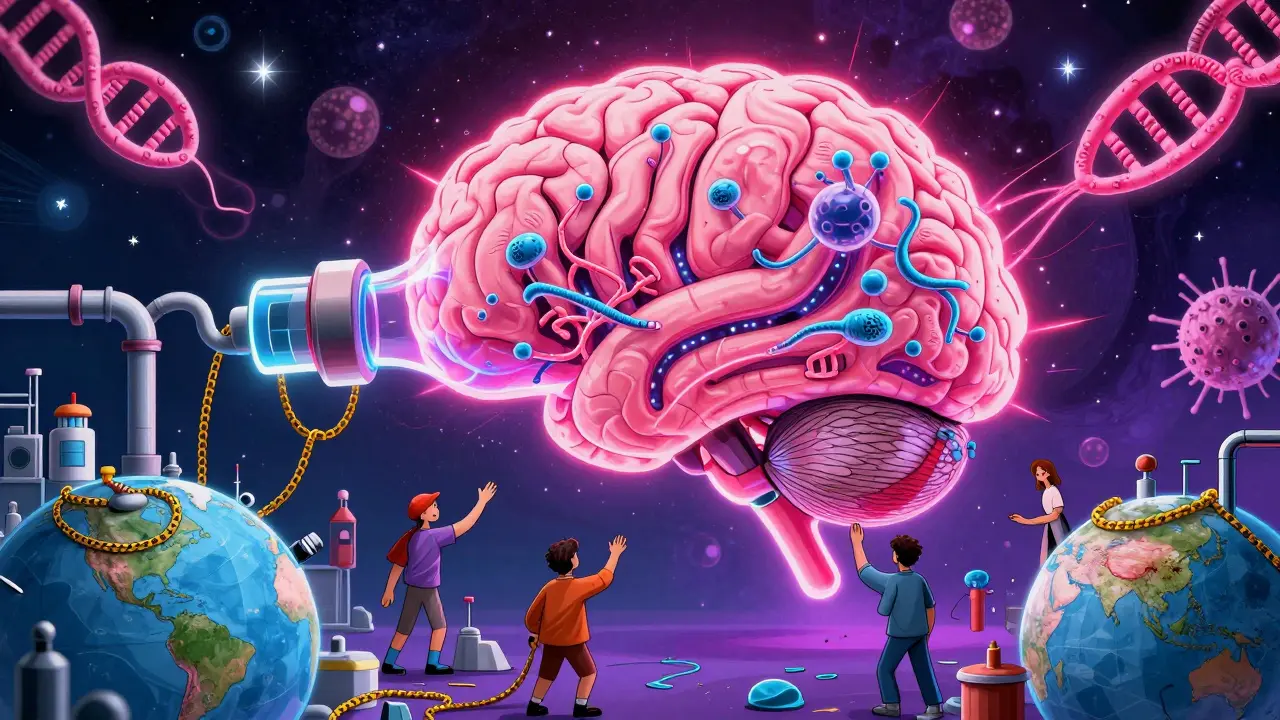
When people talk about generic vaccines, they’re imagining something like generic pills-cheaper, widely available, and easy to copy. But vaccines aren’t pills. They’re not chemical compounds you can reverse-engineer in a lab. They’re biologics-living, complex molecules made from cells, viruses, or proteins. And that changes everything about how they’re made, who can make them, and who gets them.
Why There’s No Such Thing as a ‘Generic Vaccine’
You can’t just copy a vaccine the way you copy a painkiller. A generic ibuprofen tablet has the same active ingredient, same dosage, same effect. But a vaccine? It’s not just about the ingredient. It’s about how it’s grown, purified, stabilized, and delivered. Take mRNA vaccines like Pfizer’s or Moderna’s. They need lipid nanoparticles to protect the fragile genetic material. Those lipids? Only five or seven companies worldwide can make them at the scale and purity required. If you don’t have access to those, you can’t make the vaccine-even if you have the recipe.
The U.S. FDA doesn’t even have a shortcut process for vaccines like it does for small-molecule drugs. For regular drugs, manufacturers can use the Abbreviated New Drug Application (ANDA) to prove bioequivalence. But vaccines? You need a full Biological License Application. That means starting from scratch: testing every batch, proving safety, validating every step of production. It’s not a matter of copying. It’s a matter of rebuilding.
The Manufacturing Maze: Cold Chains, Containment, and Capital
Building a vaccine factory isn’t like building a drug plant. It requires biosafety level 2 or 3 labs. Temperature-controlled rooms. Ultra-cold freezers for mRNA vaccines that need -70°C. Specialized equipment for cell culture, filtration, and formulation. Each batch can take six to twelve months to produce. And the cost? A single production line can run over $500 million. That’s not a startup expense. That’s a national infrastructure project.
India’s Serum Institute of India (SII) is the world’s largest vaccine manufacturer by volume. It produces 1.5 billion doses a year across 11 facilities. But even SII couldn’t keep up during the pandemic. When global demand hit 11 billion doses, it was like trying to fill a swimming pool with a garden hose. And SII’s biggest challenge wasn’t capacity-it was supply. Nearly 70% of its raw materials, from cell culture media to lipid nanoparticles, come from China and Europe. When the U.S. restricted exports of those materials during India’s 2021 surge, global vaccine production dropped by half.
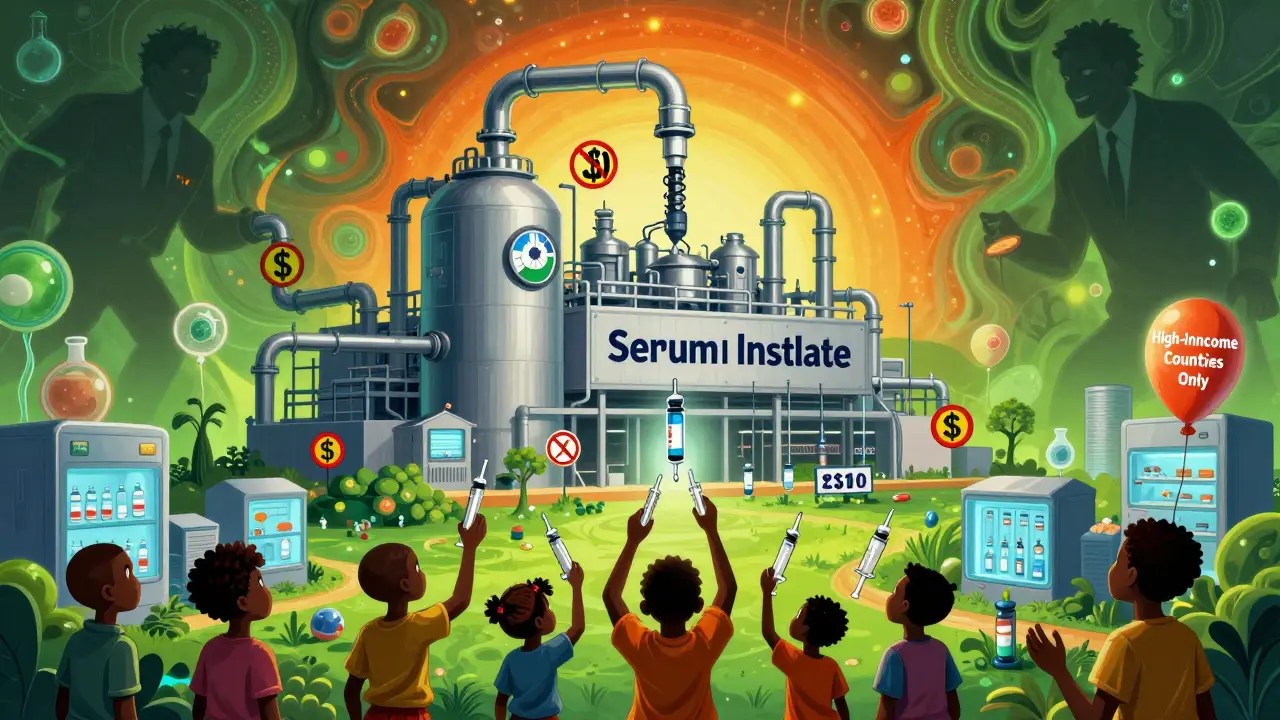
Who Makes the World’s Vaccines? And Who Gets Them?
Five companies-GSK, Merck, Sanofi, Pfizer, and Johnson & Johnson-controlled 70% of the $38 billion global vaccine market in 2020. They’re not just big. They’re entrenched. Their patents, supply chains, and regulatory relationships create a moat no new player can easily cross.
Meanwhile, India produces 60% of the world’s vaccine volume. It supplies 90% of the WHO’s measles vaccines, 70% of its DPT, and 40-70% of its BCG. But here’s the twist: Africa imports 99% of its vaccines. Despite being home to the world’s largest vaccine manufacturer, the continent produces less than 2% of its own needs. In 2021, 83% of the 1.1 million COVID-19 doses delivered to Africa through COVAX went to just 10 countries. Twenty-three African nations had vaccinated fewer than 2% of their people.
It’s not a shortage of skill. It’s a shortage of control. Indian manufacturers make vaccines for the world, but they don’t decide who gets them. High-income countries pre-bought 86% of the first COVID-19 doses. Low-income countries waited months. In the Democratic Republic of Congo, health workers received doses expiring in two weeks-with no cold chain to store them.
Technology Transfer: Promises vs. Reality
The WHO set up a technology transfer hub in South Africa in 2021, partnering with BioNTech to teach African manufacturers how to make mRNA vaccines. The goal? Local production. The reality? Eighteen months later, they were still struggling to source the right equipment. Lipid nanoparticles. Bioreactors. Precision filling machines. Many of these aren’t sold on open markets. They’re locked behind long-term contracts with a handful of suppliers.
Even when the tech is shared, the materials aren’t. Dr. Gagandeep Kang from Christian Medical College Vellore put it plainly: India has 500 API manufacturers, but imports 70% of its vaccine raw materials from China. Without control over inputs, you can’t control output.
The African Union estimates it will take $4 billion and 10 years to get Africa to 60% self-sufficiency. That’s not impossible. But it’s not happening fast enough. Meanwhile, the U.S. FDA launched a pilot in 2025 to fast-track generic drug approvals for manufacturers based in the U.S.-a move that highlights how deeply countries are now thinking about supply chain security. But for vaccines? No such program exists for low-income countries.
Price Isn’t the Problem-Power Is
Some argue that if only vaccines were cheaper, access would improve. But the problem isn’t price alone. It’s pricing power.
Generic drugs can drop 80-90% in price after a few competitors enter the market. Vaccines? Not so much. Gavi, the Vaccine Alliance, reported that even after pressure, the pneumococcal conjugate vaccine cost low-income countries over $10 per dose-while Western manufacturers sold it for $15-20. SII made the AstraZeneca vaccine for $3-4 per dose. But that wasn’t profit. It was barely enough to cover costs. No manufacturer, even one as large as SII, can afford to build a $500 million facility and operate on pennies per dose.
And when export restrictions hit-like when India halted vaccine exports in April 2021 during its second wave-global supply shrank overnight. The world learned a hard lesson: vaccine production isn’t a global public good. It’s a national priority.
What’s Next? Can Equity Be Built?
The mRNA hub in South Africa produced its first vaccines in September 2023. A milestone. But its capacity? 100 million doses a year. Global demand? Over 4 billion. That’s less than 2.5% of need.
There are models for change. SII proved that high-volume, low-margin production works. BioNTech and Moderna showed how innovation can scale fast. Oxford’s partnership with AstraZeneca proved that non-profit licensing can accelerate access. But these aren’t systems. They’re exceptions.
True equity won’t come from charity. It won’t come from donations. It will come from building local capacity-with real investment, real technology transfer, and real control over supply chains. Until then, the world will keep facing the same crisis: the people who need vaccines the most are the last to get them-not because they’re not made, but because they’re not owned.



Aileen Nasywa Shabira
March 19, 2026 AT 20:01So let me get this straight - we’re acting like vaccines are some magical unicorn potion that only five corporations can conjure? Meanwhile, India churns out 60% of the world’s vaccines but can’t even sell them because the U.S. decided to hoard lipid nanoparticles like they’re gold bars? Classic. Just classic.
And don’t even get me started on the WHO’s ‘tech transfer hub’ in South Africa. You gave them a recipe but forgot to send the ingredients. It’s like handing someone a Ferrari manual and saying ‘go build one’ while locking all the tire factories in your garage.
It’s not about cost. It’s about control. And the people who control the inputs? They’re not trying to save lives. They’re trying to save market share.
Next up: ‘generic oxygen.’ Let’s see how long it takes for Big O2 to patent the air we breathe.
lawanna major
March 19, 2026 AT 23:56This is one of the most important pieces I’ve read this year - not because it’s shocking, but because it’s painfully obvious once you see it.
Vaccines aren’t pills. They’re ecosystems. Every step - from the cell line to the cold chain to the vial filling machine - is a fragile thread. Break one, and the whole system frays.
The tragedy isn’t that low-income countries can’t afford vaccines. It’s that they can’t afford to *build the systems* to make them. And we’ve spent decades treating health equity like charity, not infrastructure.
India’s Serum Institute isn’t a miracle. It’s a testament to what’s possible when you combine scale, discipline, and global demand. But it shouldn’t be the exception. It should be the model.
We don’t need more donations. We need more sovereignty. Local production isn’t a luxury - it’s a basic human right in a world where pandemics don’t respect borders.
And yet, when we talk about ‘global health,’ we still talk about who gets the leftovers. Not who gets to decide what’s made, how, and for whom.
The real question isn’t ‘why aren’t vaccines cheaper?’ It’s ‘why are we still letting others control the levers of life?’
Ayan Khan
March 21, 2026 AT 05:08As someone from India who grew up seeing the Serum Institute as a point of national pride, this article hits differently.
We make vaccines for the world, but we don’t get to decide who gets them. We export BCG, DPT, measles - but when COVID hit, our own people waited while rich nations snapped up every dose.
The problem isn’t our capacity. It’s our vulnerability. We import 70% of our raw materials. One export ban from Europe or China, and entire production lines go silent.
It’s not about being anti-globalization. It’s about being anti-exploitation.
We need to stop seeing vaccine production as a service industry and start treating it as strategic infrastructure - like roads, power, or water.
And yes, Africa’s 2% self-production rate is a moral failure. But it’s not because they lack skill. It’s because they’ve been systematically excluded from the table where decisions are made.
Real equity means letting countries own the factories, not just the labels.
Manish Singh
March 22, 2026 AT 05:53I’ve worked in vaccine logistics in rural India. I’ve seen vials sit in trucks for days because the cold chain broke. I’ve watched health workers cry because they had doses but no way to store them.
This isn’t about money. It’s about dignity.
When you send a shipment labeled ‘donation’ with an expiration date two weeks away, you’re not helping. You’re performing charity - and making people dependent on your timing, your politics, your mood.
SII can make 1.5 billion doses a year. But if the lipid nanoparticles come from Germany and the bioreactors from the U.S., then you’re not building resilience. You’re building a house on sand.
Real change isn’t in more aid. It’s in letting people build their own supply chains. With their own rules. Their own equipment. Their own power.
Michelle Jackson
March 22, 2026 AT 10:48so like… vaccines are just too hard to copy? lol. okay. so why do we have generic pills then? if we can copy ibuprofen, why not the vaccine? is it because the big pharma execs are just too scared of competition? or is it because they’re literally scared of science? idk man. just saying. this whole thing feels like a scam. also, why does africa get expired doses? like… are we just… dumping? 🤔
Suchi G.
March 23, 2026 AT 10:15I just cried reading this.
I remember when my cousin in Bihar got her first COVID shot - it was from SII, labeled ‘Made in India,’ but the vial had a sticker from WHO saying ‘Donated by Gavi.’ She didn’t know what Gavi was. She just smiled because she was finally safe.
But then I found out the dose was one of the last ones left over from a shipment meant for Europe that didn’t get used. It was sitting in a fridge in Delhi for three weeks before being shipped out. No one told her. No one told her it was a leftover. No one told her the system had failed her twice - first by not giving her timely access, then by giving her something meant for someone else.
And the worst part? She was proud. She said, ‘India made this.’ And I didn’t have the heart to tell her that India didn’t make the lipids. Didn’t make the machines. Didn’t make the rules.
How do we fix this? How do we stop making people grateful for scraps?
I want to scream. I want to build a factory. I want to rewrite the rules.
But I don’t know how. And that’s the most terrifying part.
becca roberts
March 24, 2026 AT 21:47Let’s be real - the whole ‘generic vaccine’ idea was always a fantasy. It’s not that we’re being evil. It’s that biology is messy. You can’t patent a pill. You can patent a *process* - and that’s what the big players own.
And yeah, the U.S. FDA doesn’t have a shortcut. But guess what? They don’t need one. They have the market. They have the suppliers. They have the political leverage.
Meanwhile, the WHO hub in South Africa? Cute. 100 million doses a year? That’s like trying to fill the Pacific with a teacup.
And here’s the kicker: no one’s talking about the fact that the same companies that control vaccine production also control the diagnostics, the therapeutics, and the supply chain logistics. It’s not a monopoly. It’s a *system*.
So no, it’s not about price. It’s about who gets to decide what ‘health’ even means.
And right now? It’s not us.
Andrew Muchmore
March 26, 2026 AT 05:36Complex biologics require complex infrastructure. That’s not a bug. It’s a feature.
But the system is rigged. The rich build factories. The poor beg for scraps.
Fix the supply chain. Not the price.
Paul Ratliff
March 26, 2026 AT 05:59india makes most of the world’s vaccines but can’t even make its own lipid nanoparticles? that’s wild. we’re all just pawns in a game where the board is owned by 5 companies and the dice are rolled by the u.s. and eu. sad but true.
SNEHA GUPTA
March 27, 2026 AT 15:45It’s funny - we talk about open-source software, open-access journals, open science. But when it comes to vaccines, the idea of open-source biology is treated like heresy.
Why? Because biology is profitable. Because patents are power. Because control over life-saving tools is the ultimate currency.
India’s success with SII proves that high-volume, low-margin production works. But it also proves that even the most capable nations are still dependent on foreign inputs. That’s not sovereignty. That’s vulnerability dressed as capability.
True equity means letting every region build its own supply chain - not just its own production line.
It means letting African countries import bioreactors without waiting for a U.S. export license.
It means letting South African engineers calibrate their own filling machines - not have them shipped from Germany with a 12-month wait.
It’s not about charity. It’s about justice.
And justice doesn’t come in vials. It comes in factories.
Gaurav Kumar
March 29, 2026 AT 12:59Let’s be honest - the West wants to keep vaccines as their exclusive club. India? We’re just the factory. Africa? Just the recipient. And they wonder why we’re angry?
Look, I’m proud of SII. But proud doesn’t mean happy. We’re the world’s vaccine pharmacy - and we’re not even allowed to set the price. We’re not allowed to decide who gets what. We’re not even allowed to make our own lipids.
China and Germany control the inputs. The U.S. controls the patents. The WHO controls the charity. And we? We just assemble.
10 years and $4 billion to get Africa to 60% self-sufficiency? That’s a joke. It should’ve been done in 5. With half the money. If we had real political will.
But we don’t. Because the moment you let the Global South build real capacity - you lose control.
And they’re not going to give that up.
So keep sending expired doses. Keep calling it ‘aid.’ We’ll keep making the vaccines. And one day, we’ll stop asking for permission.
India doesn’t need your permission. We’re already the world’s vaccine engine.
Now let us fuel ourselves.