

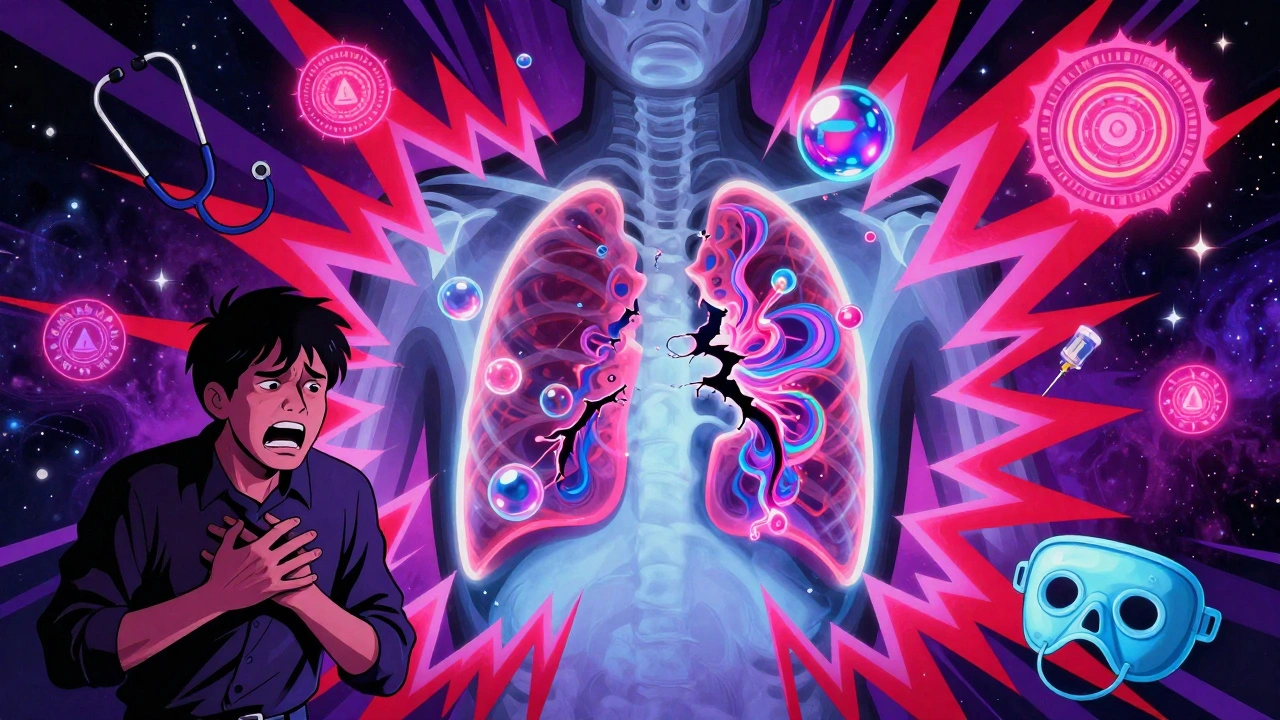
When your lung suddenly stops working right, it’s not something you can ignore. A pneumothorax - or collapsed lung - doesn’t sneak up quietly. It hits like a punch to the chest. One moment you’re breathing normally; the next, you can’t catch your breath, and pain pins you in place. This isn’t just a bad cough or a pulled muscle. It’s a medical emergency that can turn deadly in minutes if missed.
What Happens When a Lung Collapses?
Your lungs are wrapped in a thin, slippery membrane called the pleura. Normally, there’s no air between the lung and this membrane. But when air leaks out - from a burst blister, a trauma, or even without warning - it fills that space. That air pushes against the lung like a balloon being squeezed from the outside. The lung can’t expand when you breathe in. That’s a pneumothorax. It’s not rare. About 1 in 5,000 people will get one in a given year. Young, tall men who smoke are at highest risk. But it can happen to anyone - even someone with no lung disease. The key is knowing the signs before it turns into something worse.How Do You Know It’s a Collapsed Lung?
The symptoms are sharp, clear, and hard to mistake. You won’t confuse this with heartburn or muscle strain.- Sharp, stabbing chest pain - usually on one side, worse when you breathe in or cough. It often shoots up into your shoulder. Studies show this happens in over 90% of cases.
- Sudden shortness of breath - even if you were just sitting still. If your oxygen level drops below 92%, that’s a red flag. You might feel like you’re breathing through a straw.
- Fast heartbeat - your heart races because your body is screaming for oxygen. Over 134 beats per minute is a sign the situation is worsening.
- Cold, clammy skin or bluish lips - this means your body isn’t getting enough oxygen. It’s a late but critical warning.
Emergency Care: What Happens in the ER?
Time isn’t just money here - it’s life. The clock starts the moment symptoms hit.- If you’re unstable - low blood pressure, oxygen under 90%, rapid heart rate - doctors don’t wait. They stick a needle into your chest right away. This releases the trapped air and gives your lung room to breathe again. It’s not fancy. It’s life-saving.
- If you’re stable - breathing okay, oxygen above 92% - they’ll take an X-ray. But even then, if you’re in pain and struggling, they won’t wait days. A rim of air over 2 cm on the X-ray? That’s a 50% collapse. That needs treatment.
- Ultrasound is changing the game - in many ERs, they use a handheld ultrasound probe to find the “lung point,” where the lung stops moving. It’s faster than an X-ray and just as accurate in trained hands.
- Small collapse (under 30%) - you might just get oxygen and go home. Your body can reabsorb the air over 1-2 weeks. But you’ll need a follow-up X-ray.
- Larger collapse - they’ll insert a chest tube. It’s a small plastic tube threaded between your ribs to drain the air. You’ll stay in the hospital for a few days.
- Recurrent cases - if it happens again, surgery is usually the answer. A video-assisted thoracoscopic surgery (VATS) removes the weak spots and sticks the lung to the chest wall. It cuts recurrence risk from 40% down to 5%.
What Causes It?
Not all collapsed lungs are the same. The cause changes how it’s handled.- Primary spontaneous - happens in healthy people, usually young men. Often from tiny air blisters (blebs) on the lung surface that burst. No underlying disease.
- Secondary spontaneous - linked to lung disease like COPD, cystic fibrosis, or pneumonia. These cases are more dangerous. One-year mortality hits 16%.
- Traumatic - from car crashes, stab wounds, broken ribs. Air gets in from outside.
- Iatrogenic - caused by medical procedures. Think lung biopsy, central line placement, or even CPR.
Recovery and Prevention
You can’t just walk away after treatment. This isn’t over.- Stop smoking - this is the single biggest thing you can do. Quitting cuts your chance of it coming back by 77% in a year.
- Avoid flying - for at least 2-3 weeks after recovery. The change in cabin pressure can make air expand and re-collapse your lung.
- Never scuba dive - unless you’ve had surgery to prevent it. The pressure changes underwater are deadly for anyone who’s had a collapsed lung before.
- Follow up - get that repeat X-ray in 4-6 weeks. About 8% of people develop complications if they don’t.
When to Call 000 (or 911)
Don’t wait. Don’t hope it gets better. Don’t drive yourself to the hospital. Call emergency services immediately if you have:- Sudden, severe chest pain that doesn’t go away
- Difficulty breathing - so bad you can’t speak in full sentences
- Lips or fingers turning blue
- Dizziness, fainting, or cold sweat
Why This Matters More Than You Think
Most people think a collapsed lung is rare. But in Australia, with high rates of smoking and aging populations, it’s more common than you’d guess. And the longer you wait, the higher the risk of complications. Studies show every 30-minute delay in treatment increases the chance of serious problems by 7.2%. That’s not a small number. That’s the difference between a quick recovery and months in the hospital. And if you’ve had one before? Your odds of having another are high - up to 40% within two years. But surgery can bring that down to near zero. This isn’t just about treating a symptom. It’s about protecting your future ability to breathe - to run, to climb stairs, to play with your kids, to live without fear.Can a collapsed lung heal on its own?
Yes, but only if it’s small - under 30% of the lung collapsed. In those cases, your body can slowly reabsorb the air over 1-2 weeks, especially if you’re given extra oxygen. But you still need monitoring. A chest X-ray after a week or two confirms it’s fully gone. If it’s larger, or you’re short of breath, you won’t heal on your own. You’ll need a chest tube or needle.
Is pneumothorax the same as a pulmonary embolism?
No. A pulmonary embolism is a blood clot blocking an artery in the lung. It causes sudden shortness of breath and chest pain too, but it’s not air trapped outside the lung. It’s a clot inside. The treatments are completely different. Doctors use imaging and blood tests to tell them apart. But both are emergencies.
Can you get pneumothorax from coughing too hard?
Yes - especially if you have weak spots in your lung tissue, like blebs. A violent cough can rupture them. This is more common in tall, thin people or those with underlying lung disease. It’s rare in healthy young adults without risk factors, but it happens. If you feel sharp pain during a coughing fit and then can’t breathe, don’t ignore it.
Does smoking really increase the risk so much?
Extremely. Smoking increases your risk by over 20 times compared to non-smokers. It damages lung tissue, weakens the walls of air sacs, and makes blebs more likely to form and burst. Quitting doesn’t just lower your risk - it cuts it by 77% in the first year. No other single action does more to prevent recurrence.
What’s the recovery time after chest tube insertion?
Most people stay in the hospital 3-5 days. The tube stays in until no more air is leaking and the lung is fully expanded. After removal, you’ll feel sore for a week or two, but you can usually return to light activities in 2-3 weeks. Avoid heavy lifting or strenuous exercise for 4-6 weeks. Full healing takes about 6 weeks. Follow-up X-rays are required to make sure the lung stays inflated.
Can you fly after having a pneumothorax?
Not for at least 2-3 weeks after full recovery, confirmed by X-ray. Cabin pressure changes during flight can cause any remaining air to expand and re-collapse your lung. Some airlines require a doctor’s note. If you’ve had surgery to prevent recurrence, you may be cleared earlier - but always check with your doctor first. Scuba diving is permanently off-limits unless you’ve had definitive surgery.


Vivian Amadi
December 11, 2025 AT 19:40Taylor Dressler
December 12, 2025 AT 01:58Courtney Blake
December 13, 2025 AT 21:41Sylvia Frenzel
December 15, 2025 AT 01:53Lisa Stringfellow
December 15, 2025 AT 03:41Eddie Bennett
December 16, 2025 AT 17:45john damon
December 17, 2025 AT 20:35Monica Evan
December 18, 2025 AT 22:22Aidan Stacey
December 20, 2025 AT 02:44Katherine Liu-Bevan
December 22, 2025 AT 00:01Paul Dixon
December 22, 2025 AT 20:24Jimmy Kärnfeldt
December 22, 2025 AT 23:30Ariel Nichole
December 23, 2025 AT 01:39