


Heart Attack Risk Calculator
Estimate your 10-year risk of a heart attack using evidence-based guidelines. This tool demonstrates how patient decision aids help you understand your personal risk before discussing medications like statins.
As shown in the article: 35% of people who used a decision aid changed their statin decision after understanding their actual risk.
Example: One patient's risk was 7.2% (not "high risk"), preventing unnecessary medication.
Enter your details above to see your personalized risk estimate.
What matters most to you?
This exercise demonstrates how patient decision aids help align treatment with your personal values.
What Are Patient Decision Aids, and Why Do They Matter for Medication Safety?
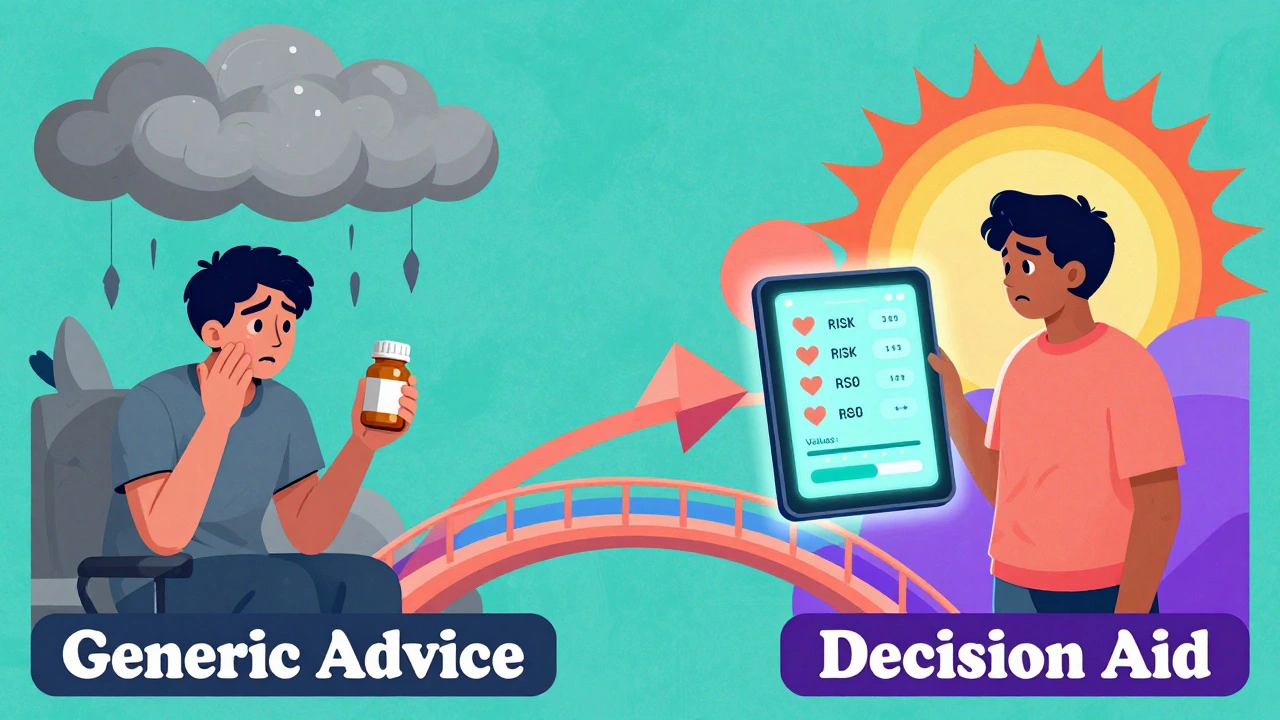
Picture this: your doctor says you need a statin. You’ve heard they can cause muscle pain. You’re not sure if the benefit is worth it. You leave the office feeling confused, unsure if you made the right call. Now imagine you’d used a patient decision aid before that appointment. It showed you your actual 10-year heart attack risk-7.2%, not "high risk"-and walked you through what side effects really mean for someone like you. You walked out confident, not confused.
That’s the power of patient decision aids (PDAs). These aren’t just brochures or websites. They’re structured, evidence-based tools designed to help people make better choices about their medications by clearly laying out the options, risks, benefits, and what matters most to them. Unlike generic handouts, PDAs include interactive elements like risk calculators and values clarification exercises. They don’t tell you what to do-they help you figure out what’s right for you.
And when it comes to medication safety, that difference is huge. Medication errors aren’t just about wrong doses or mix-ups. A big part of the problem is patients starting, stopping, or skipping meds because they don’t truly understand why they’re taking them. PDAs fix that by turning passive recipients into active participants. Studies show patients who use them are 17.3% more likely to stick with their meds six months later. That’s not a small win-it’s life-changing for people with diabetes, high blood pressure, or heart disease.
How Do Patient Decision Aids Actually Work?
Patient decision aids follow a strict set of standards called IPDAS-International Patient Decision Aids Standards. Think of it like a recipe. To be valid, a PDA must include five key ingredients:
- Clear, balanced info on all treatment options-including doing nothing
- Numbers you can understand: not "high risk," but "1 in 10 people experience this side effect"
- Visuals like charts or icons that show risk without jargon
- A values clarification exercise: "What matters more to you-avoiding a heart attack or avoiding side effects?"
- A summary to take home, so you don’t forget what you learned
Most modern PDAs are digital. You might use one on your phone before your appointment. Some even pull data from your electronic health record to personalize your risk numbers. For example, if you’re 62, have high cholesterol, and smoke, the tool calculates your exact risk of a heart attack in the next 10 years-not a guess, not a generalization. It’s your risk.
One of the most effective tools is the "Statin Choice" aid. In trials, 35% of people who started out wanting to take statins changed their mind after using it. Not because they were scared-because they realized their risk was low enough that side effects might outweigh the benefit. Others who were hesitant ended up choosing statins because they finally understood their real risk. That’s not indecision. That’s informed choice.
What Does the Evidence Say? Real Numbers, Real Impact
Over 80 randomized trials have looked at patient decision aids. The results aren’t close-they’re clear.
- Patients who used PDAs scored 13.28 points higher on medication knowledge tests than those who just got verbal advice.
- Decisional conflict dropped by 8.7 points on average-meaning less anxiety, less second-guessing.
- Patients were 43% less likely to remain undecided after using a PDA.
- Medication adherence improved by up to 17.3% at six months, especially for chronic conditions like diabetes.
- In one Mayo Clinic study, adherence jumped from 58% to 75% after PDAs were added to their diabetes care pathway.
And it’s not just about feeling better. When patients understand their meds, they’re less likely to make dangerous mistakes. Skipping a blood thinner because you think it’s "not working"? Taking two pills because you forgot if you already took one? These aren’t just errors-they’re preventable.
Even more telling: 76 out of 86 studies showed PDAs improved at least one key part of decision-making. That’s not luck. That’s design.
Who Benefits the Most-and Who Doesn’t?
PDAs work best for preference-sensitive decisions. That means situations where there’s no single "right" answer, and what matters most is what the patient values.
Examples:
- Starting statins for moderate risk
- Choosing between insulin, GLP-1 agonists, or oral meds for type 2 diabetes
- Deciding whether to take anticoagulants for atrial fibrillation
- Whether to continue long-term opioids for chronic pain
But here’s the catch: PDAs don’t work equally for everyone. Patients with low health literacy, limited English, or cognitive challenges often need extra support. A digital tool with tiny text and complex charts won’t help someone who struggles to read. That’s why the best clinics pair PDAs with trained staff who use the "teach-back" method: "Can you explain to me in your own words why you’re taking this med?"
Also, PDAs aren’t magic in emergencies. If someone’s having a heart attack, they don’t need a decision aid-they need treatment. But for planned, ongoing care? They’re essential.
One patient on Reddit put it perfectly: "The statin decision aid helped me understand my actual 10-year CVD risk was 7.2%, not the ‘high risk’ my doctor mentioned-this prevented me from starting unnecessary medication with potential side effects." That’s safety. That’s empowerment.
How Clinics Are Actually Using Them-And What Gets in the Way
Using PDAs isn’t as simple as handing someone a tablet. It takes planning.
Successful clinics do three things:
- Pre-visit distribution: Send the PDA link via patient portal before the appointment. That way, the visit isn’t about explaining-it’s about discussing.
- Training providers: Doctors and nurses need 2-3 hours of training to learn how to guide the conversation, not just hand out the tool.
- Integration with EHRs: Tools that sync with electronic records (using FHIR APIs) auto-fill patient data, making the aid more accurate and faster to use.
But challenges remain. Time is the biggest one. Adding a PDA to a 15-minute visit can stretch it to 20-25 minutes. Some clinics solve this by having nurses introduce the tool first. Others use it for follow-ups.
Another issue? Reimbursement. Medicare now pays for shared decision-making in some cases, but most insurance plans still don’t cover the time it takes. That’s why adoption is still uneven. In 2015, only 12% of U.S. primary care doctors used PDAs. By 2022, it was 37%. That’s progress-but there’s still a long way to go.
Top health systems like Mayo Clinic, Kaiser Permanente, and the VA have made PDAs standard in cardiology, endocrinology, and oncology. Why? Because they saw the numbers: fewer medication errors, higher adherence, better patient satisfaction.

The Future: AI, Personalization, and Regulation
The next wave of patient decision aids is smarter. The NIH is funding a new system that uses your EHR data-your age, lab results, medications, even your sleep patterns-to build a custom risk profile. It’s not just "what’s true for most people"-it’s "what’s true for you."
The FDA now recognizes certain decision aids as part of medication labeling for complex drugs. That means when a new diabetes drug comes out, the manufacturer might include a validated PDA as part of the prescribing package.
By 2025, CMS plans to require PDAs for 12 more clinical scenarios. By 2027, experts predict 75% of high-stakes medication decisions will involve one.
And the market is growing fast. The global PDA market was $127 million in 2022. By 2028, it’s expected to hit $386 million. That’s not hype-it’s demand. Clinicians are tired of patients leaving confused. Patients are tired of being talked at, not talked with.
Where to Start: Free, Validated Tools You Can Use Today
You don’t need a fancy hospital system to use a decision aid. The Ottawa Hospital Research Institute’s Decision Aids Library offers 107 free, IPDAS-certified tools. All are evidence-based, available in multiple languages, and work on phones.
Popular ones include:
- Statin Choice - For people considering cholesterol meds
- Diabetes Medication Choice - Compares insulin, metformin, GLP-1s, and more
- Blood Thinners for Atrial Fibrillation - Helps weigh stroke risk vs. bleeding risk
Just search for the condition + "decision aid". Most are free, no login needed. Print them. Share them. Use them before your next appointment.
Final Thought: It’s Not About Making Decisions Faster. It’s About Making Them Right.
Medication safety isn’t just about pills and dosages. It’s about understanding. It’s about trust. It’s about knowing why you’re taking something-and feeling okay about it.
Patient decision aids don’t replace doctors. They make doctors better. They don’t replace judgment-they support it. And for patients? They turn fear into confidence, confusion into clarity, and silence into voice.
If you’re on a medication you don’t fully understand, ask for a decision aid. If you’re a provider, start with one tool. One conversation. One patient who finally gets it. That’s how change begins.




Jamie Clark
December 13, 2025 AT 21:54Let’s be real-this whole PDA thing is just another layer of bureaucratic theater wrapped in fancy jargon. We’re talking about human beings making life-or-death choices with a digital quiz that thinks it knows what ‘values’ mean. You don’t need a chart to know if you’re scared of side effects. You just know. And if your doctor can’t explain statins in under two minutes without sounding like a pharmaceutical rep, then they shouldn’t be prescribing them. This isn’t empowerment-it’s distraction. The system’s broken. Stop automating empathy.
Alvin Montanez
December 14, 2025 AT 09:07Wow. Just… wow. I’ve been reading medical literature for over 20 years and this is the most comprehensive, beautifully articulated case for patient-centered care I’ve seen in a decade. You nailed it. The IPDAS framework isn’t just a checklist-it’s a moral imperative. The fact that 76 out of 86 studies showed improvement across decision-making metrics? That’s not statistical noise. That’s systemic transformation. And the statin choice tool? I’ve used it with my own patients. One guy, 64, smoker, borderline cholesterol-he walked out saying, ‘I thought I was a ticking time bomb, but now I see I’m just… a guy who needs to quit smoking.’ That’s not compliance. That’s liberation. The 17.3% adherence boost? That’s not a number. That’s lives saved. People skip meds because they feel like passive objects in their own bodies. PDAs turn them into authors of their health story. And honestly? If your doctor hasn’t offered you one, you’re being failed. Demand it. Print it. Bring it to your next visit. This isn’t optional. It’s essential.
Keasha Trawick
December 16, 2025 AT 05:31Okay, but imagine if your PDA could also detect when your provider is subtly gaslighting you into taking a drug they’re incentivized to push? Like, what if it had an AI layer that cross-referenced your EHR with the pharma company’s kickback disclosures? 🤯 We’re talking about a system where the algorithm knows your risk, but your doctor’s bonus depends on you taking the pill. The ‘values clarification’ exercise is cute-until you realize your values were shaped by 20 years of Big Pharma ads and insurance co-pays that make ‘doing nothing’ financially impossible. This tool doesn’t just inform-it interrogates. And if we’re gonna call it ‘empowerment,’ then let’s also name the power imbalance it’s trying to fix. Also, can we get a PDA for the doctors? Because half of them still think ‘high risk’ means ‘take this.’
Webster Bull
December 17, 2025 AT 05:53Just use it. Seriously. No fluff. If you’re on meds and confused? Go to Ottawa’s library. Search ‘statin choice.’ Do it before your appt. Print it. Bring it. Done. No need to overthink. It’s free. It works. Stop waiting for permission. Your health > their schedule.
Bruno Janssen
December 19, 2025 AT 05:11I read this and felt… nothing. Like, I know it’s good. I know it’s right. But I just… can’t. Too much info. Too many numbers. Too many words. I just want someone to tell me what to do. I don’t want to ‘clarify values.’ I just want to feel safe. Why does everything have to be so complicated?
Emma Sbarge
December 20, 2025 AT 10:05Look, I get the intent. But this isn’t about ‘empowerment.’ It’s about shifting responsibility onto patients who don’t have the time, education, or mental bandwidth to navigate a broken system. We’re asking grandma with 4 meds and 2 chronic conditions to fill out a 20-minute interactive quiz because the system won’t pay the doctor to explain it. That’s not innovation. That’s austerity dressed up as progress. And don’t get me started on ‘FHIR APIs’-you think people in rural Alabama are syncing their EHRs? This is tech-bro medicine for people who can afford to care. Real safety means better staffing, not better apps.
Tommy Watson
December 21, 2025 AT 00:25So basically… we’re paying people to watch a video before seeing their doctor so the doctor can charge more? And this is called ‘safety’? Bro. I’ve been on blood thinners for 8 years. I didn’t need a ‘values clarification’-I needed someone to tell me if I could still drink beer. This whole thing feels like a marketing campaign for a startup that got VC funding. Also, why is the ‘Statin Choice’ tool the only one they list? Coincidence? I think not. Pharma’s got their fingerprints all over this. Just saying.
Donna Hammond
December 22, 2025 AT 10:08I’m a nurse practitioner in a community clinic, and I’ve been using PDAs for three years now. The difference isn’t in the numbers-it’s in the silence. Before, patients would leave nodding, but their eyes said, ‘I don’t get it.’ Now? They sit down, open the tool on their phone, and say, ‘I didn’t realize my risk was only 5.8%.’ And then they ask questions. Real ones. Like, ‘Will this make me too tired to play with my grandkids?’ That’s the moment it works. We don’t need perfect tech-we need trained humans who know how to hold space while the tool does the heavy lifting. The VA started this in cardiology. We copied it. Now we’re seeing fewer ER visits for missed doses. Fewer calls at 2 a.m. asking if they should skip their pill. This isn’t magic. It’s just good care, made visible. If your provider hasn’t offered this, ask. Politely. But ask. And if they say no? Tell them Donna Hammond sent you.