

When you fill a prescription for a generic drug, you might think the price you see at the pharmacy is the full cost. But what your insurance company actually pays? That’s a different story-and it’s not always what you’d expect.
Generics don’t work like brand-name drugs
Most people assume all prescription drugs work the same way when it comes to pricing. That’s not true. Brand-name drugs often come with big rebates-sometimes 30% to 70% off the list price. These rebates are negotiated by pharmacy benefit managers (PBMs), who act as middlemen between drug makers, insurers, and pharmacies. The insurer pays the full list price upfront, then gets a chunk of that money back later as a rebate. It’s a system designed to make expensive drugs look cheaper on paper.Generics? They don’t play by those rules.
Why? Because there’s no reason to. Generic drugs are made by multiple manufacturers. They’re copies of expired brand-name drugs, and they compete on price. That competition keeps the list price low-often under $10 for a 30-day supply. With prices already this low, there’s almost no room for big rebates. In fact, the U.S. Government Accountability Office found that when rebates do happen on generics, they’re usually just 2% to 5% of the list price. Compare that to the 30%-70% rebates on brand-name drugs. That’s not a difference in degree-it’s a difference in system.
What insurance really pays for generics
So if there’s no rebate, how does insurance pay for generics?The answer lies in something called spread pricing.
Here’s how it works: Your insurance plan agrees to reimburse the pharmacy a certain amount-for example, $8.50-for a generic pill. But the pharmacy’s actual cost to buy that pill from the wholesaler might be only $4.25. The $4.25 difference? That’s the spread. And it doesn’t go to the pharmacy. It goes straight to the PBM.
This isn’t a rebate. It’s not a discount. It’s a hidden profit. The insurer thinks they’re paying $8.50. The pharmacy gets $4.25. The PBM pockets $4.25-and you never see a line item for it on your explanation of benefits.
According to the U.S. Department of Health and Human Services, the average spread on generic prescriptions in 2022 was $4.73 per fill. Multiply that by millions of prescriptions, and you’re talking about billions of dollars shifting from insurers-and ultimately, you-to PBM profits.
Why PBMs don’t want you to use generics
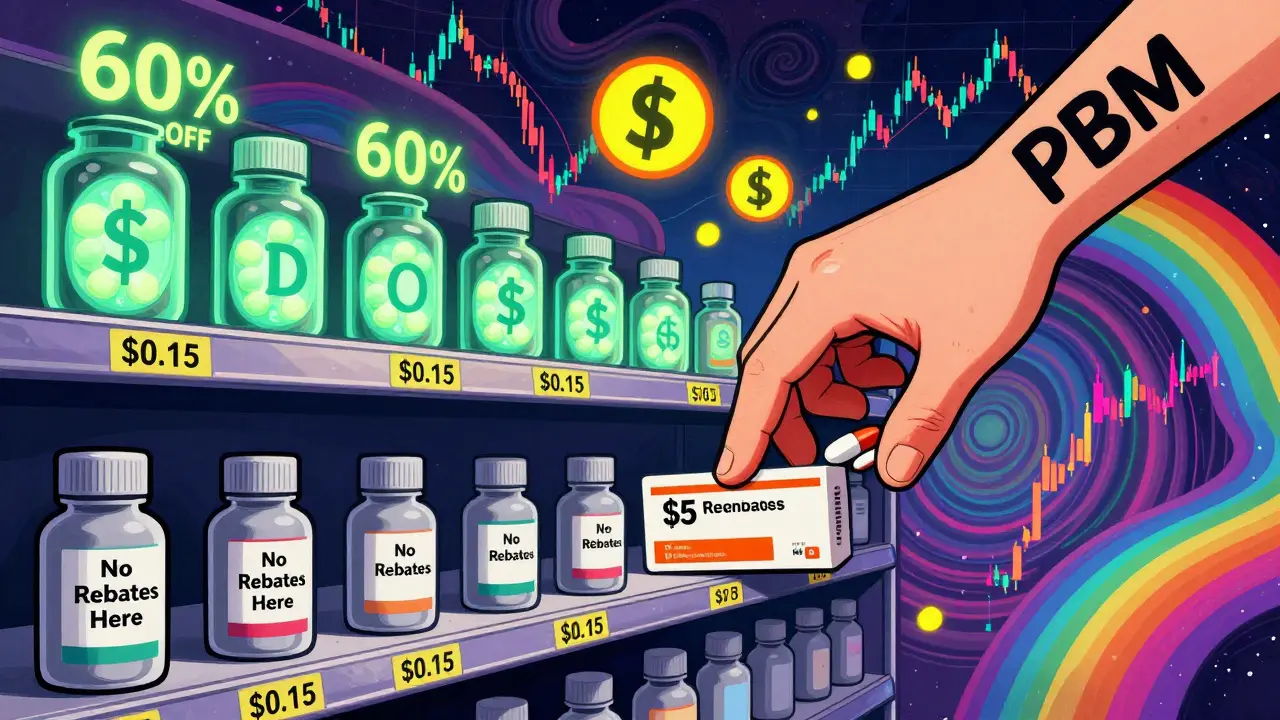
Here’s the twist: even though generics are cheaper, PBMs sometimes push you toward more expensive brand-name drugs.Why? Because those brand-name drugs come with big rebates. If a PBM gets a 60% rebate on a $50 brand-name drug, that’s $30 back. Even if the generic costs $1, the rebate on the brand-name drug can make the whole transaction more profitable for the PBM-even if the insurer ends up paying more overall.
A 2023 report from Rightway Healthcare found that PBMs frequently exclude low-cost generics from their formularies to keep brand-name drugs with high rebates in place. One employer case study showed a PBM blocking a $0.15-per-dose generic in favor of a $5.00 brand-name drug with a 60% rebate. Net result? The insurer paid more, the patient paid more, and the PBM made more.
This isn’t a glitch. It’s a design flaw. The system rewards PBMs for maximizing rebate income, not minimizing total drug costs. That’s why the Commonwealth Fund called it a “perverse incentive.”
The difference between list price and net price
You’ve probably seen drug prices advertised as “$500 per pill.” That’s the list price. It’s not what anyone actually pays. But for generics, there’s no list price to hide behind.For brand-name drugs, the list price is inflated to make rebates look bigger. For generics, the list price is usually just the wholesale cost. There’s no game. No manipulation. Just a low price set by competition.
But because PBMs control the reimbursement rate, they can still make the real cost look higher than it is. They set the reimbursement rate at $8.50, even though the drug costs $4.25. The insurance company thinks they’re paying $8.50. The pharmacy gets $4.25. The PBM keeps the rest.
That’s why employers and self-insured plans struggle to know what they’re really spending. A 2023 survey by the National Business Group on Health found that 68% of large employers couldn’t accurately track the net cost of generic drugs because PBMs refused to disclose acquisition prices.
What’s changing-and what’s not
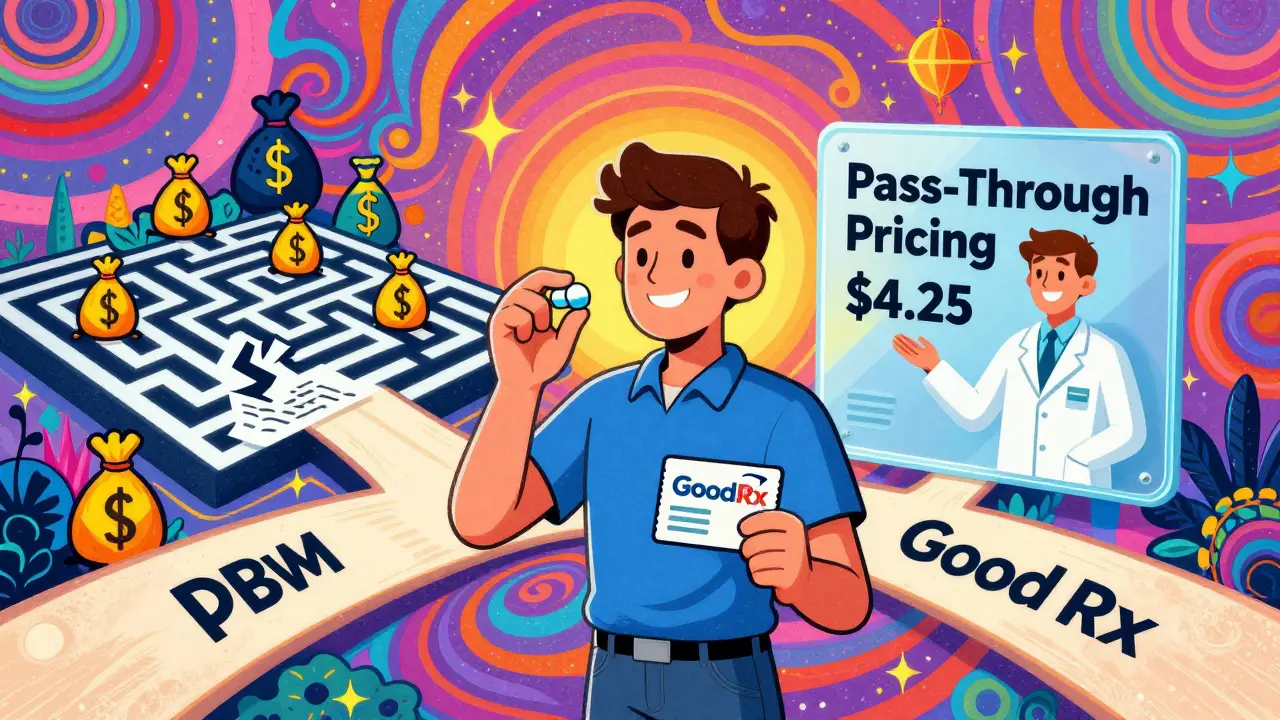
There’s pressure to fix this. The No Surprises Act of 2020 started forcing some transparency. The Biden administration’s 2024 executive order directed the Department of Health and Human Services to look into practices that limit generic use. And by 2026, new legislation is expected to require PBMs to fully disclose the true cost of generic drugs.Meanwhile, more employers are switching to “pass-through” pricing models. Instead of letting PBMs keep the spread, the insurer pays the pharmacy’s actual cost-plus a flat administrative fee. No hidden profits. No spread. Just transparency.
In 2020, only 18% of large employers used this model. By 2024, that number jumped to 42%. It’s not widespread yet-but it’s growing.
And here’s something important: Medicare’s new drug price negotiation program, which started in 2025, explicitly excludes generics. Why? Because lawmakers recognized that generics already work on competition, not rebates. The system is already designed to keep prices low. Adding negotiation would be redundant-and possibly disruptive.
What you can do
If you’re a patient, you have little direct control over PBM practices. But you can still protect yourself:- Always ask if a generic is available-even if your doctor didn’t suggest it.
- Check your plan’s formulary. If a generic is excluded, ask why. It might be because of a rebate deal, not medical necessity.
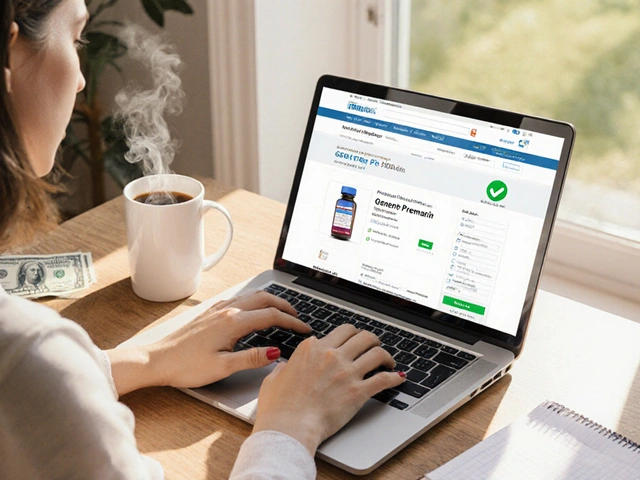
- Use tools like GoodRx or SingleCare to compare cash prices. Sometimes, paying cash is cheaper than using insurance because of how spreads work.
- If you’re an employer or plan sponsor, demand full cost transparency from your PBM. Ask for the actual acquisition cost of every generic drug on your formulary.
The bottom line: Insurance doesn’t pay rebates on generics. It pays spreads. And those spreads aren’t helping you save money-they’re lining the pockets of middlemen.
Generics are the most effective tool we have to lower drug costs. But as long as the system rewards opacity over transparency, their potential will be held back-not by science, but by finance.
Do generic drugs have rebates like brand-name drugs?
No, generic drugs rarely have rebates. Unlike brand-name drugs, which often come with 30%-70% rebates negotiated by pharmacy benefit managers (PBMs), generics are sold at low, competitive prices with little to no room for rebates. When rebates do occur, they’re typically only 2%-5% of the list price. The system for generics relies on direct pricing, not post-purchase discounts.
Why does my insurance pay more for a generic than what the pharmacy pays?
That difference is called “spread pricing.” Your insurance plan reimburses the pharmacy a set amount-say $8.50-but the pharmacy’s actual cost to buy the drug is lower, like $4.25. The $4.25 difference goes to the PBM, not the pharmacy. This is a hidden profit for the PBM, not a rebate to the insurer. It’s not disclosed on your explanation of benefits, which is why many people don’t realize it’s happening.
Are PBMs discouraging the use of generic drugs?
Yes, in some cases. PBMs make more money from rebates on expensive brand-name drugs than from low-cost generics. To maximize rebate income, some PBMs exclude generics from their formularies-even when they’re medically appropriate-so they can promote higher-priced drugs with bigger rebates. This is called a “perverse incentive,” and it’s been documented by the Commonwealth Fund and Rightway Healthcare.
Why are generics excluded from Medicare’s new drug price negotiation program?
Because generics are already subject to market competition. With multiple manufacturers producing the same drug, prices stay low without government intervention. The Inflation Reduction Act of 2022 specifically excludes generics from negotiation because they don’t need it-their pricing is already controlled by supply and demand, not monopolies.
How can I find out what my insurance really pays for my generic prescriptions?
You can’t always see it on your statement, but you can ask. If you’re covered through an employer, request a full breakdown of PBM contracts, including the acquisition cost of generics. If you’re an individual, compare the price you pay with cash prices on apps like GoodRx. If the cash price is lower than your insurance copay, your plan is likely using spread pricing. You might save money by paying cash instead.
Is there a movement to fix how generics are priced?
Yes. More employers are switching to “pass-through” pricing, where PBMs charge a flat fee instead of keeping the spread. In 2020, only 18% of large employers used this model. By 2024, that number rose to 42%. Legislation is also expected by 2026 to require PBMs to disclose the true acquisition cost of generic drugs. The goal is to end hidden profits and make pricing transparent.


Ron Williams
December 17, 2025 AT 00:57Man, I never realized how much of this was hidden. I just assumed my $5 copay was the whole story. Turns out I’m basically funding some middleman’s yacht without even knowing it. 🤷♂️
James Rayner
December 18, 2025 AT 16:35It’s wild, isn’t it?… The system is designed to make us think we’re saving money… but really, we’re just being played by invisible accounting tricks… and nobody talks about it… because if they did… we’d all be furious… and maybe… just maybe… we’d demand change…
Dave Alponvyr
December 18, 2025 AT 16:45So PBMs get rich off generics. Got it. So what’s the solution? Pay cash. Done.
Cassandra Collins
December 19, 2025 AT 20:30THIS IS A DEEP STATE PLOT. PBMs are working with Big Pharma to keep us sick. They don’t want you healthy-they want you on $500 pills so they can rake in rebates. They’re even hiding the truth from Congress. I’ve seen the documents. It’s all connected. #PBMControl
Joanna Ebizie
December 20, 2025 AT 01:24Of course they do this. These guys are just greed machines with office chairs. You think they care about your diabetes? Nah. They care about their quarterly bonus. Dumbasses.
Elizabeth Bauman
December 21, 2025 AT 08:46Our government lets foreign drug makers and corporate middlemen rob American families blind. This isn’t capitalism-it’s legalized theft. And they wonder why people are angry? We’re not just paying more-we’re being disrespected. It’s time to burn it all down.
Dylan Smith
December 21, 2025 AT 11:58I never thought about how the spread works… I just use GoodRx now… and I save like 70%… I wish I knew this sooner… maybe I should’ve asked my pharmacist more questions…
Mike Smith
December 22, 2025 AT 18:47It is imperative to underscore that the structural incentives embedded within the Pharmacy Benefit Manager ecosystem are fundamentally misaligned with the public health imperative. The absence of cost transparency constitutes a material breach of fiduciary duty owed to plan beneficiaries. We must advocate for legislative mandates requiring full disclosure of acquisition costs, and the elimination of spread pricing as a pernicious form of economic rent-seeking.
Kitty Price
December 23, 2025 AT 19:13GoodRx changed my life. I was paying $12 for my blood pressure med. Paid $3 cash. Mind blown. 🙌
Aditya Kumar
December 25, 2025 AT 12:05Yeah ok. Whatever.
Colleen Bigelow
December 26, 2025 AT 05:36They’re not just hiding spreads-they’re hiding the fact that generics are being sabotaged to keep people dependent on overpriced junk. This isn’t capitalism, it’s corporate feudalism. And the worst part? The media won’t touch it because they’re owned by the same people running the PBMs. Wake up, sheeple.
Billy Poling
December 26, 2025 AT 14:03It is my considered opinion, informed by a decade of regulatory analysis and public policy review, that the current reimbursement paradigm for generic pharmaceuticals represents a profound failure of market governance. The opacity of spread pricing, coupled with the absence of mandated cost disclosure, violates the principles of equitable access and informed consent. It is therefore incumbent upon federal agencies to institute comprehensive audit protocols, enforce mandatory disclosure of acquisition costs, and establish a public registry of PBM financial transactions related to generic drug reimbursement. Without such measures, the integrity of our healthcare financing system remains fundamentally compromised.
Josias Ariel Mahlangu
December 28, 2025 AT 08:37People in America pay too much for everything. Even the air. But this? This is just another way the rich get richer. I don’t have insurance. I pay cash. I’m fine.
Randolph Rickman
December 29, 2025 AT 08:01This is exactly why I started pushing my company to switch to pass-through pricing. We saved over $1.2 million last year on generics alone. It’s not magic-it’s just honesty. If your employer isn’t asking for transparency, they’re not fighting for you. Go talk to HR. Bring this post. They’ll thank you later.
sue spark
December 31, 2025 AT 06:15I used to think generics were just cheaper versions of brand drugs… now I realize they’re the only honest part of the whole system… I’m going to start asking my doctor to always prescribe them… and I’m never using insurance for them again…