

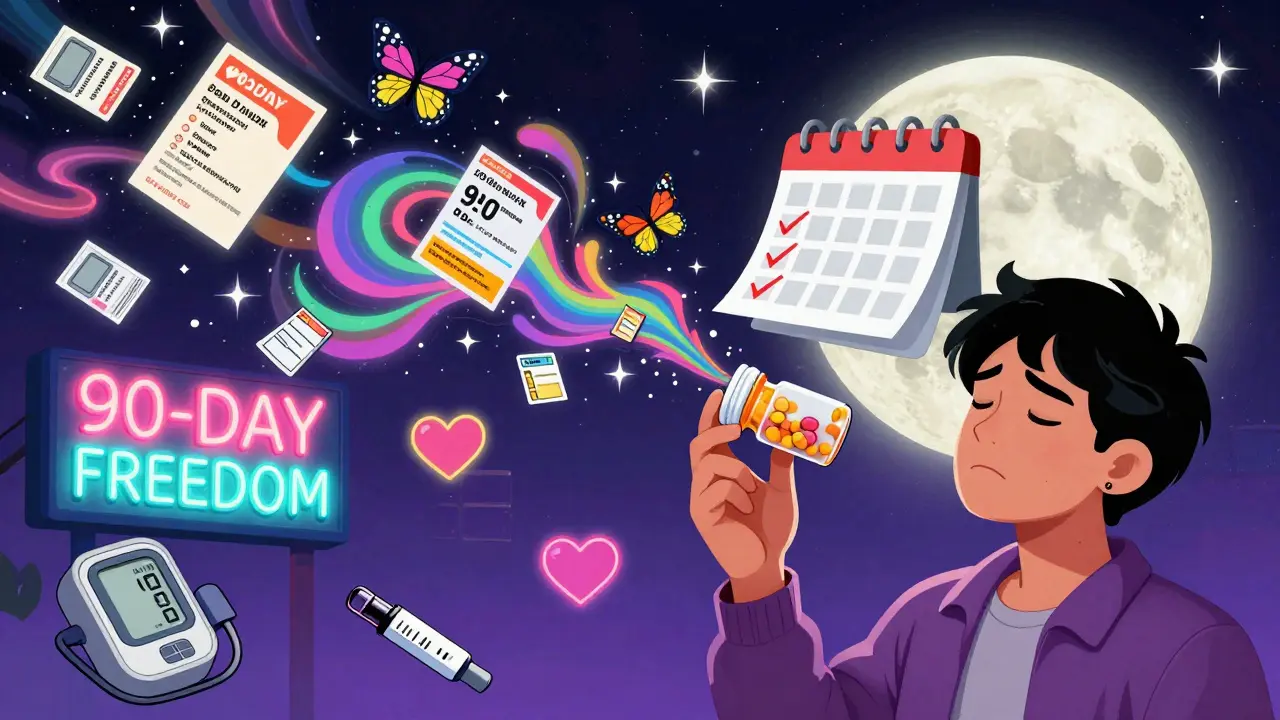
Running out of your blood pressure or diabetes meds every month is exhausting. You’re juggling work, family, and appointments-then you remember you’re out of pills. You rush to the pharmacy, wait in line, and hope they have your prescription in stock. It’s a cycle that eats up time, energy, and sometimes your peace of mind. What if you could cut that down to just four trips a year instead of twelve? That’s the real promise of a 90-day prescription supply.
Why 90-Day Supplies Work Better
Most people get 30-day fills because that’s what doctors usually write and pharmacies default to. But for medications you take every day-like those for high blood pressure, cholesterol, diabetes, or depression-there’s a smarter way. A 90-day supply means you get three months’ worth in one go. No more monthly runs. No more forgetting refills. No more running out on a weekend. Studies show people who use 90-day supplies take their meds more consistently. One major study in JAMA Network Open found that switching to a 90-day supply increased the number of days patients had their medication on hand by nearly 27%. That’s huge. Better adherence means fewer hospital visits, fewer complications, and less stress. You also save money. On average, people pay $2.35 less per prescription each month with a 90-day fill. That adds up to over $28 a year per med. At Walmart, generic 90-day supplies can cost as little as $10. For brand-name drugs, plans like Express Scripts and Cigna often charge $20-$40 for a 90-day supply, compared to $60-$120 for three separate 30-day fills.Which Medications Qualify?
Not every drug can be filled for 90 days. These programs are meant for maintenance medications-drugs you take daily for chronic conditions. That includes:- High blood pressure (lisinopril, amlodipine)
- Cholesterol (atorvastatin, simvastatin)
- Diabetes (metformin, glimepiride)
- Thyroid (levothyroxine)
- Depression and anxiety (sertraline, escitalopram)
- Heartburn (omeprazole)
How to Get a 90-Day Prescription
Step one: Check your insurance plan. Log into your insurer’s website-Cigna, Aetna, Express Scripts, or CVS Caremark-and look for “90-day supply,” “mail order,” or “extended fill.” If you’re on Medicare Part D, you’re automatically eligible. Medicare Advantage plans sometimes offer 100-day supplies. Step two: Talk to your doctor. Don’t just ask, “Can I get 90 days?” Say this instead: “I’d like to switch my [medication name] to a 90-day supply to make refills easier and save on costs. Can you write a new prescription for 90 days?” Most doctors are happy to do this-it’s better for you and reduces their follow-up calls. Step three: Choose your delivery method. You have two main options:- Mail-order pharmacy: Use your insurer’s service like CVS Caremark Mail Service or Express Scripts Home Delivery. You’ll get your meds delivered to your door in 7-10 business days. You can set up automatic refills so you never run out.
- Select retail pharmacies: Some plans, like Cigna 90 NowSM, let you get 90-day fills at specific pharmacies in their network. Walmart is a big one for generics-you can walk in and pay $10 for a 90-day supply of common meds.

What to Watch Out For
Not all plans are created equal. Here are the common traps:- Network restrictions: Cigna members can’t just go to any pharmacy. You must use a participating location. Check your plan’s list before you go.
- State limits: Some states like California, Texas, and Minnesota block certain mail-order programs. If you live there, you may need to use retail or switch plans.
- Specialty drugs: These often require prior authorization or three 30-day fills before you can get 90 days. Don’t assume you qualify right away.
- Tiered pricing: Your copay changes based on whether your drug is generic, preferred brand, or non-preferred brand. Always check your plan’s formulary before switching.
How to Stay on Track
Once you’ve got your 90-day supply, set up reminders. Most mail-order services offer automatic refills and text/email alerts. You can also link your prescription to your phone’s calendar. Mark the day you’ll need to refill-three months from now-and set a reminder for two weeks before that. If you miss a refill, don’t panic. Call your pharmacy or insurer right away. Many will send you a partial refill or expedite delivery if you’re running low.
Who Benefits the Most?
This isn’t just for older adults. Anyone taking daily meds for a chronic condition can benefit. If you work long hours, have a busy schedule, or live far from a pharmacy, 90-day supplies are a game-changer. Parents managing their child’s asthma meds, young adults on antidepressants, people with multiple prescriptions-all of them save time, money, and mental energy. The biggest winners? People who used to forget to refill or skip doses because it was too much hassle. The data shows they’re the ones who see the biggest jump in adherence.What’s Next?
These programs are getting even better. Insurers are adding features like drug interaction checks, automatic dose adjustments, and telehealth consultations to renew prescriptions. Some are even using AI to identify patients who’d benefit most from extended fills-before they even ask. The bottom line: If you’re on a daily medication, asking for a 90-day supply isn’t a stretch. It’s a smart, proven way to take better care of yourself without extra effort. You don’t need to be sick or old to qualify. You just need to be willing to ask.Can I get a 90-day supply for any medication?
No. Only maintenance medications for chronic conditions qualify-like those for high blood pressure, diabetes, cholesterol, or depression. Short-term drugs like antibiotics, painkillers, or steroids don’t qualify. Specialty drugs often require three 30-day fills before you’re eligible.
Do I need a new prescription for a 90-day supply?
Yes. Your doctor must write a new prescription specifically for a 90-day supply. Don’t assume your existing 30-day script can be extended. Ask your doctor to write it for 90 days and specify whether you want it sent to a mail-order pharmacy or filled at a retail location.
Is a 90-day supply cheaper than three 30-day fills?
Usually, yes. Most insurance plans offer lower copays for 90-day supplies. For example, a generic drug might cost $10 for 90 days at Walmart, but $45 for three separate 30-day fills. Even with brand-name drugs, you often pay less per day with a 90-day supply due to tiered pricing.
Can I use my local pharmacy for a 90-day supply?
Only if your insurance plan allows it. Plans like Cigna 90 NowSM require you to use specific network pharmacies. Others, like Express Scripts, only offer 90-day fills through mail order. Walmart accepts 90-day prescriptions for generics at their counters. Always check your plan’s rules before assuming your local pharmacy can fill it.
What if I live in a state that doesn’t allow mail-order pharmacies?
Some states like California, Texas, Minnesota, New Hampshire, and Washington have restrictions on mail-order delivery for certain plans. If you’re in one of these states, your best bet is to use a participating retail pharmacy that offers 90-day fills-like Walmart for generics-or ask your insurer about alternative options. You may need to switch to a different plan or use a specialty pharmacy.
How long does it take to get my 90-day supply?
Mail-order pharmacies typically take 7-10 business days to deliver. If you’re using a retail pharmacy like Walmart, you can get it the same day if your prescription is already in their system. Always plan ahead-don’t wait until you’re out of pills to start the process.
Can I switch back to 30-day fills later?
Yes. You can always go back to 30-day fills if your situation changes-like if your doctor adjusts your dose or you stop taking the medication. Just call your pharmacy or insurer and ask them to change your prescription length. No penalty applies.



Elaine Douglass
December 20, 2025 AT 02:13No more rushing at 7pm on a Friday when the pharmacy’s closed
My mom even started doing it for her blood pressure meds after seeing me not panic about refills
Walmart’s $10 for generics is a game changer
Takeysha Turnquest
December 20, 2025 AT 19:50For decades they conditioned us to believe we need to beg for pills every 30 days
But the truth? You don’t need to beg
You just need to ask
And suddenly the machine bends to your will
Emily P
December 22, 2025 AT 04:45Jedidiah Massey
December 24, 2025 AT 00:0190-day supplies are the only rational response to pharmacoeconomic externalities
Also 👍
Allison Pannabekcer
December 25, 2025 AT 07:53Some folks don’t have reliable mail service
Some live in states that block mail-order
Some can’t get their doctor to sign off
But the fact that this is even possible? That’s progress
And if you can do it? Do it
If you can’t? You’re not failing-you’re navigating a broken system
And that’s brave too
Sarah McQuillan
December 27, 2025 AT 02:52anthony funes gomez
December 28, 2025 AT 22:15It’s not just convenience-it’s epistemological liberation
And the cost savings? They’re not incidental-they’re systemic
But most people are too conditioned to ask for what they deserve
Alana Koerts
December 30, 2025 AT 13:26They want you to take more meds longer
And they save money by cutting out 8 trips to the pharmacy
Meanwhile your doctor gets paid the same whether you refill every 30 or 90 days
It’s not about you-it’s about profit margins
Mark Able
December 31, 2025 AT 19:35But my wife’s pharmacy said they couldn’t fill it unless the doctor called in a new script
Can someone explain why that’s even a thing? I thought e-scripts were universal
William Storrs
January 2, 2026 AT 06:52It’s not hard
Call your doctor
Log into your insurance
Ask for the 90-day
Walmart’s waiting
And your future self is already thanking you
One less trip. One less worry. One less moment stolen from your life
Go do it today