


For decades, doctors told us: take vitamin D to protect your bones. But what if the advice was wrong? Or at least, not as simple as it sounded?
Here’s the truth: vitamin D matters for your bones. But vitamin D isn’t a magic bullet. Taking more doesn’t mean stronger bones. In fact, taking too much might actually hurt them.
Why Vitamin D Matters for Bones
Your body needs vitamin D to absorb calcium from food. Without it, your gut only grabs 10-15% of the calcium you eat. With enough vitamin D, that jumps to 60-80%. That’s huge. Calcium builds your bones. Vitamin D makes sure that calcium actually gets used.
It’s not just about absorption. Vitamin D also helps your bones renew themselves properly. Old bone gets broken down and replaced with new bone. If vitamin D is low, this process gets messy. Bones become porous, weak, and more likely to break.
And then there’s muscle. Low vitamin D weakens your leg muscles. That doesn’t just make you feel tired. It increases your risk of falling - especially as you get older. A fall with weak bones? That’s how fractures happen.
What’s the Right Level?
For years, labs and guidelines said you need at least 30 ng/mL (75 nmol/L) of 25-hydroxyvitamin D in your blood to be "sufficient." But recent studies are shaking that idea.
The VITAL trial, led by Harvard researchers, followed over 25,000 people for five years. Those taking 2,000 IU of vitamin D daily didn’t have fewer fractures than those taking a placebo. Not even close. And here’s the kicker: people who started with low vitamin D levels didn’t benefit much either.
Meanwhile, a 2020 JAMA study found something shocking. People taking 4,000 IU or 10,000 IU daily for three years ended up with lower bone density than those taking 400 IU. The higher the dose, the worse the numbers got - especially at the radius and tibia. This wasn’t a fluke. It was a clear negative trend.
So what’s enough? For most healthy adults, 20 ng/mL (50 nmol/L) might be fine. The old 30 ng/mL target? It might be based on outdated assumptions. The science now suggests that once you’re past deficiency, more vitamin D doesn’t mean better bones.
The Supplement Mess
Not all vitamin D supplements are created equal. And not all are even accurate.
ConsumerLab.com tested 50 popular vitamin D products in 2022. Fifteen percent contained less than 90% of what was on the label. One brand had only 72% of its claimed dose. That’s a big gap if you’re relying on it to fix a deficiency.
On the flip side, some brands over-delivered. Garden of Life’s 2,000 IU capsule contained 128% of the labeled amount. That’s not necessarily bad - unless you’re taking multiple supplements and don’t realize how much you’re really getting.
And here’s another problem: form matters. Vitamin D3 (cholecalciferol) is far more effective than D2 (ergocalciferol). D3 raises blood levels 87% more than D2. If your supplement says "vitamin D" without specifying D3, you’re probably getting the weaker version.
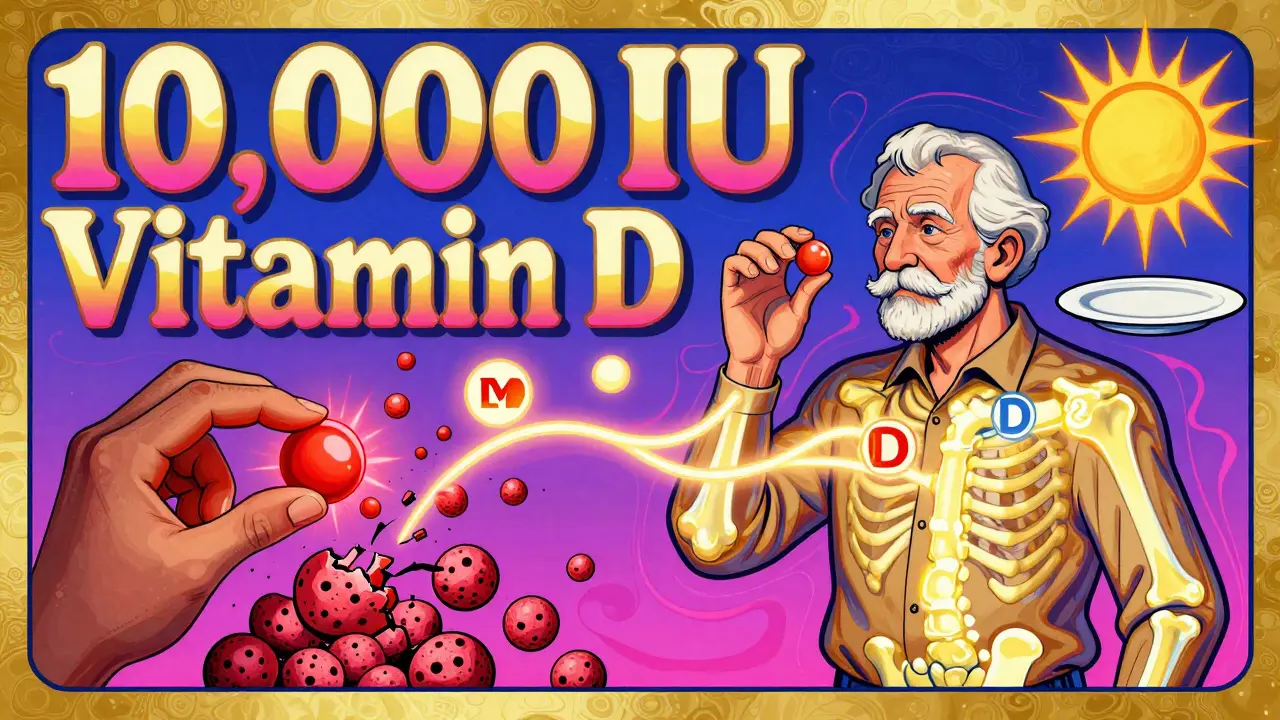
Calcium + Vitamin D: A Team Effort
Supplementing vitamin D alone? Often pointless. Calcium is the building block. Vitamin D is the delivery truck. You need both.
A 2023 meta-analysis found that when people took calcium and vitamin D together, total fracture risk dropped by 15%. Hip fractures? Cut by 30%. But only if the dose was right.
Here’s the twist: the best results came from doses under 400 IU of vitamin D per day. At higher doses - 800 IU or more - there was no benefit at all. In fact, some studies showed bone density stopped improving or even declined.
This isn’t about taking more. It’s about taking just enough. For most people, 800 IU of vitamin D3 with 1,000 mg of calcium is enough. More than that? Probably unnecessary - and possibly harmful.
Who Actually Needs Supplements?
Not everyone needs a daily pill. If you’re healthy, eat fish occasionally, get sunlight, and don’t have digestive issues - you’re probably fine.
But some groups do need help:
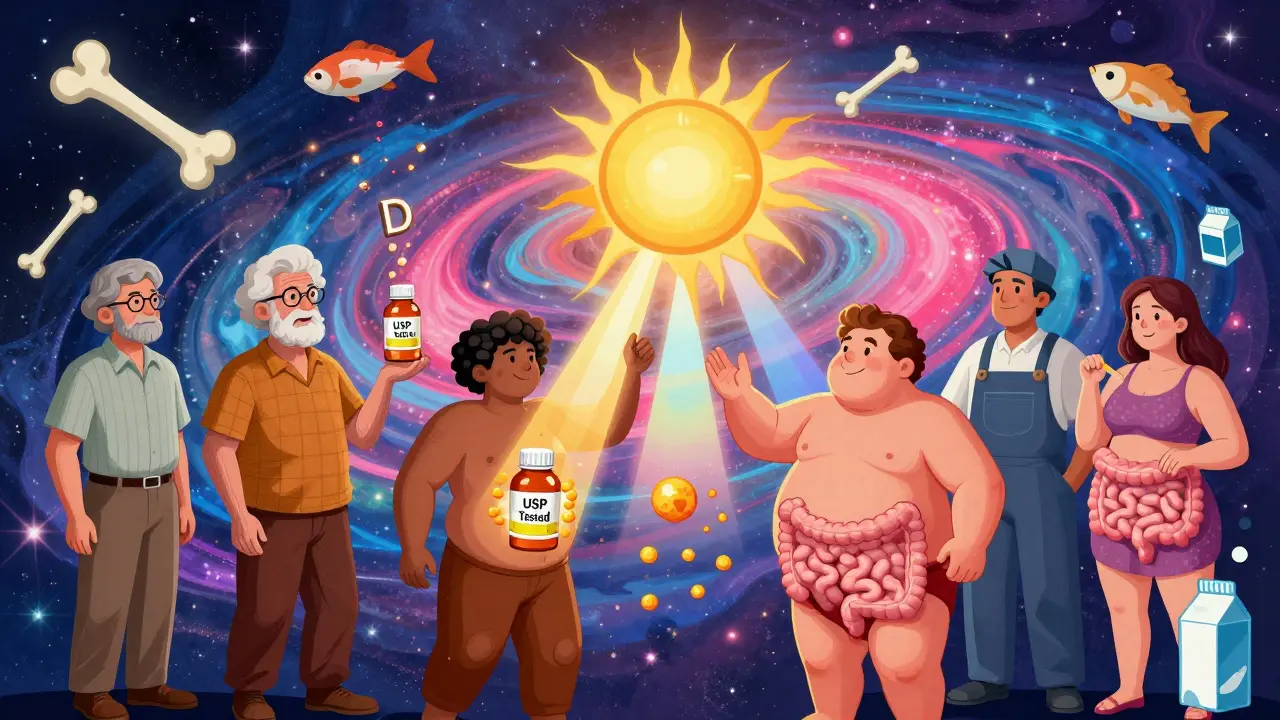
- People over 65 - skin makes less vitamin D, and many don’t get outside enough.
- Those with dark skin - melanin reduces vitamin D production from sunlight.
- People with obesity - fat tissue traps vitamin D, making it less available.
- Anyone with Crohn’s, celiac, or gastric bypass surgery - your gut can’t absorb it well.
- People living north of 35° latitude in winter - sunlight is too weak to make vitamin D.
For obese individuals, the Endocrine Society recommends double the standard dose. That’s because fat cells soak up vitamin D like a sponge. You need more to get the same effect.
When and How to Take It
Timing matters more than you think.
A 2015 study found that taking vitamin D with your largest meal - usually dinner - boosted absorption by 56.7%. Taking it on an empty stomach? You’re wasting half of it.
Also, don’t take it with calcium-rich foods unless you’re also taking calcium. Vitamin D and calcium compete for absorption pathways. Separate them by a few hours if you’re supplementing both.
And wait three months after changing your dose before testing your blood level. Vitamin D doesn’t stabilize right away. Test too soon, and you’ll get a misleading number.
The Big Debate
Some experts still swear by high-dose vitamin D. The International Osteoporosis Foundation says everyone at risk for fractures should aim for 30 ng/mL.
But others, like Dr. Meryl LeBoff and Dr. JoAnn Manson from Harvard, say the evidence doesn’t support it. Their research shows no benefit for fracture prevention in healthy older adults. In fact, the American Geriatrics Society reported a 22% drop in high-dose prescriptions between 2020 and 2023 - because doctors are seeing the data.
Dr. Bess Dawson-Hughes put it bluntly: "Effects didn’t vary by sex, race, BMI, or baseline vitamin D levels." In other words, the old assumptions don’t hold up. What works for one person might do nothing - or even backfire - for another.
What to Do Now
Here’s a simple plan:
- If you’re under 50 and healthy: get sunlight 10-15 minutes a day, eat fatty fish twice a week, and consider a 600 IU D3 supplement if you’re indoors all day.
- If you’re over 60: take 800 IU of D3 daily with your main meal. Add 1,000 mg of calcium if your diet is low in dairy or leafy greens.
- If you’re at risk (obesity, dark skin, malabsorption): get your 25(OH)D level checked. Don’t guess. Then adjust based on results, not a blanket recommendation.
- Avoid doses over 2,000 IU daily unless you’re under medical supervision. More isn’t better.
- Choose D3, not D2. Look for third-party tested brands (USP, ConsumerLab, NSF).
The goal isn’t to hit a magic number on a lab report. It’s to avoid deficiency and prevent fractures - without overdoing it.
What’s Next?
The D-Health Trial, wrapping up in 2024, is testing 60,000 IU of vitamin D monthly in 21,000 Australians over 60. That’s equivalent to 2,000 IU daily - but delivered in one big monthly dose. If results show fewer fractures without harm, it could change how we think about dosing.
For now, the message is clear: vitamin D is important. But it’s not a supplement for everyone. And more isn’t better. The sweet spot is small, precise, and personalized.
Can I get enough vitamin D from food alone?
It’s very hard. Fatty fish like salmon have about 570 IU per 3 oz. Fortified milk gives you 100 IU per cup. Eggs have 44 IU. Even if you eat all these every day, you’d still fall short of the 800 IU most experts recommend for older adults. Sunlight helps, but many people don’t get enough - especially in winter or if they wear sunscreen or cover up. For most, a supplement is necessary.
Is vitamin D3 better than D2?
Yes, by a lot. Vitamin D3 (cholecalciferol) raises blood levels 87% more effectively than D2 (ergocalciferol). D2 is cheaper and comes from plants, but it’s less potent and doesn’t last as long in your body. If your supplement says "vitamin D" without specifying D3, it’s probably the weaker version. Always choose D3.
Should I take vitamin D with calcium?
Only if you’re not getting enough calcium from food. If you eat dairy, leafy greens, or fortified foods regularly, you likely don’t need extra calcium. But if your diet is low, combining 800 IU of D3 with 1,000 mg of calcium reduces fracture risk. Taking them together helps absorption - but don’t take them with a high-fiber meal, which can block both.
Can too much vitamin D hurt my bones?
Yes. The JAMA 2020 study showed that taking 4,000 IU or 10,000 IU daily for three years led to lower bone density at the radius and tibia. High doses may disrupt bone remodeling, causing more bone breakdown than formation. If you’re not deficient, extra vitamin D doesn’t strengthen bones - it might weaken them.
How often should I get my vitamin D level checked?
Only if you’re at risk or taking high doses. For most people, annual testing isn’t needed. If you start a supplement, wait three months before testing - that’s how long it takes for levels to stabilize. If you’re healthy and taking 800 IU daily, testing is usually unnecessary. Save it for people with obesity, malabsorption, or those on very high doses.



Lillian Knezek
February 27, 2026 AT 11:02Christopher Brown
February 27, 2026 AT 19:56Sanjaykumar Rabari
March 1, 2026 AT 10:15Kenzie Goode
March 3, 2026 AT 09:52Dominic Punch
March 3, 2026 AT 22:35Valerie Letourneau
March 5, 2026 AT 09:25Khaya Street
March 7, 2026 AT 09:24Brooke Exley
March 8, 2026 AT 18:52