


Many adults with ADHD spend their days feeling like they’re running in place. Bills go unpaid. Deadlines slip. Important emails get buried. You know what needs to be done - but starting feels impossible, and staying focused feels like fighting a tide. If this sounds familiar, you’re not broken. You’re not lazy. You have ADHD - and the good news is, there’s a clear path forward that actually works.
ADHD Isn’t Just a Childhood Thing
For decades, ADHD was seen as a kid’s problem. But research shows about 4.4% of U.S. adults - that’s nearly 9 million people - still struggle with it. Symptoms don’t vanish when you turn 18. They just change shape. Instead of bouncing off the walls, you might zone out during meetings. Instead of forgetting your homework, you forget to pay your rent. The core issue? Executive function. That’s the brain’s internal control panel - the part that helps you plan, start, stay on track, and follow through. When it’s underactive, even simple tasks feel overwhelming.
What makes adult ADHD harder to manage? Society doesn’t make room for it. Schools have structure. Jobs? Not so much. You’re expected to self-manage, prioritize, and deliver - without the tools to do it. That’s why treatment needs to be more than just a pill. It needs to be a system.
Medication: The Foundation, Not the Fix
Medication is the most studied and effective tool for adult ADHD. Stimulants like methylphenidate (Ritalin, Concerta) and amphetamines (Adderall, Vyvanse) work by boosting dopamine and norepinephrine - brain chemicals that help with focus and impulse control. Non-stimulants like atomoxetine (Strattera) and guanfacine work slower but are gentler on the heart.
Here’s what actually happens when you start: Stimulants kick in within 30 to 60 minutes. You might notice your mind stops racing. Emails stop piling up. You can sit through a meeting without mentally checking out. Studies show 70-80% of adults see major improvements in focus and task completion. One person on Reddit said, “Vyvanse gave me 6 focused hours daily to manage my small business.” That’s not magic. That’s neurochemistry working as it should.
But medication isn’t a cure. It’s a tool. And like any tool, it needs proper handling. Side effects? Common ones include dry mouth, trouble sleeping, and reduced appetite - usually mild and fade after a few weeks. But there’s a real concern: heart health. Stimulants can raise blood pressure and heart rate. A 2023 JAMA Psychiatry study found each extra year of stimulant use slightly increases cardiovascular risk - especially if you’re over 40 or already have high blood pressure.
That’s why monitoring matters. The American Heart Association recommends a baseline heart check before starting. Then, blood pressure should be checked every 3 months. Yet, a 2022 JAMA Internal Medicine study found most primary care doctors only check it twice a year - if at all. That’s dangerous. One user on HealthUnlocked shared: “My doctor didn’t check my blood pressure for two years on Vyvanse. I ended up with undiagnosed hypertension.”
Medication works best when it’s not the only thing you’re doing. It’s the engine - but you still need a driver.
Coaching: Your Personal ADHD Navigator
Imagine having someone who understands why you forget your keys, why you avoid emails, why you start projects but never finish them. That’s what an ADHD coach does. They’re not therapists. They don’t dig into your childhood. They show you how to build systems that work with your brain, not against it.
Coaches use tools like the Eisenhower Matrix (urgent vs. important tasks), time-blocking, and visual calendars. They help you break down “clean the house” into “put one dish in the sink” - tiny steps your brain can handle. A 2023 survey by the ADHD Coaches Organization found that 81% of people who used coaching alongside medication saw big improvements in time management. Only 58% did with medication alone.
Why does coaching work? Because ADHD isn’t about willpower. It’s about brain wiring. You can’t just “try harder.” You need external structure. A coach gives you that structure - without judgment. They’re the person who says, “Okay, you didn’t pay the bill. Let’s figure out why. Was it the email? The deadline? The fear of the amount? Let’s fix the system.”
Coaching isn’t cheap - $80 to $150 per session - but it’s often covered by workplace wellness programs. CHADD, a national ADHD nonprofit, offers free workshops across the U.S. And if you’re in Australia, groups like ADHD Australia run local support circles. You don’t need to do this alone.
Organization: Building a Life That Fits Your Brain
Forget fancy planners. Forget color-coded tabs. What works for adults with ADHD? Simplicity, consistency, and low friction.
- One inbox, one calendar. Use Google Calendar or Apple Calendar. Put every single thing in it - meetings, bills, laundry, dentist appointments. No exceptions. Your brain doesn’t trust memory. Trust the calendar.
- Out of sight, out of mind. If you keep clutter on your desk, your brain is constantly distracted. Keep surfaces clear. Use drawers and bins. Put things away immediately.
- Set alarms for everything. Not just meetings. “Take meds.” “Call mom.” “Start dinner.” Set 3 alarms for each task. The first reminds you. The second nudges you. The third forces action.
- Use the 2-minute rule. If a task takes less than two minutes, do it now. Reply to the email. Put the dish in the sink. Hang up the coat. These tiny wins build momentum.
- Track your progress. Use the Adult ADHD Self-Report Scale (ASRS) every two weeks. It’s free online. You’ll see patterns: “I’m better on days I take my meds and sleep 7 hours.” That’s data. That’s power.
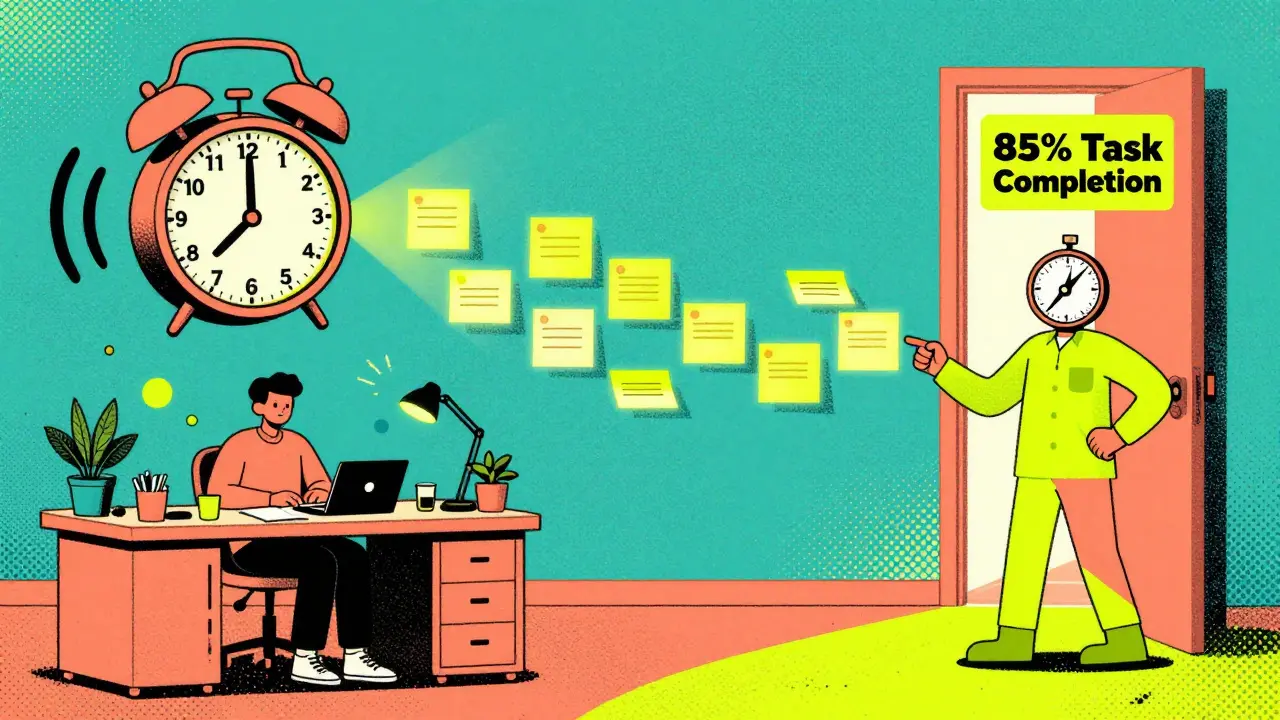
One woman shared on an ADHD blog: “After two months on Concerta and using a daily checklist, I went from 30% task completion to 85% at work.” That’s not luck. That’s a system.
Safety First: What You Need to Know About Medication
ADHD meds are safe - when used correctly. But they’re not risk-free. Here’s what you need to know:
- Stimulants are Schedule II drugs. That means they’re controlled. You can’t get a refill without a new prescription. In-person visits are required - though telehealth is now widely accepted.
- Don’t mix with MAO inhibitors. These are some antidepressants. The combo can cause a dangerous spike in blood pressure. Always tell your doctor every medication you take.
- Non-stimulants are safer for the heart. Atomoxetine doesn’t raise blood pressure like stimulants do. If you have heart issues, this might be your best first option.
- Long-term use? Monitor yearly. A 2024 Nature study found ADHD meds lower overall mortality risk - but only if you’re monitored. Unchecked, the cardiovascular risk adds up.
- Don’t skip checkups. If your doctor doesn’t ask about your blood pressure or sleep, ask them. You’re your own best advocate.
The FDA reviewed over 440,000 adults in 2011 and found no increased risk of heart events from ADHD meds. But a 2023 study showed a small, cumulative risk over years. The key? Monitoring. If your doctor isn’t tracking your vitals, find one who will.
What Works Best? The Real-World Combo
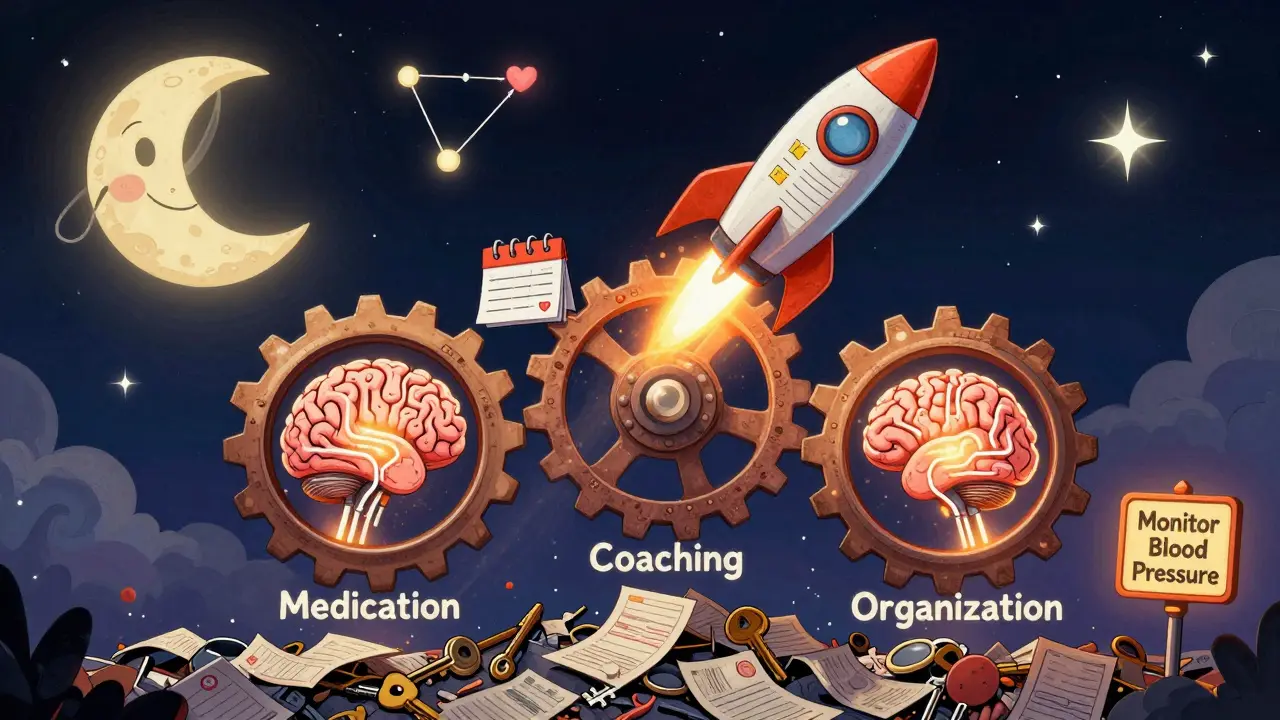
The best outcomes don’t come from one thing. They come from the intersection of medication, coaching, and organization.
Medication gives you the mental clarity to focus. Coaching gives you the strategy to use that focus. Organization gives you the structure to keep it going.
Look at the numbers: 74% of adults are happy with how meds help their focus. But only 52% feel their monitoring is good enough. Meanwhile, 81% of those using coaching + meds report major improvements in daily life.
This isn’t theoretical. It’s lived. A man in Perth told me: “I used to lose jobs because I missed deadlines. I started Vyvanse, got a coach, and now I use a color-coded app for every task. I’ve held the same job for three years - something I never did before.”
You don’t need to fix everything at once. Start with one thing. Take your meds. Set one daily alarm. Write down one task. That’s enough. Then add the next.
What’s Next? The Future Is Integrated
The ADHD treatment landscape is changing. Big health systems are now combining medication management with coaching under one roof. Employers are offering workplace accommodations. The global ADHD market is growing fast - because more people are asking for help.
And the science is clear: treatment works. People with ADHD who get proper care have fewer accidents, better relationships, higher incomes, and longer lives. The risks? Manageable. The rewards? Life-changing.
You don’t have to live in chaos. You don’t have to feel broken. You just need the right tools - and the courage to use them.
Can ADHD in adults be treated without medication?
Yes, but it’s harder. Coaching, organizational systems, and lifestyle changes (sleep, exercise, routine) can help significantly. Many people improve without meds - especially if their symptoms are mild. But for moderate to severe ADHD, medication is the most effective single tool. The best results come from combining medication with coaching and structure.
How long does it take for ADHD medication to work?
Stimulants like Adderall or Vyvanse start working in 30 to 60 minutes. You’ll notice clearer thinking and less mental fog within hours. But finding the right dose takes time - usually 6 to 8 weeks. Non-stimulants like Strattera take 1 to 2 weeks to build up in your system. Patience is key. Don’t give up after a few days.
Is ADHD coaching worth the cost?
If you’ve tried to organize your life on your own and failed, yes. Coaching isn’t about being told what to do - it’s about building systems that work with your brain. People who use coaching with medication are 40% more likely to improve time management than those using meds alone. Many employers cover coaching through wellness programs. CHADD and ADHD Australia offer free workshops too.
What are the biggest risks of ADHD medication?
The biggest risks are increased heart rate and blood pressure, especially with stimulants. People over 40, or those with existing heart conditions, need closer monitoring. Other side effects include trouble sleeping, loss of appetite, and anxiety. These often fade after a few weeks. The most dangerous risk? Not monitoring at all. Regular blood pressure checks and annual heart screenings are non-negotiable.
Can ADHD meds cause addiction?
When taken as prescribed, the risk of addiction is very low. In fact, studies show people with ADHD who take medication are less likely to abuse drugs than those who don’t. The reason? The medication reduces impulsivity and the urge to self-medicate. Vyvanse is a prodrug - it only converts to active form slowly, making it harder to misuse. Abuse happens mostly with pills taken in high doses or crushed/snorted - which is why you should never share your meds.
What if my doctor won’t prescribe ADHD meds?
Many primary care doctors aren’t trained in adult ADHD. Ask for a referral to a psychiatrist or neurologist who specializes in ADHD. You can also see a psychologist for a formal assessment - they can send a report to your doctor to support your case. If your doctor refuses without explanation, it’s okay to find another. You deserve care.





Lawrence Jung
January 11, 2026 AT 13:39Medication is just chemical crutches for people who can't get their shit together
Stop pretending ADHD is a real disorder and start taking responsibility
Everyone else manages their life without pills why can't you
Alice Elanora Shepherd
January 12, 2026 AT 20:02I appreciate how thoroughly you've outlined the evidence-based approach to adult ADHD management.
As a clinical psychologist, I've seen clients transform when medication is paired with coaching and environmental structuring.
It's not about 'fixing' the brain-it's about aligning external systems with neurodivergent cognition.
One of my clients, a university lecturer, went from chronic underperformance to publishing three papers in a year after implementing time-blocking and consistent stimulant dosing.
The key is personalization: what works for one person may overwhelm another.
Also, please note that non-stimulants like atomoxetine can take up to 6–8 weeks for full effect-many give up too soon.
And yes, blood pressure monitoring is non-negotiable.
I always insist on baseline ECGs for patients over 35.
Thank you for emphasizing that this isn't about willpower-it's about neurology.
Christina Widodo
January 13, 2026 AT 03:30Wait so if I take Vyvanse and set three alarms for everything... I'm basically a robot now?
Also does anyone else feel like ADHD coaching is just expensive life coaching for people who can't use Google Calendar?
Also why is everyone talking about this like it's new news? I've had this since I was 12 and it's still just... hard.
But I do love the 2-minute rule. I do the dishes immediately now. Small wins.
Also I just took my meds and I'm already feeling calmer. Weird.
Prachi Chauhan
January 14, 2026 AT 10:01adhd is not a disease it is a different way of thinking
we dont need to be fixed we need to be understood
meds help some but they dont teach you how to live
coaching is good because it helps you build habits that fit your brain
not the other way around
my brain is like a browser with 100 tabs open
and someone keeps yelling at me to close them
but i need all of them
so i need systems not shame
Jennifer Phelps
January 15, 2026 AT 13:46Has anyone tried non-medication approaches and actually kept them going for more than a month?
I tried time blocking and it lasted three days
I got bored
Then I forgot
Then I just stopped
What’s the secret?
Also I hate alarms they make me feel like a child
But I also forget everything
Help
beth cordell
January 15, 2026 AT 23:33YESSSS this is so real 😭
I used to cry in my car before work because I couldn’t even open my email
Now I take my meds at 7am, use Google Calendar with color codes 🟢🔵🔴, and my coach texts me every Monday morning like ‘hey did you pay the electric bill?’
It’s not perfect but I have a life now 🙌
Also I just bought a tiny plant and I water it every Tuesday
It’s alive and so am I 💚
Lauren Warner
January 17, 2026 AT 07:51Let’s be honest. Most of these ‘success stories’ are from people who had supportive families, good insurance, and time off work to figure this out.
What about the single mom working two jobs with no benefits?
Who’s paying for $150/hour coaching?
Who’s getting a heart check before being prescribed stimulants?
And why is the entire narrative framed as ‘you just need to try harder’ when the system is designed to fail people like us?
This post reads like a corporate wellness pamphlet.
It’s not empowering.
It’s gaslighting with footnotes.
Craig Wright
January 18, 2026 AT 22:35As a British man who has worked in healthcare for over 25 years, I must say this article is dangerously oversimplified.
Stimulant use in adults is not a trivial matter.
The JAMA studies cited are robust, yet you omit the fact that the UK’s NICE guidelines recommend cognitive behavioural therapy as first-line for mild cases.
Also, coaching is not regulated in the United States. Anyone can call themselves an ADHD coach.
There are no standards.
And while I applaud the emphasis on structure, I find it troubling that the article assumes all patients have access to technology, stable housing, and medical literacy.
ADHD is not a lifestyle brand.
It is a neurodevelopmental condition requiring systemic support.
And if your doctor won't monitor your vitals, change doctors.
That is not optional.
Ben Kono
January 19, 2026 AT 19:41I just took my meds and now I can finally finish this comment
Before I was stuck on the word 'executive' for 10 minutes
Now I'm like 'yeah I know what that means'
Also I forgot to pay my rent again but I set an alarm for tomorrow
It's progress
Windie Wilson
January 20, 2026 AT 07:44So let me get this straight...
My brain is broken, so I need a pill to be normal, a coach to tell me what to do, and an app to remind me to breathe?
And if I don't do all three, I'm just lazy?
Wow.
Just... wow.
Thanks for making me feel like a malfunctioning toaster with a PhD.
Jose Mecanico
January 21, 2026 AT 06:03I've been on Concerta for 4 years and I can't imagine life without it.
But honestly? The coaching was the game-changer.
My coach helped me realize I don't need a perfect system.
I just need a system that doesn't require me to be perfect.
Now I use sticky notes on my mirror.
One says 'take meds.'
One says 'you're doing fine.'
That's it.
And it works.
steve ker
January 21, 2026 AT 23:39adhd? more like adulting deficiency
just get a job and grow up
no one cares about your brain chemistry
stop making excuses
meds are for cowards
also i dont even believe this is real
probably made up by big pharma
and this coach thing? sounds like a scam
go outside and touch grass
George Bridges
January 22, 2026 AT 00:32Thank you for writing this.
I’ve been silent for years because I thought I was just lazy.
Reading this made me cry.
I’ve been taking Strattera for a year and I finally paid off my credit card last month.
I didn’t use a fancy app.
I just wrote one thing on a notepad every night.
And I kept it.
It’s not perfect.
But I’m here.
And I’m not alone.