

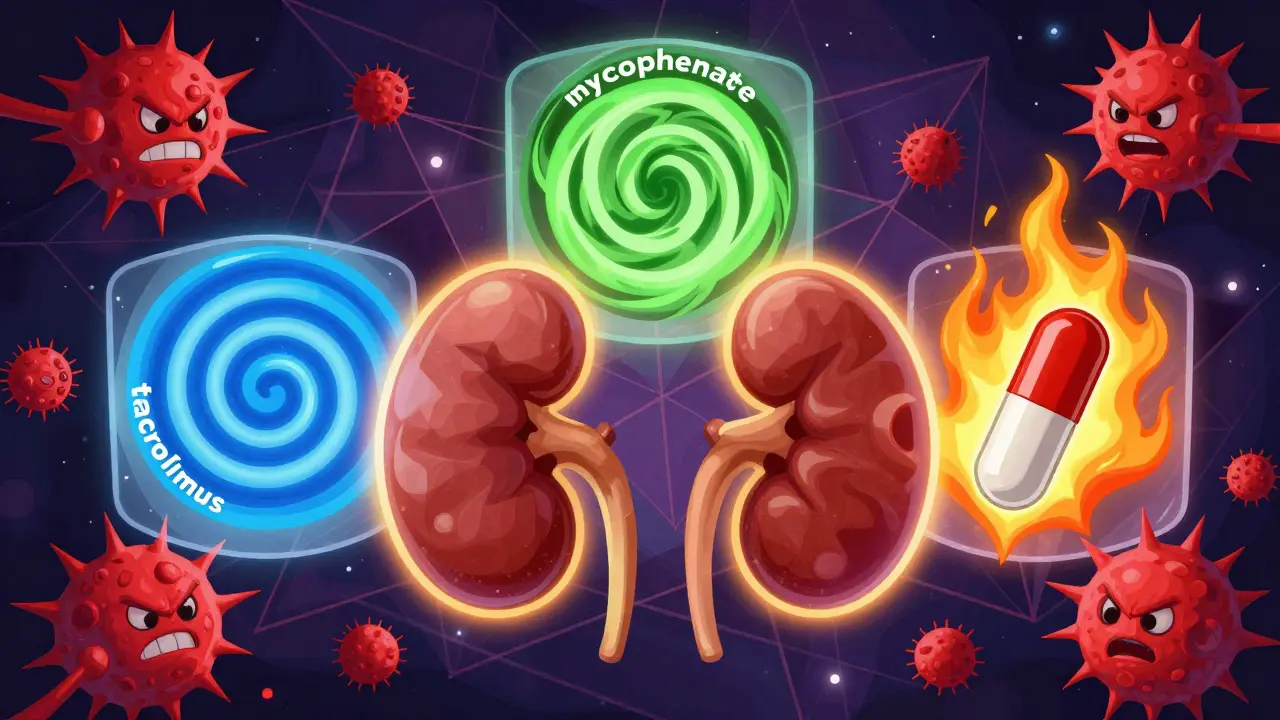
After a kidney transplant, your body doesn’t know the new organ isn’t supposed to be there. It sees it as an invader-and tries to destroy it. That’s where tacrolimus, mycophenolate, and steroids come in. Together, they form the most common immunosuppression combo used worldwide to keep your new kidney alive. This isn’t just a one-size-fits-all pill schedule. It’s a carefully balanced system, tweaked over decades, designed to stop rejection without leaving you vulnerable to infections, diabetes, or other serious side effects.
Why This Triple Combo Exists
In the 1980s and early 1990s, most transplant patients took cyclosporine with steroids. It worked, but not well enough. About 21% of patients still had a biopsy-proven acute rejection within the first year. Then came tacrolimus and mycophenolate mofetil (MMF). By the late 1990s, studies showed that adding MMF to tacrolimus and steroids slashed rejection rates to just 8.2%. That’s a 61% drop. Suddenly, graft survival jumped. This trio became the gold standard-not because it was perfect, but because nothing else came close at the time.How Each Drug Works
Tacrolimus is a calcineurin inhibitor. It blocks the signal that tells your immune cells to attack. Think of it like cutting the phone line between your immune system and the alarm that says, "Kidney! Danger!" It starts working within 12 to 24 hours. But it’s tricky. Too little, and rejection happens. Too much, and you risk kidney damage, tremors, high blood sugar, or even seizures. Doctors aim for a blood level between 5 and 10 ng/mL in the first year. That’s a narrow window. A few points off, and things can go sideways. Mycophenolate (MMF) is different. It stops immune cells from multiplying. It’s like shutting down the factory that makes new attack soldiers. You take 1 gram twice a day-usually with food to reduce stomach upset. But here’s the catch: about 25 to 30% of people get bad diarrhea. Another 15% develop low white blood cell counts (leukopenia). That’s why many end up on 500 mg twice a day, or stop it entirely. It’s not the drug’s fault-it’s just how your body reacts. The good news? When you can stay on it, it’s one of the best predictors of long-term kidney survival. Steroids (usually prednisone or methylprednisolone) are the heavy hitters. You get a 1,000-mg IV dose right in the operating room. Then, over the next few weeks, it’s slowly cut back. By three months, most people are on 10 mg a day. Steroids suppress inflammation fast. But they come with a price: weight gain, acne, mood swings, cataracts, and-most concerning-new-onset diabetes. Studies show 18 to 21% of transplant patients develop diabetes within the first year because of steroids. That’s why many centers now try to get people off them entirely by six months.What the Data Says About Effectiveness
The triple combo works better than any double combo. Take tacrolimus and steroids alone? Rejection hits 21%. Add mycophenolate? It drops to 8.2%. That’s not a small improvement-it’s life-changing. But here’s the twist: some studies show you don’t always need steroids. In a 2005 trial, patients on tacrolimus, MMF, and a one-time induction drug (daclizumab) had the same rejection rate (16.5%) as those on the full triple therapy. And 89% of them stayed steroid-free at six months. No weight gain. No acne. Fewer infections. That’s why today, about 30% of centers start patients on a steroid-free plan, especially if they’re low-risk. Still, for high-risk patients-like those getting a kidney from a deceased donor, or who’ve had prior transplants-the triple combo remains the default. Why? Because the stakes are too high. One rejection episode can scar the kidney permanently. And even one episode increases the risk of long-term failure.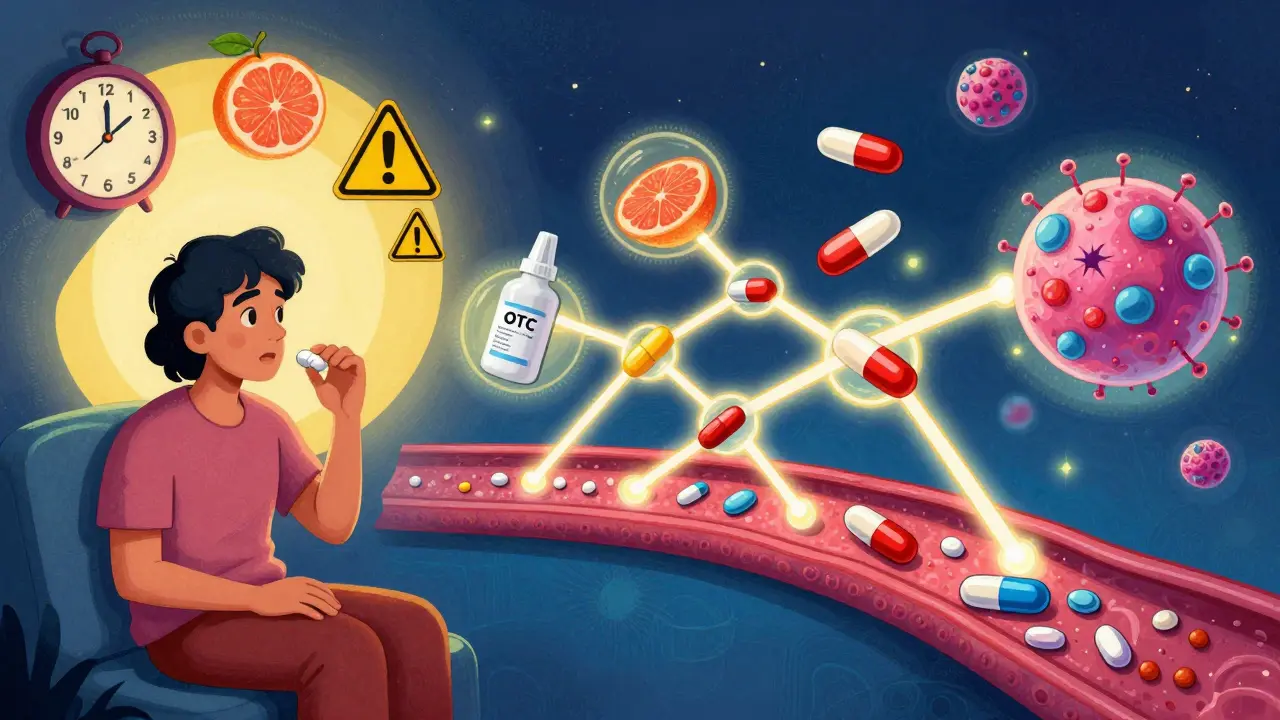
The Real-World Challenges
Let’s talk about what no one tells you before the transplant. First, timing matters. Tacrolimus and MMF should be taken at least two to four hours apart. If you take them together, your stomach can’t absorb either properly. That’s why many patients end up on a strict schedule: MMF at 7 a.m. and 7 p.m., tacrolimus at 11 a.m. and 11 p.m. It’s exhausting. And if you miss a dose? Your drug level drops. Rejection risk rises. Second, interactions are sneaky. Proton pump inhibitors (PPIs) like omeprazole reduce MMF absorption by up to 30%. If you’re on heartburn meds, your transplant team needs to know. Antibiotics, antifungals, even grapefruit juice-each can spike or crash your tacrolimus levels. One patient I spoke to had a rejection episode after starting an OTC antifungal cream. No one warned her. Third, monitoring isn’t just about blood tests anymore. For years, doctors checked trough levels-the lowest concentration before your next dose. But now, experts say that’s not enough. The area under the curve (AUC), which measures total drug exposure over 12 hours, gives a clearer picture. It’s harder to do, requires more blood draws, and isn’t available everywhere. But if your center offers it, ask. It’s more accurate.Side Effects You Can’t Ignore
Yes, these drugs save your kidney. But they also change your life. - Diabetes: You might need insulin. Your A1C might creep up. This isn’t rare-it’s expected in 1 in 5 patients. Your care team should screen you monthly in the first year. - Diarrhea: It’s not just "a little tummy upset." For some, it’s constant, severe, and leads to stopping MMF. If you’re losing weight or dehydrated, don’t wait. Tell your doctor. - Infections: CMV (cytomegalovirus) is the most common. It can cause fever, fatigue, and even mimic rejection. You’ll get tested regularly, and often get antiviral pills for the first six months. - Long-term damage: Even if your kidney looks fine at year one, chronic injury still creeps in. About 25% of adult transplant recipients lose their graft within five years. These drugs prevent rejection, but they don’t stop the slow wear and tear. That’s the next frontier.
Where the Future Is Headed
The future isn’t about more drugs. It’s about smarter dosing. Researchers are now looking at genetic testing to predict how fast you metabolize tacrolimus. Some people break it down fast. Others hold onto it. One size doesn’t fit all. Pharmacogenomics could soon tell your doctor: "You need 25% more tacrolimus than average." That’s coming within the next five years. Steroid minimization is already happening. More centers are skipping steroids entirely for low-risk patients. Induction drugs like basiliximab or daclizumab are replacing them. And AUC monitoring? It’s becoming standard in top transplant centers. By 2030, experts predict 15 to 20% fewer people will be on the classic triple combo. They’ll be on personalized, biomarker-driven regimens. But for now? If you’ve had a kidney transplant, you’re likely on this trio. And if you’re doing well-no rejection, no major side effects-you’re part of the 75% who beat the odds.What You Should Ask Your Transplant Team
- Is my tacrolimus level being monitored with troughs or AUC? If it’s just troughs, ask if AUC is an option. - Am I at high risk for rejection? If yes, why are we keeping steroids? - Can we try reducing my MMF dose if I have side effects? Or switch to mycophenolic acid (MPA)? - Are there any new medications or trials I could join to reduce long-term toxicity? - What’s my plan if I develop diabetes or need to stop one of these drugs? There’s no perfect regimen. But with the right monitoring, adjustments, and communication, this triple therapy gives you the best shot at a long, healthy life with your new kidney.Can I stop taking steroids after a kidney transplant?
Yes, many patients can. Steroid-free regimens using tacrolimus and mycophenolate with an induction drug like basiliximab are now common, especially for low-risk transplant recipients. Studies show they prevent rejection just as well as the traditional triple combo. The main benefit? Fewer side effects like weight gain, diabetes, and bone thinning. But for high-risk patients-like those with prior rejections or kidneys from deceased donors-steroids are often kept longer, sometimes indefinitely. Always discuss this with your transplant team before making any changes.
Why is my tacrolimus level always changing?
Tacrolimus has very unpredictable absorption. It’s affected by food, gut health, other medications, liver function, and even your genetics. A dose that worked last month might not work now. That’s why frequent blood tests are needed, especially in the first year. Your doctor may switch you from immediate-release to extended-release tablets, or adjust your dose based on AUC (total exposure) rather than just the trough level. Don’t panic if your levels fluctuate-it’s normal. But do report any new symptoms like tremors, headaches, or increased thirst.
What happens if I miss a dose of mycophenolate?
Missing one dose is unlikely to cause rejection, but it’s not harmless. Mycophenolate works by keeping immune cells from multiplying. If you skip doses, those cells get a chance to wake up and attack your kidney. If you miss a dose, take it as soon as you remember-unless it’s close to your next scheduled dose. Never double up. If you miss more than one dose in a week, call your transplant team. They may check your drug level or adjust your regimen. Consistency matters more than perfection.
Do these drugs increase my cancer risk?
Yes. All immunosuppressants, including tacrolimus and mycophenolate, carry a black box warning for increased risk of skin cancer, lymphoma, and other cancers. Your risk is higher than the general population, especially if you’re on long-term therapy. That’s why regular skin checks, sun protection, and cancer screenings are non-negotiable. Don’t skip your annual dermatology visit. Catching skin cancer early is easy. Letting it grow because you forgot your sunscreen isn’t worth the risk.
Can I take over-the-counter meds while on this regimen?
Be very careful. Many OTC drugs interfere with your transplant meds. NSAIDs like ibuprofen can hurt your kidney function. Antacids and PPIs (like omeprazole) reduce mycophenolate absorption. Even herbal supplements like St. John’s Wort can drop tacrolimus levels dangerously low. Always check with your transplant pharmacist before taking anything-even a cold tablet or vitamin. There’s no such thing as "safe" without clearance. Your meds are fine-tuned. Don’t disrupt them.


Vikas Verma
March 4, 2026 AT 18:01Tacrolimus trough levels are obsolete. AUC monitoring is the gold standard now. Without pharmacokinetic profiling, you're flying blind. 25% of rejections occur in patients with 'therapeutic' troughs but suboptimal AUC. This isn't opinion-it's peer-reviewed data from the AST 2022 guidelines.
MMF absorption is pH-dependent. PPIs reduce bioavailability by 30%. H2 blockers are safer. Proton pump inhibitors are not benign in transplant recipients. Your GI doctor doesn't get it. Your transplant team does.
Steroid minimization isn't experimental anymore. It's standard of care for low-risk recipients. The 2023 KDIGO update explicitly endorses steroid withdrawal by 3 months in patients with no prior rejection. If your center still defaults to 6 months, ask why.
Tacrolimus metabolism is genetically polymorphic. CYP3A5 expressers need 50% higher doses. Genotyping isn't luxury-it's precision medicine. We're doing it at Mayo. You should demand it too.
Diarrhea from MMF? Switch to enteric-coated mycophenolic acid. Same efficacy, 70% less GI toxicity. It's not harder to get. It's not more expensive. It's just not pushed enough.
CMV prophylaxis isn't optional. Six months of valganciclovir isn't overkill-it's survival. CMV reactivation is the silent killer post-transplant. It accelerates fibrosis. It triggers rejection. It's not a footnote. It's the elephant in the room.
Don't let your A1C creep up. Start metformin preemptively if you're prediabetic. Steroid-induced diabetes is preventable in 60% of cases with early intervention. Waiting for symptoms is malpractice.
Skin cancer screening isn't 'nice to have.' It's mandatory. Squamous cell carcinoma risk is 65x higher in transplant recipients. Monthly self-checks. Quarterly derm visits. No exceptions.
Consistency > perfection. One missed dose of tacrolimus can trigger a rejection cascade. Set phone alarms. Use pill organizers. Your kidney doesn't care if you're tired. It only cares if you're compliant.
This isn't just medicine. It's a lifelong operational protocol. Treat it like your job. Because it is.
Sean Callahan
March 6, 2026 AT 10:18so i missed my tacrolimus like 3 times last week and my kidney is fine?? lol i think these drugs are overhyped. also why do i have to take them 2 hours apart?? like i'm not a robot. i just take them when i remember. also i started taking omeprazole for heartburn and nothing happened?? maybe the whole thing is a scam??
Ferdinand Aton
March 8, 2026 AT 05:53Wow. So you're telling me the entire transplant community has been wrong for 30 years because some study in 1998 showed a 61% drop in rejection? That's not science-that's marketing. Steroids are the real villain here. They're the reason people gain 50 lbs and get diabetes. Why not just use tacrolimus and MMF and call it a day? The data says we can. The system says no. Coincidence? I think not.
William Minks
March 9, 2026 AT 02:05Yesss! 🙌 So glad someone finally said it-AUC is the future. I’ve been pushing my team for months to switch from troughs. They said it’s "too expensive." But my last lab bill was $1200 for 3 troughs… and AUC only costs $80 more per test. It’s not about money-it’s about survival. Also, yes, MMF with food = less diarrhea. I started doing that and my butt stopped rebelling. 🤦♂️😂
Jeff Mirisola
March 10, 2026 AT 19:33Let’s not pretend this is just about science. It’s about power. Pharma companies built empires on this triple combo. They funded the studies. They trained the doctors. They convinced the guidelines. Steroid-free regimens? They don’t sell as many pills. That’s why they’re not mainstream yet. The data is there. The will isn’t. Your kidney doesn’t care about profit margins. Neither should you.
Susan Purney Mark
March 12, 2026 AT 17:24Thank you for writing this. I’m 4 years post-transplant and still struggling with the weight gain and mood swings from steroids. I finally got mine down to 5mg after 2 years. It was the hardest thing I’ve ever done. I cried the day they took me off. Not because I was scared-because I felt like I’d lost a part of myself. But now? I sleep better. I see my kids without feeling like a zombie. This isn’t just medicine. It’s reclaiming your life. 💛
Ian Kiplagat
March 13, 2026 AT 06:45AUC monitoring. Yes. But only if you can afford it. In the UK, most centers still use troughs. Access isn't equal. This is a global issue, not just a technical one.
Amina Aminkhuslen
March 13, 2026 AT 15:21Oh honey. You’re telling me we’re still using 1990s protocols like they’re gospel? This isn’t medicine-it’s a cult. Tacrolimus? More like "taco-rumus"-because you’re always tasting it on your tongue after you swallow. MMF? More like "mucus-phate"-because your butt is permanently in revolt. Steroids? More like "steroid-terror." We’re not saving kidneys. We’re just delaying the inevitable while turning people into diabetic, acne-ridden, diarrhea-suffering zombies. Wake up.
amber carrillo
March 15, 2026 AT 06:26Consistency matters. I’ve been on this regimen for 7 years. No rejection. No diabetes. No major side effects. I take my meds at the same time every day. I never skip. I check my levels. I see my team. It’s not glamorous. It’s not easy. But it’s worth it. You’re not just surviving-you’re living. And that’s a gift.
Tim Hnatko
March 16, 2026 AT 07:24For anyone new to this: don’t panic. The system is complex, but you don’t have to master it alone. Ask your pharmacist. They’re the unsung heroes. I didn’t know PPIs messed with MMF until my pharmacist flagged it. She called my doctor. They switched me to famotidine. My diarrhea vanished. No one told me to ask. I did. You should too. You’re not a burden. You’re a partner in care.
Aaron Pace
March 18, 2026 AT 00:07Wait, so if I stop taking steroids, will I still be able to eat pizza? Because I really miss pizza. Also, can I take CBD oil for my anxiety? My friend says it’s fine. I’m just asking.