


Newborn Medication Safety Calculator
Calculate Medication Risk for Jaundiced Newborns
This tool helps determine if certain medications are safe for jaundiced newborns based on bilirubin levels, age, and risk factors. Used by medical professionals to prevent kernicterus.
When a newborn turns yellow, it’s usually just jaundice - common, harmless, and easily treated. But in rare cases, that yellow tint can signal something far more dangerous: kernicterus. This isn’t just severe jaundice. It’s permanent brain damage caused by bilirubin leaking into the brain tissue. And it’s almost always preventable - if you know which medications to avoid.
What Exactly Is Kernicterus?
Kernicterus happens when unconjugated bilirubin, a natural byproduct of red blood cell breakdown, builds up to toxic levels in a newborn’s blood. The baby’s liver isn’t mature enough to process it, and the blood-brain barrier is still leaky. When bilirubin crosses into the brain, it stains the basal ganglia and other critical areas, leading to irreversible damage. Symptoms include lethargy, high-pitched crying, arching of the back, and poor feeding. Left untreated, it can cause cerebral palsy, hearing loss, intellectual disabilities, or even death.The good news? Only about 1.3 in every 100,000 term infants develop kernicterus, according to a 2019 Swedish study of nearly a million babies. The bad news? Most of those cases weren’t unavoidable - they were preventable. In fact, data from the National Library of Medicine shows 43% of affected infants had no clear medical reason for their bilirubin spike. Their brains were damaged not because of a rare condition, but because a simple medication was given without checking the bilirubin level first.
Why Sulfonamides Are a Silent Threat
Sulfonamides - like sulfisoxazole and sulfamethoxazole - are antibiotics used for urinary tract infections, ear infections, and other bacterial issues. They’ve been around since the 1930s. But in newborns, they’re a ticking time bomb.Here’s how they cause harm: bilirubin normally sticks to albumin, a protein in the blood, which keeps it from entering the brain. Sulfonamides compete for the same binding spots. At therapeutic doses, they can displace 25-30% of bilirubin from albumin, flooding the bloodstream with free, unbound bilirubin. That’s the kind that slips through the blood-brain barrier and starts poisoning neurons.
It doesn’t take much. A single dose of sulfisoxazole in a baby with bilirubin levels just below the phototherapy threshold can push them over the edge. One nurse practitioner in Texas documented a case where a 5-day-old infant’s bilirubin jumped from 14.2 mg/dL to 22.7 mg/dL within 12 hours after receiving sulfisoxazole for UTI prevention. That baby needed emergency phototherapy and nearly required an exchange transfusion.
Other Dangerous Medications
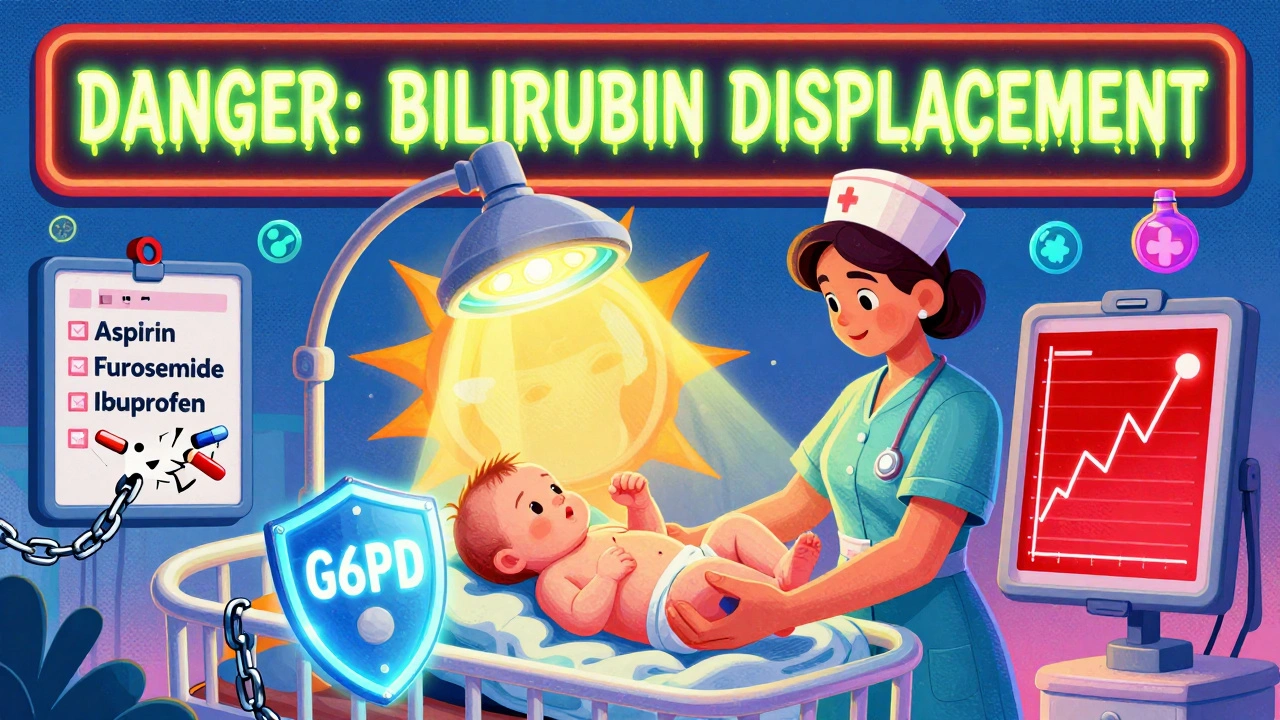
Sulfonamides aren’t the only offenders. Several other common drugs carry similar risks:- Ceftriaxone - a widely used IV antibiotic - displaces about 15-20% of bilirubin. It’s less risky than sulfonamides but still dangerous in jaundiced infants.
- Aspirin and other salicylates - even small amounts can displace bilirubin. Never give aspirin to a newborn.
- Furosemide - a diuretic sometimes used for fluid overload - can reduce albumin levels and increase free bilirubin.
- NSAIDs like ibuprofen - while generally safe, they should be used cautiously in infants with borderline bilirubin levels.
The American Academy of Pediatrics (AAP) updated its guidelines in 2022 to list all these drugs as high-risk for bilirubin-induced neurotoxicity. The rule is simple: if a baby’s bilirubin is above 75% of the phototherapy threshold, avoid these medications entirely.
Who’s at Highest Risk?
Not all newborns are equally vulnerable. Certain factors make kernicterus more likely:- Preterm babies - their livers are less developed, and their blood-brain barrier is even more permeable.
- Babies with G6PD deficiency - this genetic condition affects about 7% of people globally and causes red blood cells to break down faster, spiking bilirubin. Sulfonamides can trigger dangerous hemolysis in these infants.
- Babies with acidosis or low albumin - when albumin drops below 3.0 g/dL, even normal bilirubin levels become dangerous.
- Infants with feeding problems - poor intake leads to dehydration and less bilirubin excretion.
It’s not just about the number on the bilirubin test. A baby with a bilirubin level of 13 mg/dL might be fine if they’re full-term, well-fed, and have no risk factors. But the same level in a 35-week preterm baby with low albumin and a recent sulfonamide dose? That’s a medical emergency.
What Doctors and Nurses Are Doing Differently
In the past, many providers didn’t connect the dots between antibiotics and jaundice. But things are changing.Since 2023, the AAP has pushed for a 5-step safety checklist before giving any high-risk medication to a newborn:
- Check the total serum bilirubin level - is it below 75% of the phototherapy threshold for the baby’s age in hours?
- Measure serum albumin - if it’s under 3.0 g/dL, avoid bilirubin-displacing drugs.
- Screen for G6PD deficiency - especially in infants of African, Mediterranean, or Southeast Asian descent.
- Calculate the free bilirubin index if available - levels above 10 mcg/dL are dangerous.
- Choose a safer alternative - amoxicillin-clavulanate, for example, carries no bilirubin displacement risk.
Hospitals that use this checklist have seen a 37% drop in phototherapy needs and fewer emergency transfers. Some electronic health record systems, like Epic, now automatically block sulfonamide orders if bilirubin levels are too high.
Real-World Consequences
The cost of getting this wrong is devastating - both for families and the healthcare system.The Birth Injury Justice Center reviewed over 200 kernicterus cases and found that 12% involved inappropriate sulfonamide use. The average malpractice settlement? $4.2 million per child. These aren’t theoretical risks - they’re documented tragedies.
One Reddit post from a neonatology resident described a late preterm infant who received sulfamethoxazole-trimethoprim for suspected sepsis. The baby had a bilirubin of 12.8 mg/dL - not alarming on its own. But within 18 hours, bilirubin hit 26.5 mg/dL. The infant developed seizures and spent months in rehab. The family’s life changed forever. And it all started with a routine antibiotic order.

What Parents Should Know
Parents aren’t expected to know pharmacology. But they can ask the right questions:- “Is this medication safe for jaundiced babies?”
- “Has my baby’s bilirubin been checked today?”
- “Are there safer alternatives?”
If your baby is being treated for jaundice and a doctor wants to prescribe an antibiotic, don’t assume it’s safe. Ask specifically about sulfonamides, ceftriaxone, or aspirin. Most providers will appreciate the question - it means you’re engaged in your baby’s care.
Also, keep an eye on feeding. Poor feeding worsens jaundice. If your baby isn’t latching well or isn’t wetting six diapers a day, speak up. Dehydration raises bilirubin levels faster.
The Bigger Picture
The global market for neonatal jaundice management is growing fast - expected to hit $1.89 billion by 2027. But the real progress isn’t in new devices or fancy lights. It’s in smarter prescribing.Since 2007, the FDA has required black box warnings on sulfonamide labels: “Avoid use in neonates and infants under 2 months.” Yet, in low-resource settings, these drugs are still used because they cost pennies per dose. In the U.S., their use has dropped from 28% of neonatal antibiotic prescriptions in 1990 to less than 2% today. That’s progress.
But gaps remain. In 23% of rural U.S. hospitals, rapid bilirubin testing isn’t available. That’s why standardized order sets - which automatically block high-risk drugs when bilirubin is elevated - are so critical. They don’t rely on memory or experience. They rely on systems.
What’s Next?
The National Institutes of Health funded a $2.4 million project in early 2023 to develop a point-of-care device that measures free bilirubin - not just total bilirubin. Right now, we only know how much bilirubin is in the blood. We don’t know how much is free and dangerous. That’s like checking the fuel gauge on a car but not knowing if the tank is leaking.When that device becomes available, it will change everything. Until then, the safest approach is simple: avoid sulfonamides and other bilirubin-displacing drugs in newborns with jaundice. Use alternatives. Check bilirubin. Check albumin. Screen for G6PD. And never assume a baby is “just jaundiced.”
Kernicterus isn’t a disease of the past. It’s a failure of attention. And it’s still happening - because we forget that a tiny dose of a common antibiotic can change a child’s life forever.
Can newborns ever take sulfonamides safely?
Only if the baby has no signs of jaundice, bilirubin levels are well below the phototherapy threshold, albumin is normal (>3.0 g/dL), and there’s no G6PD deficiency. Even then, safer alternatives like amoxicillin are preferred. Most experts recommend avoiding sulfonamides entirely in infants under 2 months unless no other option exists and the infection is life-threatening.
How do I know if my baby’s bilirubin level is dangerous?
Bilirubin risk depends on the baby’s age in hours, gestational age, and health status. The AAP provides detailed charts showing treatment thresholds. For example, a full-term 48-hour-old infant with a bilirubin level of 15 mg/dL is at high risk. A 12-hour-old with the same level is even more dangerous. Always ask for the specific threshold for your baby’s age and whether the level is above 75% of that threshold.
Are there blood tests to check for bilirubin displacement?
Yes - the free bilirubin index measures unbound bilirubin in the blood. Levels above 10 mcg/dL are considered dangerous. However, this test isn’t available everywhere. Most hospitals still rely on total serum bilirubin and clinical judgment. If your hospital doesn’t offer free bilirubin testing, ask if they use the AAP’s Bilirubin Exposure Risk Calculator, which factors in medication risks and other variables.
Can kernicterus be reversed?
No. Once bilirubin has damaged brain tissue, the damage is permanent. Treatment like phototherapy or exchange transfusion can prevent further injury, but it can’t undo what’s already happened. That’s why prevention - avoiding risky medications and catching jaundice early - is the only reliable strategy.
What should I do if my baby was given a sulfonamide and is jaundiced?
Ask for immediate bilirubin testing and inform the provider that a bilirubin-displacing drug was given. Request an albumin level check and watch for signs of worsening jaundice - increased yellowing, poor feeding, lethargy, or high-pitched crying. If bilirubin is rising quickly, insist on phototherapy or further evaluation. Time is critical.

May .
December 3, 2025 AT 23:35Jessica Ainscough
December 5, 2025 AT 08:21Michael Bene
December 5, 2025 AT 22:41Cristy Magdalena
December 7, 2025 AT 12:48It's not about 'jaundice.'
It's about bilirubin displacement.
It's about albumin saturation.
It's about the blood-brain barrier being porous.
It's about the fact that a single pill can turn a healthy newborn into a lifelong patient.
And yet, here we are.
Still giving sulfonamides like they're candy.
And then acting shocked when the child can't walk or hear their own mother.
It's not a tragedy.
It's a failure of basic pharmacology.
And the system that allows it to keep happening?
It's broken.
And we're all complicit.
Adrianna Alfano
December 9, 2025 AT 08:26Casey Lyn Keller
December 10, 2025 AT 09:34Sara Larson
December 10, 2025 AT 11:39Josh Bilskemper
December 11, 2025 AT 18:10Storz Vonderheide
December 13, 2025 AT 10:34