

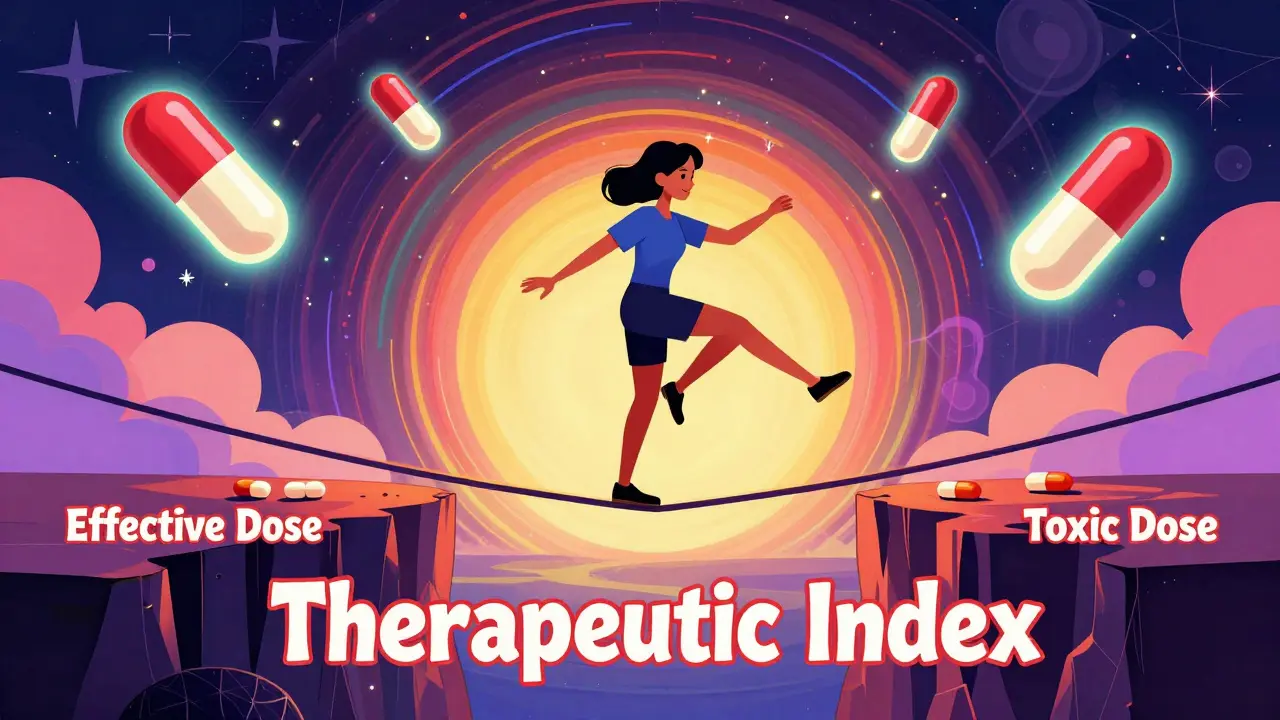
When you take a medication like warfarin, phenytoin, or tacrolimus, even a tiny change in your blood levels can mean the difference between effective treatment and serious harm. These are called Narrow Therapeutic Index (NTI) drugs - medications where the gap between a safe dose and a toxic one is razor-thin. The FDA doesn’t treat these like regular drugs. They’ve built a whole separate set of rules just for them.
What Makes a Drug an NTI Drug?
The FDA defines NTI drugs using hard numbers, not opinions. In 2022, they published a clear cutoff: if a drug’s therapeutic index is 3 or less, it’s an NTI drug. That means the smallest effective dose is no more than three times smaller than the smallest toxic dose. Think of it like walking a tightrope - one step too far, and you fall.
Drugs like digoxin, lithium carbonate, carbamazepine, and valproic acid all fall into this category. They’re used for heart conditions, seizures, mood disorders, and transplant rejection. But here’s the catch: the FDA doesn’t publish a public list of NTI drugs. Instead, they set the rules case by case through product-specific guidance documents. If you’re looking for the standards for a specific generic drug, you’ll find them in its own guidance - not in a general database.
How Bioequivalence Works for Regular Drugs
For most generic medications, the FDA only requires that the generic version delivers between 80% and 125% of the brand-name drug’s active ingredient. That’s a 45% range. It sounds wide, but for most drugs, it’s safe. Your body can handle some variation without side effects.
For example, if you take a generic version of a blood pressure pill, your body might absorb 90% or 120% of the active ingredient - and you’ll still feel the same effect. That’s why most generics are interchangeable.
Why NTI Drugs Need Tighter Rules
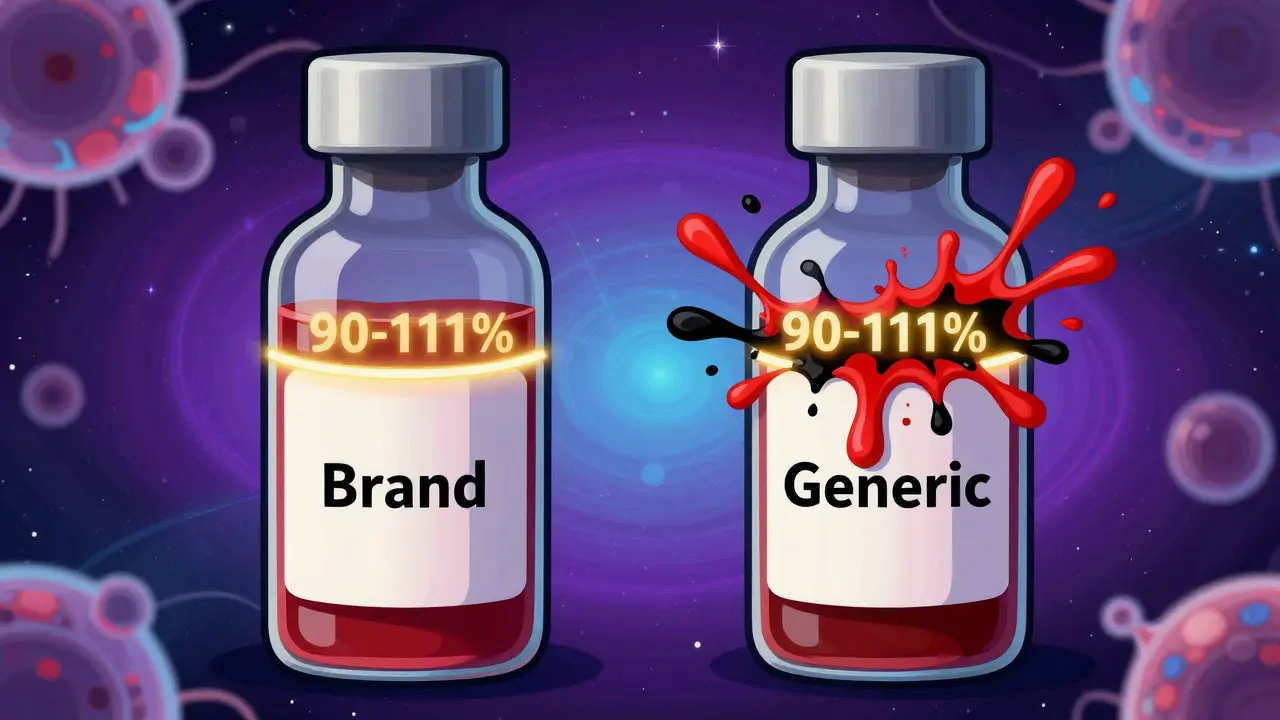
With NTI drugs, a 20% difference in blood concentration isn’t just a number - it can trigger seizures, organ rejection, or dangerous bleeding. That’s why the FDA rejected the standard 80-125% rule back in 2010. A panel of experts voted 11-2 that it was too loose. They said: if we’re going to let people switch between brand and generic for these drugs, we need tighter control.
The result? A new standard: 90-111%. That’s a 21% range - less than half the width of the old one. And it’s not just about the average. The FDA looks at how consistent the drug is from person to person. They require the upper limit of the 90% confidence interval for the ratio of within-subject variability (how much the drug behaves differently in the same person over time) to be no more than 2.5. In plain terms: the generic must behave as predictably as the brand.
The Scaled Average Bioequivalence (SABE) Method
The FDA doesn’t just use one test. They use a two-step system called Scaled Average Bioequivalence (SABE). Here’s how it works:
- First, they check if the generic passes the standard 80-125% range.
- Then, they apply the tighter 90-111% rule - but only if the reference drug (the brand) shows moderate variability (within-subject variability > 0.21).
This means the stricter limits aren’t applied to every NTI drug. Only those where the brand itself shows enough variation to make predictability a concern. It’s a smart, science-based approach. If the original drug is inconsistent, the generic has to be even more consistent to match it.
Quality Control Is Also Tighter
It’s not just about how much drug gets into your bloodstream. The FDA also tightens the quality control for NTI drugs. While regular generics must meet a 90-110% potency range, NTI generics must stay within 95-105%. That’s a 10% window - half the tolerance. Every pill must be nearly identical in strength. No room for manufacturing drift.
This matters because even small differences in how a tablet breaks down or how quickly it dissolves can change how much drug enters your blood. For NTI drugs, that’s not a minor issue - it’s a safety issue.
Replicate Studies: The Gold Standard
Because NTI drugs are so sensitive, the FDA requires replicate studies. That means each participant takes both the brand and the generic multiple times - often in a crossover design like RTRT or TRTR (where R = reference, T = test).
These studies are longer, more expensive, and need more volunteers than standard bioequivalence trials. But they give the FDA a clearer picture of how the drug behaves in real people over time. A single dose doesn’t tell the whole story. Multiple doses do.
Real-World Examples: Tacrolimus and Phenytoin
Take tacrolimus, a drug used after organ transplants. Studies show that generic versions that meet the 90-111% standard work just as well as the brand. Patients who switched had no increase in rejection rates.
But here’s the twist: some generic versions that passed the standard 80-125% rule still didn’t match each other. One generic might be fine with the brand, but not with another generic. That’s why the FDA insists on the tighter standard - it reduces the risk of unpredictable switching between different generics.
Same with phenytoin. Even though studies show generics are bioequivalent under the new rules, some doctors still hesitate. Why? Because in the 1990s, some patients had seizures after switching. Those cases were rare - but they stuck in people’s minds.

Why Some Doctors Still Doubt
Even with FDA approval, many clinicians - especially neurologists and transplant specialists - remain cautious. They’ve seen patients who did fine on one brand, then had problems after switching to a generic. Sometimes it’s a seizure. Sometimes it’s kidney damage. Sometimes it’s nothing at all.
The FDA says real-world data supports the safety of these generics. But they also admit: “Conflicting literature results have raised doubts in both patients and clinicians.” That’s why some states require written consent before switching an NTI drug, even if the FDA says it’s safe.
Global Differences: FDA vs. EMA vs. Health Canada
The U.S. doesn’t do this the same way as Europe or Canada. The EMA and Health Canada mostly just tighten the bioequivalence range to 90-110% across the board. The FDA’s method is more complex - it uses the variability of the original drug to decide how strict the test should be.
That’s why a generic approved in the U.S. might not be approved in Europe - and vice versa. It’s not about quality. It’s about different rules. The FDA admits this creates confusion and wants more global alignment.
What This Means for Patients
If you’re on an NTI drug, you can still switch to a generic. The FDA says they’re safe and effective. But here’s what you should know:
- Your doctor or pharmacist should tell you if the generic you’re getting is approved under NTI standards.
- Don’t switch between different generics unless your provider says it’s okay.
- If you feel different after a switch - even slightly - tell your doctor. That’s not “in your head.” It’s data.
- Therapeutic drug monitoring (blood tests) is still essential. The FDA doesn’t remove the need for it.
There’s no perfect system. But the FDA’s current standards are the most scientifically rigorous in the world. They’re based on real data, not fear. And they’ve kept thousands of patients safe.
What’s Next?
The FDA is still refining how it classifies NTI drugs. More drugs may be added. New methods for measuring variability are being tested. And they’re pushing for global harmonization - so a generic approved in the U.S. can be trusted everywhere.
For now, if you’re taking one of these drugs, know this: the system isn’t perfect, but it’s designed to keep you safe. The tighter limits, the replicate studies, the stricter quality checks - they’re all there for a reason. Not because generics are unsafe. But because for these drugs, safety can’t afford to be left to chance.
Are all generic NTI drugs safe to switch to?
Yes - if they meet the FDA’s stricter bioequivalence standards. All FDA-approved generic NTI drugs are required to pass the 90-111% bioequivalence range and tighter quality controls. They are considered therapeutically equivalent to the brand. However, switching between different generic versions of the same NTI drug may carry risk if those generics were not tested against each other. Always consult your doctor before switching between generics.
Why doesn’t the FDA publish a list of NTI drugs?
The FDA avoids a public list because drug classification depends on complex pharmacometric data that changes with new research. Instead, they apply NTI-specific standards through product-specific guidance documents. If you want to know whether a specific drug has NTI requirements, check its generic drug approval guidance on the FDA website - not a general list.
Do I still need blood tests if I switch to a generic NTI drug?
Yes. Therapeutic drug monitoring remains essential for all NTI drugs, whether brand or generic. The FDA’s bioequivalence standards reduce risk, but they don’t eliminate the need for monitoring. Blood levels can still vary due to diet, other medications, or changes in liver function. Regular testing is the best way to ensure safety.
Can I trust a generic NTI drug approved in another country?
Not necessarily. The FDA’s NTI standards are more complex than those used by Health Canada or the EMA. A drug approved under European or Canadian rules may not meet the U.S. requirements for variability and quality control. Only FDA-approved generics should be used in the U.S. unless specifically authorized under special circumstances.
What should I do if I feel different after switching to a generic NTI drug?
Contact your prescriber immediately. Even minor changes - like a slight headache, dizziness, or unusual fatigue - could signal a change in drug levels. Don’t assume it’s “all in your head.” Keep a symptom log and ask for a blood test. Your provider may need to adjust your dose or switch you back.
NTI drugs demand precision. The FDA’s standards reflect that. They’re not about distrust of generics - they’re about respect for biology. For these medications, every milligram counts.


Ben Estella
February 27, 2026 AT 09:10And don't even get me started on the 'no public list' nonsense. They're hiding something. You think they're protecting us? They're protecting profits.
Miranda Anderson
February 28, 2026 AT 00:34Gigi Valdez
March 1, 2026 AT 11:53Sneha Mahapatra
March 1, 2026 AT 15:14bill cook
March 2, 2026 AT 23:03Byron Duvall
March 3, 2026 AT 09:34Katherine Farmer
March 4, 2026 AT 14:20Full Scale Webmaster
March 5, 2026 AT 08:17Angel Wolfe
March 6, 2026 AT 09:11Sophia Rafiq
March 6, 2026 AT 17:43Ajay Krishna
March 8, 2026 AT 06:44